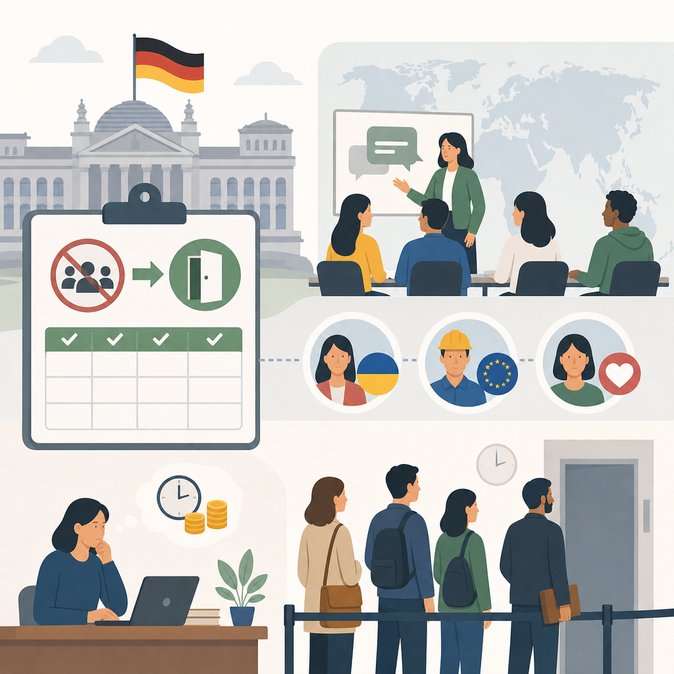
After months of political wrangling, Germany’s coalition government has partially reversed its controversial freeze on free integration courses for newcomers. Speaking after the cabinet meeting on 15 May 2026, Interior Ministry officials confirmed that, from 1 June, up to 70,000 additional course places will be released—roughly one-third of the capacity that existed before admissions were halted in January. Priority will be given to Ukrainian war-displaced persons, EU nationals regarded as critical for the labour market and a small discretionary pool for ‘hardship cases’.
Background: Integration courses—typically 700 hours of language tuition plus civic-orientation modules—have been a cornerstone of German migration policy since 2005. But costs have soared to more than €1.3 billion a year. In January 2026 the conservative-led Interior Ministry froze new admissions, arguing that finances should be focused on compulsory participants only. The decision triggered a storm of criticism from employers’ groups, Länder governments and educational providers, who warned that shutting out voluntary attendees would deepen skills shortages and push migrants into informal language schools of uneven quality.
What changes now? Under the new quota model, the Federal Office for Migration and Refugees (BAMF) will allocate seats quarterly, tied directly to budget authorisations. Local job centres must pre-authorise candidates on a ‘first-need, first-served’ basis and report uptake in real time. Course providers fear that the stop-start financing will make lesson planning and teacher recruitment even harder than before, potentially shrinking capacity in the long term.
![Berlin U-turn: Germany Re-opens State-Funded Integration Courses—but With Strict Quotas]()
Whether you’re an HR team coordinating multiple assignees or an individual relocating to Germany, VisaHQ can simplify the paperwork behind residence permits and visa extensions that often determine eligibility for integration courses. Our digital portal (https://www.visahq.com/germany/) offers step-by-step checklists, live support and automated reminders, helping applicants secure the right status quickly so they can claim one of the limited BAMF seats as soon as they open.
Business impact: Corporations that rely on non-EU hires—especially in IT, engineering and healthcare—often insist that staff attend integration courses as part of their relocation packages. With fewer publicly funded places, employers may have to pay for private tuition or negotiate reserved blocks with course providers. Mobility managers are advised to budget an extra €1,200–€1,800 per employee for language training and to book slots months in advance.
Practical advice:
• Check whether an employee’s residence permit (e.g. EU Blue Card, §18g Skilled Worker) makes them legally entitled to an integration course place—these cases will still be prioritised.
• Prepare alternative options such as company-based classes or online ‘Deutsch B1/B2’ platforms if quotas are exhausted.
• For Ukrainian assignees under Temporary Protection, ensure proof of status is attached to the course application to avoid delays.
Background: Integration courses—typically 700 hours of language tuition plus civic-orientation modules—have been a cornerstone of German migration policy since 2005. But costs have soared to more than €1.3 billion a year. In January 2026 the conservative-led Interior Ministry froze new admissions, arguing that finances should be focused on compulsory participants only. The decision triggered a storm of criticism from employers’ groups, Länder governments and educational providers, who warned that shutting out voluntary attendees would deepen skills shortages and push migrants into informal language schools of uneven quality.
What changes now? Under the new quota model, the Federal Office for Migration and Refugees (BAMF) will allocate seats quarterly, tied directly to budget authorisations. Local job centres must pre-authorise candidates on a ‘first-need, first-served’ basis and report uptake in real time. Course providers fear that the stop-start financing will make lesson planning and teacher recruitment even harder than before, potentially shrinking capacity in the long term.

Whether you’re an HR team coordinating multiple assignees or an individual relocating to Germany, VisaHQ can simplify the paperwork behind residence permits and visa extensions that often determine eligibility for integration courses. Our digital portal (https://www.visahq.com/germany/) offers step-by-step checklists, live support and automated reminders, helping applicants secure the right status quickly so they can claim one of the limited BAMF seats as soon as they open.
Business impact: Corporations that rely on non-EU hires—especially in IT, engineering and healthcare—often insist that staff attend integration courses as part of their relocation packages. With fewer publicly funded places, employers may have to pay for private tuition or negotiate reserved blocks with course providers. Mobility managers are advised to budget an extra €1,200–€1,800 per employee for language training and to book slots months in advance.
Practical advice:
• Check whether an employee’s residence permit (e.g. EU Blue Card, §18g Skilled Worker) makes them legally entitled to an integration course place—these cases will still be prioritised.
• Prepare alternative options such as company-based classes or online ‘Deutsch B1/B2’ platforms if quotas are exhausted.
• For Ukrainian assignees under Temporary Protection, ensure proof of status is attached to the course application to avoid delays.