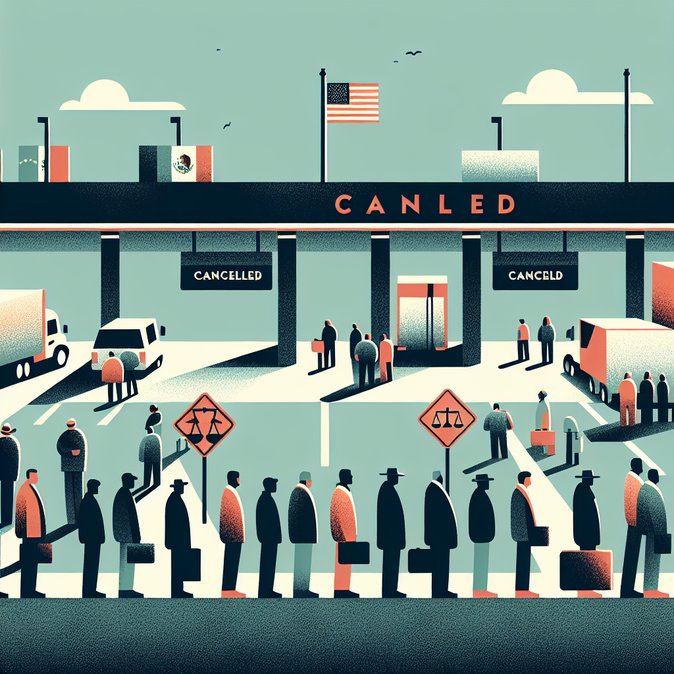
The Trump administration has informed a federal court that it intends to issue new termination notices to roughly 900,000 migrants who entered the United States under the Biden-era CBP One humanitarian-parole programme, reviving a policy that a judge blocked last year. In an 24 April 2026 filing, Justice Department lawyers said Customs and Border Protection (CBP) Commissioner Rodney Scott signed a memo asserting that ‘parole is no longer appropriate’ for the cohort, clearing the way for removal orders once procedural hurdles are met. CBP One allowed asylum seekers stuck in Mexico to schedule port-of-entry appointments and receive temporary legal status while their claims were adjudicated. Business and travel groups had viewed the programme as a stabilising factor at land crossings, reducing ad-hoc port closures and facilitating legitimate trade flows. Terminating the status could reignite congestion at border checkpoints if large numbers of migrants are placed in removal proceedings simultaneously. From a corporate-mobility perspective, the move deepens uncertainty for employers with cross-border operations in Texas, Arizona, and California. Workforce planners should monitor port-processing times and prepare contingency routes for critical staff whose commutes rely on predictable entry lanes.
![Trump administration moves again to revoke CBP One parole status]()
Amid such shifting rules, VisaHQ can help organisations and affected individuals explore alternative visa pathways, manage documentation, and stay ahead of U.S. travel authorisation changes through its intuitive online portal: https://www.visahq.com/united-states/
Companies sponsoring humanitarian-parole employees may need to explore alternative visa options or remote-work arrangements if parole protections evaporate. Legal advocates representing the migrants have asked U.S. District Judge Allison Burroughs to block the new effort, calling it a ‘deliberate attempt to evade’ her prior order. A hearing is set for 6 May. Until the court rules, the status of CBP One parolees—and the operational predictability at the southern border—remains in flux.

Amid such shifting rules, VisaHQ can help organisations and affected individuals explore alternative visa pathways, manage documentation, and stay ahead of U.S. travel authorisation changes through its intuitive online portal: https://www.visahq.com/united-states/
Companies sponsoring humanitarian-parole employees may need to explore alternative visa options or remote-work arrangements if parole protections evaporate. Legal advocates representing the migrants have asked U.S. District Judge Allison Burroughs to block the new effort, calling it a ‘deliberate attempt to evade’ her prior order. A hearing is set for 6 May. Until the court rules, the status of CBP One parolees—and the operational predictability at the southern border—remains in flux.