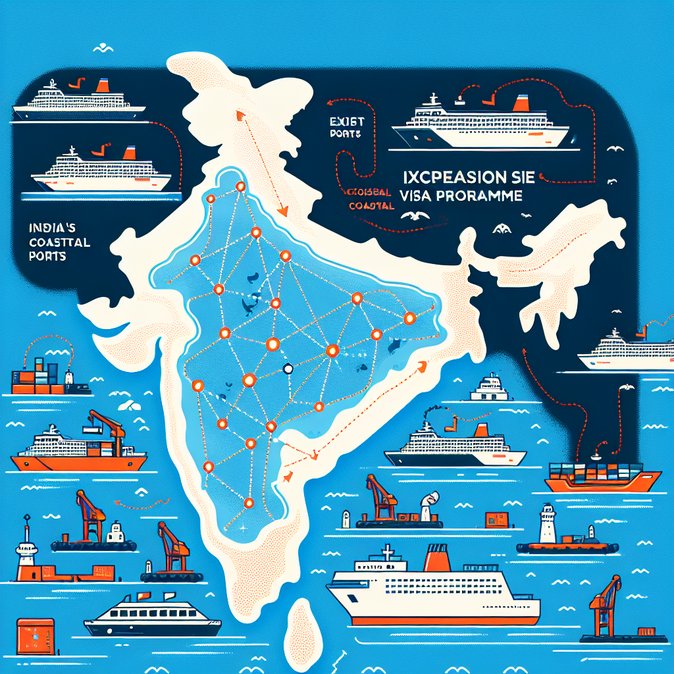
India’s Ministry of Home Affairs has quietly issued an order designating 14 additional seaports as Immigration Check Posts (ICPs) eligible to process electronic visas, widening the e-Visa network to 114 air, sea, land, rail and river entry points nationwide. Half of the newly-minted maritime ICPs—Alang, Bedi Bandar, Bhavnagar, Porbandar, Hazira, Pipavav and Mandvi—sit along Gujarat’s busy cargo coast, while Cuddalore, Nagapattinam and Tuticorin strengthen coverage in Tamil Nadu. Four more ports were approved but not individually named in the public notice.
![India Adds 14 Seaports to e-Visa Scheme, Taking Total ICPs to 114]()
Those unsure about which of the 114 entry points best fits their itinerary can lean on VisaHQ. The company’s dedicated India page (https://www.visahq.com/india/) guides users through the e-Visa application, highlights eligible seaports, and even offers real-time status updates—making compliance painless for both leisure cruisers and time-critical marine technicians.
Until now, e-Visa holders arriving by sea could disembark at only 33 ports, most of them geared to cruise traffic. The expansion gives shipping lines and corporate mobility teams greater flexibility to route technicians, surveyors or super-cargo staff directly into industrial hubs rather than flying them inland first. Procedures remain unchanged: travellers must present a printed Electronic Travel Authorisation and clear biometrics on arrival, but they may now complete those formalities at any of the 114 ICPs. For coastal states jockeying for cruise and conference business, the upgrade is a marketing boon. Gujarat’s flagship cruise terminal at Hazira, for example, can now process foreign passengers without insisting on a pre-arranged sticker visa, reducing turnaround time for high-end sailings. Logistics operators moving engineers to ship-breaking yards in Alang or oil-and-gas facilities off Porbandar likewise gain a faster, paper-light route into project sites. Tech vendors that support the e-Visa platform say adding ICPs is largely a software toggle—the same back-end that pushes authorisation data to Delhi’s airports can beam it to Immigration desks in Pipavav or Tuticorin. The bigger challenge is staffing: regional police and Bureau of Immigration (BoI) units need extra personnel trained on facial-recognition gates and watch-list protocols. For global mobility managers, the practical advice is simple. First, update internal travel approval systems so that new port codes appear in dropdown menus and duty-of-care tools. Second, remind travellers that an e-Visa does not authorise entry at every port: Nhava Sheva, India’s largest container gateway, still lies outside the scheme. Finally, check that cruise lines or vessel agents have filed the port manifest electronically; BoI officers will not stamp travellers through if a ship’s arrival has not been pre-cleared in the ICEGATE system.

Those unsure about which of the 114 entry points best fits their itinerary can lean on VisaHQ. The company’s dedicated India page (https://www.visahq.com/india/) guides users through the e-Visa application, highlights eligible seaports, and even offers real-time status updates—making compliance painless for both leisure cruisers and time-critical marine technicians.
Until now, e-Visa holders arriving by sea could disembark at only 33 ports, most of them geared to cruise traffic. The expansion gives shipping lines and corporate mobility teams greater flexibility to route technicians, surveyors or super-cargo staff directly into industrial hubs rather than flying them inland first. Procedures remain unchanged: travellers must present a printed Electronic Travel Authorisation and clear biometrics on arrival, but they may now complete those formalities at any of the 114 ICPs. For coastal states jockeying for cruise and conference business, the upgrade is a marketing boon. Gujarat’s flagship cruise terminal at Hazira, for example, can now process foreign passengers without insisting on a pre-arranged sticker visa, reducing turnaround time for high-end sailings. Logistics operators moving engineers to ship-breaking yards in Alang or oil-and-gas facilities off Porbandar likewise gain a faster, paper-light route into project sites. Tech vendors that support the e-Visa platform say adding ICPs is largely a software toggle—the same back-end that pushes authorisation data to Delhi’s airports can beam it to Immigration desks in Pipavav or Tuticorin. The bigger challenge is staffing: regional police and Bureau of Immigration (BoI) units need extra personnel trained on facial-recognition gates and watch-list protocols. For global mobility managers, the practical advice is simple. First, update internal travel approval systems so that new port codes appear in dropdown menus and duty-of-care tools. Second, remind travellers that an e-Visa does not authorise entry at every port: Nhava Sheva, India’s largest container gateway, still lies outside the scheme. Finally, check that cruise lines or vessel agents have filed the port manifest electronically; BoI officers will not stamp travellers through if a ship’s arrival has not been pre-cleared in the ICEGATE system.