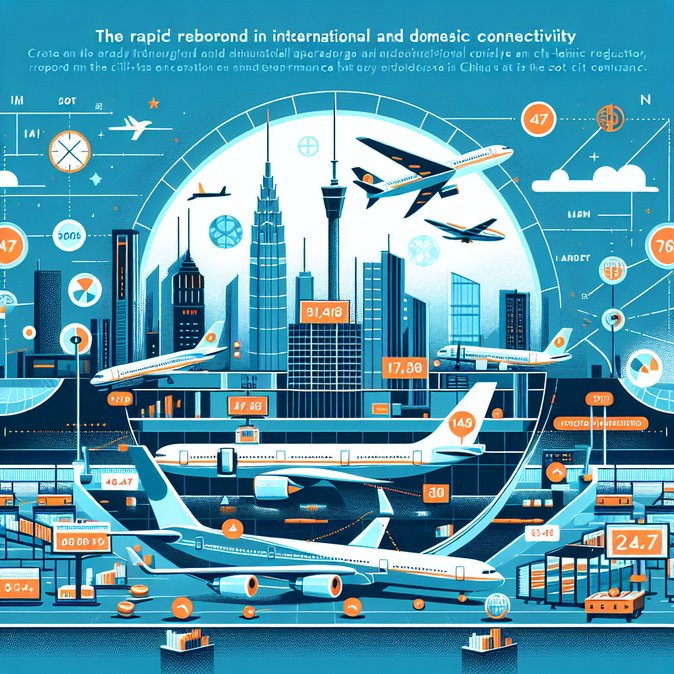
On 22 April 2026 the Civil Aviation Administration of China (CAAC) released its much-anticipated Statistical Bulletin covering calendar year 2025. The data confirm that China’s commercial airlines carried 770 million passengers last year—a 5.5 percent rise that pushed traffic within 3 percent of the pre-COVID peak. International recovery was the standout, with routes to 147 overseas cities in 65 countries generating passenger growth above 20 percent and cargo growth of a similar magnitude.
![CAAC Statistical Bulletin Shows Record Passenger Volume and 147 International City Pairs in 2025]()
Travel planning teams grappling with this surge in connectivity should not overlook entry requirements: VisaHQ’s China specialists (https://www.visahq.com/china/) provide a one-stop online platform for securing business and tourist visas, offering real-time status tracking and up-to-date documentation checklists that streamline itineraries as new nonstop routes come online.
For corporate travel managers this means that nonstop options are fast returning: Chinese carriers added services to Riyadh, Dublin and Nairobi, while bilateral capacity to the United States increased 18 percent after regulators approved ten new weekly frequencies. Infrastructure kept pace. China ended 2025 with 270 commercial airports, seven more than the previous year, and 4,574 in-service commercial aircraft. Notably, 220 of those jets were domestically produced COMAC models—an early milestone in Beijing’s campaign to localise its fleet and reduce exposure to US export-control risk. Operational reliability also improved. The on-time performance for domestic passenger flights hit 91.1 percent, the best in Asia-Pacific, and average delays fell to seven minutes. The figures suggest that post-pandemic air-traffic-management reforms—especially mandatory CDM (Collaborative Decision-Making) at the 28 busiest airports—are paying dividends. For multinationals, the bulletin is more than a score-card: it signals that airlines will resume pre-covid timetable density by mid-2026, easing employee mobility and shortening layovers on multi-city itineraries. But as demand rebounds, airport slot scarcity is re-emerging in Beijing and Shanghai, prompting CAAC to hint at differential slot fees for peak-hour operations—an element companies should watch when budgeting for 2027 travel.

Travel planning teams grappling with this surge in connectivity should not overlook entry requirements: VisaHQ’s China specialists (https://www.visahq.com/china/) provide a one-stop online platform for securing business and tourist visas, offering real-time status tracking and up-to-date documentation checklists that streamline itineraries as new nonstop routes come online.
For corporate travel managers this means that nonstop options are fast returning: Chinese carriers added services to Riyadh, Dublin and Nairobi, while bilateral capacity to the United States increased 18 percent after regulators approved ten new weekly frequencies. Infrastructure kept pace. China ended 2025 with 270 commercial airports, seven more than the previous year, and 4,574 in-service commercial aircraft. Notably, 220 of those jets were domestically produced COMAC models—an early milestone in Beijing’s campaign to localise its fleet and reduce exposure to US export-control risk. Operational reliability also improved. The on-time performance for domestic passenger flights hit 91.1 percent, the best in Asia-Pacific, and average delays fell to seven minutes. The figures suggest that post-pandemic air-traffic-management reforms—especially mandatory CDM (Collaborative Decision-Making) at the 28 busiest airports—are paying dividends. For multinationals, the bulletin is more than a score-card: it signals that airlines will resume pre-covid timetable density by mid-2026, easing employee mobility and shortening layovers on multi-city itineraries. But as demand rebounds, airport slot scarcity is re-emerging in Beijing and Shanghai, prompting CAAC to hint at differential slot fees for peak-hour operations—an element companies should watch when budgeting for 2027 travel.