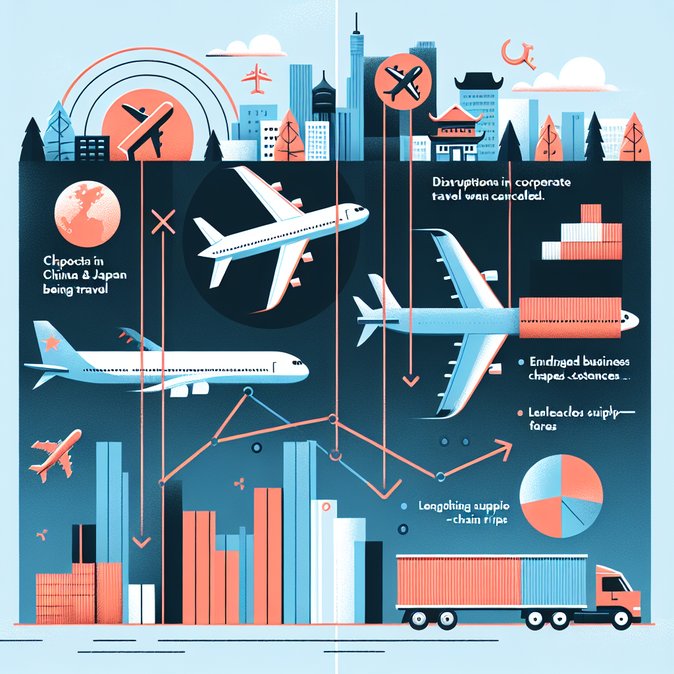
Business passengers shuttling between the world’s second- and third-largest economies face an escalating air-capacity crunch. According to aviation-data provider DAST, 2,691 scheduled services on China-Japan routes were cancelled in March—almost one in every two flights. Capacity cuts began in November 2025 after Tokyo hinted it could intervene militarily in any Taiwan crisis, but the speed and scale of the March reductions surprised even seasoned analysts. OAG schedules show that Chinese carriers—rather than their Japanese counterparts—are responsible for the pull-back. Airports serving China’s core manufacturing belts in Beijing, Shanghai, Guangzhou, Dalian and Nanjing are the most affected, with some losing more than half of their planned frequencies.
Looking ahead, 45 % of May flights have already been scrubbed, including 210 services during the highly lucrative 1–5 May Labour Day holiday. Forward schedules for June are almost as thin, pointing to a prolonged squeeze on seat availability.
For travellers who do manage to secure scarce seats, having paperwork in order is critical. VisaHQ’s online portal (https://www.visahq.com/china/) streamlines the Chinese visa application process with digital forms, real-time status updates and expert support, ensuring that documentation doesn’t become another bottleneck just when flights are hardest to find.
The capacity crunch has immediate commercial implications. Sino-Japanese supply chains rely on frequent short-haul flights for engineers, quality-control teams and senior executives. Manufacturers in the auto-parts, electronics and chemicals sectors told the South China Morning Post that they now face multi-day detours via Seoul or Taipei, adding cost and eroding just-in-time production buffers.
![Nearly 2,700 China-Japan flights axed in March as diplomatic rift widens]()
Tourism operators are also counting the cost: Japanese National Tourism Organisation figures show Chinese arrivals plunging 55.9 % year-on-year in March to just 291,600 visitors.
Industry experts believe politics—not weak demand—is driving the retreat. “This is primarily a Chinese-airline thing, which by extension is a political move,” said John Grant, chief analyst at OAG.
With neither Beijing nor Tokyo signalling an imminent thaw, corporates should expect constrained capacity and higher fares into the summer peak. Travel managers are advised to secure seats well in advance, consider third-country connections and review duty-of-care policies for staff forced onto longer routings.
Longer term, the episode is a reminder that geopolitical risk can rewrite flight schedules overnight. Companies with Asia-wide mobility programmes may wish to map alternative hubs, diversify carrier portfolios and build flexible travel budgets that can absorb sudden spikes in airfares on politically sensitive routes.
Looking ahead, 45 % of May flights have already been scrubbed, including 210 services during the highly lucrative 1–5 May Labour Day holiday. Forward schedules for June are almost as thin, pointing to a prolonged squeeze on seat availability.
For travellers who do manage to secure scarce seats, having paperwork in order is critical. VisaHQ’s online portal (https://www.visahq.com/china/) streamlines the Chinese visa application process with digital forms, real-time status updates and expert support, ensuring that documentation doesn’t become another bottleneck just when flights are hardest to find.
The capacity crunch has immediate commercial implications. Sino-Japanese supply chains rely on frequent short-haul flights for engineers, quality-control teams and senior executives. Manufacturers in the auto-parts, electronics and chemicals sectors told the South China Morning Post that they now face multi-day detours via Seoul or Taipei, adding cost and eroding just-in-time production buffers.
Tourism operators are also counting the cost: Japanese National Tourism Organisation figures show Chinese arrivals plunging 55.9 % year-on-year in March to just 291,600 visitors.
Industry experts believe politics—not weak demand—is driving the retreat. “This is primarily a Chinese-airline thing, which by extension is a political move,” said John Grant, chief analyst at OAG.
With neither Beijing nor Tokyo signalling an imminent thaw, corporates should expect constrained capacity and higher fares into the summer peak. Travel managers are advised to secure seats well in advance, consider third-country connections and review duty-of-care policies for staff forced onto longer routings.
Longer term, the episode is a reminder that geopolitical risk can rewrite flight schedules overnight. Companies with Asia-wide mobility programmes may wish to map alternative hubs, diversify carrier portfolios and build flexible travel budgets that can absorb sudden spikes in airfares on politically sensitive routes.