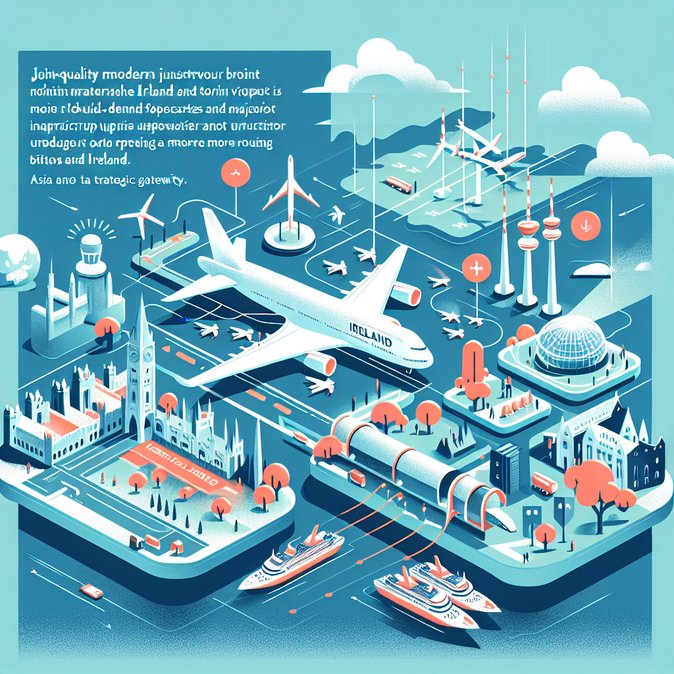
Dublin Airport (DUB) and Tourism Ireland mounted a joint charm-offensive in Xi’an this weekend, pitching the island of Ireland as the natural Atlantic gateway for Asian carriers attending the Routes Asia 2026 forum. Over three days of back-to-back meetings, the Team Ireland delegation – staffed by route-development managers from airport operator daa and market specialists from Tourism Ireland – met more than 40 network-planning executives from airlines across mainland China, Southeast Asia and the Gulf. Their message was straightforward: Dublin already offers one-stop connectivity to 185 destinations, has plenty of uncongested slots outside the early-morning trans-Atlantic peak, and will shortly be freed from the controversial 32-million-passenger cap once the Dublin Airport (Passenger Capacity) Bill 2026 clears the Oireachtas. For airlines, that translates into guaranteed room for growth; for the Irish economy it promises fresh inbound visitor flows, wider export belly-cargo options and a stronger case for multinational firms to base EMEA operations in Dublin rather than rival hubs in Amsterdam, Manchester or Copenhagen. Tourism Ireland used the forum to unveil refreshed demand data showing that outbound travel from China alone could generate 125,000 visitors a year by 2028 if even a single thrice-weekly service were launched. Delegates were told that a direct Xi’an–Dublin flight would shave at least four hours off current routings and plug Chinese students directly into Ireland’s expanding third-level sector, where enrolments topped 6,500 last year.
![Dublin Airport and Tourism Ireland court Asian airlines at Routes Asia 2026]()
Travellers eager to take advantage of any future Xi’an–Dublin service can simplify the paperwork through VisaHQ’s dedicated Ireland portal (https://www.visahq.com/ireland/), which provides step-by-step visa guidance, document checks and courier options for passengers from China, Southeast Asia and the Gulf—helping tourists, students and business travellers get travel-ready the moment new routes launch.
The agency also flagged the Common Travel Area with the UK – meaning Chinese tourists could combine Ireland and Britain on a single visa – and cited the forthcoming Schengen Entry/Exit System as a catalyst for Asian itineraries that begin or end in Dublin. For Dublin Airport, the timing is critical. With passenger numbers already back to 36.4 million – just shy of the pre-pandemic record – daa is racing to secure new long-haul routes before rival European hubs consolidate their own Asia capacity. Executives briefed prospective airline partners on Pier 5, a €950 million expansion that will create eight Code F stands capable of handling Airbus A350s and Boeing 777-300ERs by 2029, as well as on fast-track security lanes that will keep minimum-connect times at 60 minutes. Corporate mobility managers should monitor the talks closely. First-mover carriers are likely to secure marketing support, start-up fee waivers and attractive operating windows – incentives that could translate into lower fares or new belly-hold cargo options for Irish exporters. Employers with large Asia-Pacific footprints may wish to pencil Dublin into 2027 travel-policy updates, especially once the airport publishes its revised schedule coordination parameters later this summer.

Travellers eager to take advantage of any future Xi’an–Dublin service can simplify the paperwork through VisaHQ’s dedicated Ireland portal (https://www.visahq.com/ireland/), which provides step-by-step visa guidance, document checks and courier options for passengers from China, Southeast Asia and the Gulf—helping tourists, students and business travellers get travel-ready the moment new routes launch.
The agency also flagged the Common Travel Area with the UK – meaning Chinese tourists could combine Ireland and Britain on a single visa – and cited the forthcoming Schengen Entry/Exit System as a catalyst for Asian itineraries that begin or end in Dublin. For Dublin Airport, the timing is critical. With passenger numbers already back to 36.4 million – just shy of the pre-pandemic record – daa is racing to secure new long-haul routes before rival European hubs consolidate their own Asia capacity. Executives briefed prospective airline partners on Pier 5, a €950 million expansion that will create eight Code F stands capable of handling Airbus A350s and Boeing 777-300ERs by 2029, as well as on fast-track security lanes that will keep minimum-connect times at 60 minutes. Corporate mobility managers should monitor the talks closely. First-mover carriers are likely to secure marketing support, start-up fee waivers and attractive operating windows – incentives that could translate into lower fares or new belly-hold cargo options for Irish exporters. Employers with large Asia-Pacific footprints may wish to pencil Dublin into 2027 travel-policy updates, especially once the airport publishes its revised schedule coordination parameters later this summer.