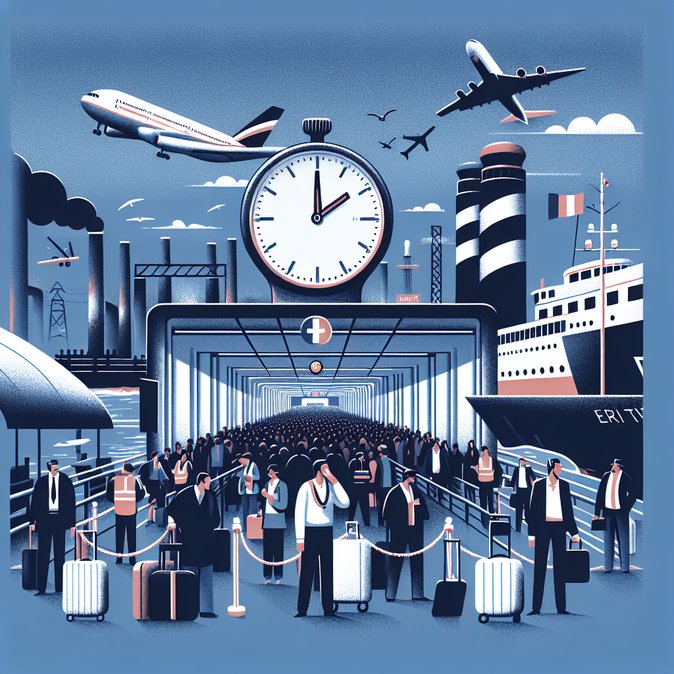
Only eight days after the European Union’s new biometric Entry/Exit System (EES) went live on 10 April 2026, French border posts are already feeling the strain. Indrastra’s situation-report of 18 April describes 45-minute average wait times at Paris-Charles-de-Gaulle during the afternoon peaks and backups of lorries stretching three kilometres outside the Eurotunnel freight terminal at Coquelles. Operators admit that enrolment—four fingerprints and a live facial image for every non-EU traveller—is taking 30–50 seconds per person, far longer than the five-second passport stamp it replaced. Background: France handled 89 million foreign arrivals in 2025, more than any other Schengen country; its border police therefore pushed to be “EES-ready” first. Over €240 million has gone into hundreds of self-service kiosks in airports, ferry ports and the juxtaposed controls in Dover and Folkestone. Yet police unions warned that staffing models were based on best-case throughput rather than real-world trial data, and airlines say they were given little time to redesign passenger flows. Business implications: Corporate travel managers report missed connections and extra hotel nights for assignees transiting Paris and Nice. Eurostar has asked companies to advise staff to arrive **90 minutes** before departure, up from the pre-EES 45. Logistics firms moving just-in-time components across the Channel complain of penalty clauses kicking in when drivers lose their delivery slot at British factories. Some multinationals are re-routing urgent cargo via Zeebrugge or air-freight into Birmingham to avoid French choke-points.
![First Week of EU Entry/Exit System Sees Long Queues at French Borders]()
Amid these shifting requirements, digital visa specialists such as VisaHQ can relieve much of the administrative burden. Through its France portal (https://www.visahq.com/france/), the platform lets employers and individual travellers pre-screen documentation, lodge ETIAS applications in bulk and track status updates in real time—services that can smooth the path through French borders while the new systems bed in.
What to do now: Employers should build longer buffers into travel itineraries, preload employee data into carriers’ Advance Passenger Information (API) systems, and brief travellers to proceed straight to immigration on arrival. The Interior Ministry says processing times will fall once the “initial capture” phase is complete—every enrolment is valid for three years—but it concedes that the 8 May holiday weekend could be “very challenging”. Looking ahead: From the fourth quarter of 2026, the separate ETIAS travel-authorisation will add another layer of pre-travel bureaucracy for visa-exempt visitors. Companies with high-volume short-stay traffic are already exploring agency solutions that can bundle ETIAS submissions with flight bookings, while airports press the EU to raise the current 1-kiosk-per-bus guideline for group arrivals.

Amid these shifting requirements, digital visa specialists such as VisaHQ can relieve much of the administrative burden. Through its France portal (https://www.visahq.com/france/), the platform lets employers and individual travellers pre-screen documentation, lodge ETIAS applications in bulk and track status updates in real time—services that can smooth the path through French borders while the new systems bed in.
What to do now: Employers should build longer buffers into travel itineraries, preload employee data into carriers’ Advance Passenger Information (API) systems, and brief travellers to proceed straight to immigration on arrival. The Interior Ministry says processing times will fall once the “initial capture” phase is complete—every enrolment is valid for three years—but it concedes that the 8 May holiday weekend could be “very challenging”. Looking ahead: From the fourth quarter of 2026, the separate ETIAS travel-authorisation will add another layer of pre-travel bureaucracy for visa-exempt visitors. Companies with high-volume short-stay traffic are already exploring agency solutions that can bundle ETIAS submissions with flight bookings, while airports press the EU to raise the current 1-kiosk-per-bus guideline for group arrivals.