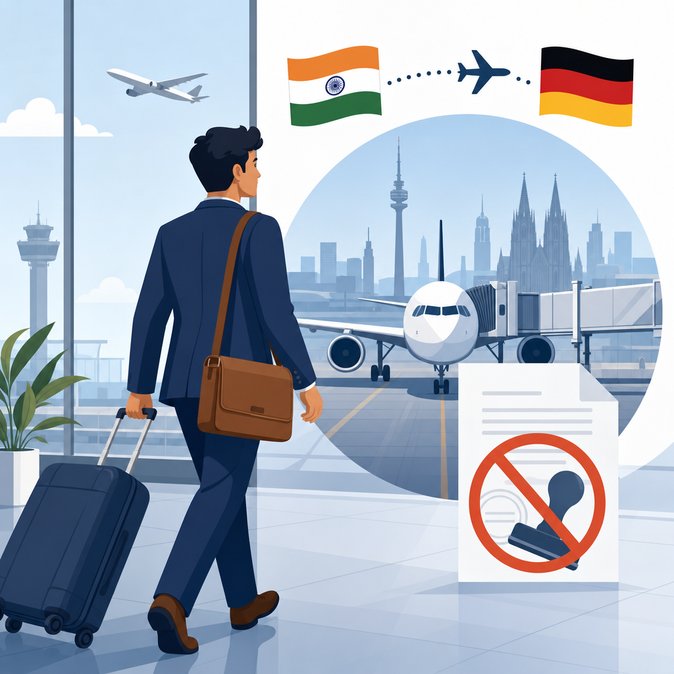
Business and leisure travelers from India who change planes in Germany on their way to the United States woke up to welcome news on June 3 – the Federal Republic has abolished the long-standing requirement that Indian nationals obtain an Airport Transit Visa (ATV) before passing through German hubs such as Frankfurt, Munich and Berlin. The change was published in Germany’s Federal Law Gazette late on June 2 and took effect at 00:01 CET on June 3.
![Germany lifts airport-transit-visa rule for Indians, streamlining US-bound connections via Frankfurt and Munich]()
For anyone who still needs help sorting out onward U.S. visas or Schengen permits, VisaHQ’s online portal offers fast, end-to-end support, including digital document reviews, up-to-date requirements and optional rush processing. Indian travelers and the corporate mobility teams that support them can start an application or simply verify the latest rules in seconds at https://www.visahq.com/united-states/
Indian citizens now join passengers from most other countries who can remain in the secure international zone of a German airport for up to 24 hours without a visa, provided they hold confirmed onward tickets and do not exit to landside Germany. Lufthansa Group and United Airlines, which jointly sell more than 30 daily India-US itineraries with a same-day connection in Germany, said the move will cut at least two weeks from the typical trip-planning timeline and save travelers roughly €80 in visa fees and courier charges. From a global-mobility perspective the policy shift removes a chronic friction point for multinational companies that rotate Indian engineers, consultants and executives through U.S. headquarters on short notice. HR mobility managers frequently reported last-minute project delays because employees discovered – often at the airport – that an ATV stamp was missing from their passports. The issue became acute in the run-up to the 2026 FIFA World Cup in North America, with Indian tech vendors expecting to send hundreds of staff to temporary operations centers in the United States. German officials framed the decision as a goodwill gesture that deepens economic ties with India following Chancellor Friedrich Merz’s January trade mission to New Delhi. Mobility advisers note, however, that it also aligns Germany with France, the Netherlands and Switzerland, all of which scrapped their Indian ATV rules in the past three years to remain competitive as connecting hubs. U.S. Customs and Border Protection (CBP) sources told Financial Express that the agency expects a surge in Global Entry and ESTA enrollments from Indian nationals who find it easier to route flights through German airports. Practical tips for U.S. employers: Continue to remind Indian travelers that the visa-free transit privilege applies only if they stay airside; entering Germany still requires a Schengen visa. Airlines will refuse boarding if connecting passengers lack the correct documents for their final destination, so travelers must still carry a valid U.S. visa, ESTA authorization or other entry permit. Companies should update travel-approval workflows and remove the ATV step for Germany-routed itineraries to avoid unnecessary delays. In the medium term, experts expect the elimination of the transit-visa hurdle to shift a measurable share of India-U.S. transfer traffic back to Frankfurt and Munich, easing capacity constraints at Middle-Eastern hubs and potentially lowering average fares for corporate buyers.

For anyone who still needs help sorting out onward U.S. visas or Schengen permits, VisaHQ’s online portal offers fast, end-to-end support, including digital document reviews, up-to-date requirements and optional rush processing. Indian travelers and the corporate mobility teams that support them can start an application or simply verify the latest rules in seconds at https://www.visahq.com/united-states/
Indian citizens now join passengers from most other countries who can remain in the secure international zone of a German airport for up to 24 hours without a visa, provided they hold confirmed onward tickets and do not exit to landside Germany. Lufthansa Group and United Airlines, which jointly sell more than 30 daily India-US itineraries with a same-day connection in Germany, said the move will cut at least two weeks from the typical trip-planning timeline and save travelers roughly €80 in visa fees and courier charges. From a global-mobility perspective the policy shift removes a chronic friction point for multinational companies that rotate Indian engineers, consultants and executives through U.S. headquarters on short notice. HR mobility managers frequently reported last-minute project delays because employees discovered – often at the airport – that an ATV stamp was missing from their passports. The issue became acute in the run-up to the 2026 FIFA World Cup in North America, with Indian tech vendors expecting to send hundreds of staff to temporary operations centers in the United States. German officials framed the decision as a goodwill gesture that deepens economic ties with India following Chancellor Friedrich Merz’s January trade mission to New Delhi. Mobility advisers note, however, that it also aligns Germany with France, the Netherlands and Switzerland, all of which scrapped their Indian ATV rules in the past three years to remain competitive as connecting hubs. U.S. Customs and Border Protection (CBP) sources told Financial Express that the agency expects a surge in Global Entry and ESTA enrollments from Indian nationals who find it easier to route flights through German airports. Practical tips for U.S. employers: Continue to remind Indian travelers that the visa-free transit privilege applies only if they stay airside; entering Germany still requires a Schengen visa. Airlines will refuse boarding if connecting passengers lack the correct documents for their final destination, so travelers must still carry a valid U.S. visa, ESTA authorization or other entry permit. Companies should update travel-approval workflows and remove the ATV step for Germany-routed itineraries to avoid unnecessary delays. In the medium term, experts expect the elimination of the transit-visa hurdle to shift a measurable share of India-U.S. transfer traffic back to Frankfurt and Munich, easing capacity constraints at Middle-Eastern hubs and potentially lowering average fares for corporate buyers.
More From United States of America
View all
USCIS softens stance on controversial Adjustment-of-Status memo after employer backlash

State Department to Slash Visa-Processing Posts in Africa, Leaving Only 20 Embassies Handling Applications