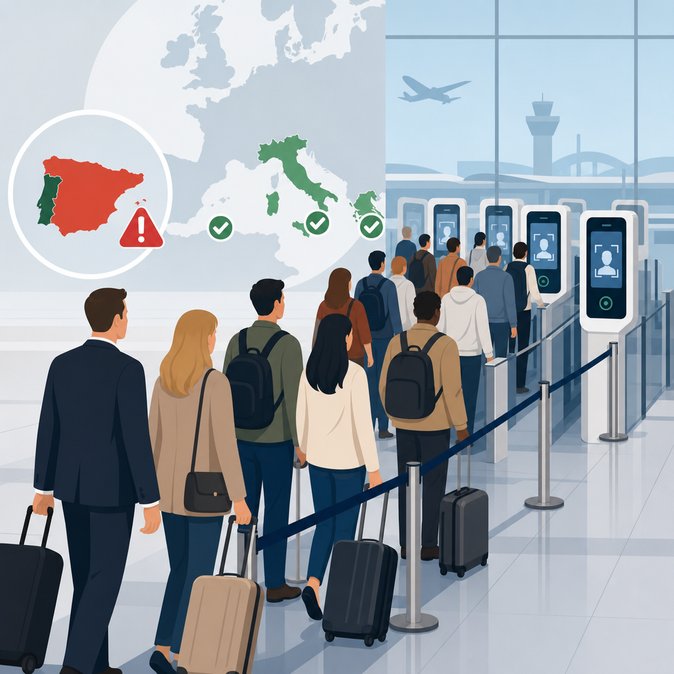
Barely two months after Spain completed the roll-out of the EU’s new Entry/Exit System (EES), passenger flows at major airports are buckling under the pressure. Since April all third-country nationals must enrol facial images and four fingerprints on arrival, a process that airport operator Aena admits is taking up to two minutes per traveller when equipment glitches occur. On Sunday, 31 May, business travellers reported queues of more than an hour at Madrid-Barajas, Barcelona-El Prat and Málaga-Costa del Sol. Airlines have warned of missed connections and are advising non-EU passengers to arrive at least three hours before departure, eroding the competitive advantage Spain gained with its pre-pandemic “fast-lane” concept for frequent-flyer executives. What makes Spain stand out is its refusal—so far—to adopt the partial suspensions authorised by Brussels. Italy has been allowed to pause biometric capture at peak periods, Portugal is limiting the data collected, and Greece is exempting British holiday-makers on selected charter flights. Spain’s Ministerio del Interior argues that a uniform implementation is vital to avoid “forum-shopping” between Schengen members, yet industry groups led by IATA and Ryanair say the stance risks crippling airports just as the summer tourist and conference season begins. For global-mobility teams the operational implications are immediate: longer dwell times on arrival, tighter minimum-connection windows and higher likelihood of re-booking or overnight lay-overs.
![Long queues return as Spain sticks to full biometric EES checks while neighbours loosen rules]()
At moments like these, services such as VisaHQ can prove invaluable. Their Spain-focused portal (https://www.visahq.com/spain/) offers travellers and corporate mobility managers up-to-date entry guidance, appointment scheduling and real-time alerts on any EES rule changes, helping to minimise disruption and keep itineraries on track.
Employers should update travel-policy guidance, factor in the cost of potential duty-of-care breaches, and monitor whether the government eventually follows its neighbours in requesting a derogation. In the medium term, Spain’s insistence on full EES compliance could reinforce its reputation for strict external-border policing—a consideration for companies choosing an EU hub for rotational assignments. Behind the scenes, sources at the Confederación Española de Hoteles reveal that hoteliers fear a repeat of 2023’s chaotic e-Gate failures, which depressed occupancy rates by six points in July. If a fix does not arrive before the peak August wave, Spain’s goal of exceeding 93 million international visitors this year could be in jeopardy.

At moments like these, services such as VisaHQ can prove invaluable. Their Spain-focused portal (https://www.visahq.com/spain/) offers travellers and corporate mobility managers up-to-date entry guidance, appointment scheduling and real-time alerts on any EES rule changes, helping to minimise disruption and keep itineraries on track.
Employers should update travel-policy guidance, factor in the cost of potential duty-of-care breaches, and monitor whether the government eventually follows its neighbours in requesting a derogation. In the medium term, Spain’s insistence on full EES compliance could reinforce its reputation for strict external-border policing—a consideration for companies choosing an EU hub for rotational assignments. Behind the scenes, sources at the Confederación Española de Hoteles reveal that hoteliers fear a repeat of 2023’s chaotic e-Gate failures, which depressed occupancy rates by six points in July. If a fix does not arrive before the peak August wave, Spain’s goal of exceeding 93 million international visitors this year could be in jeopardy.