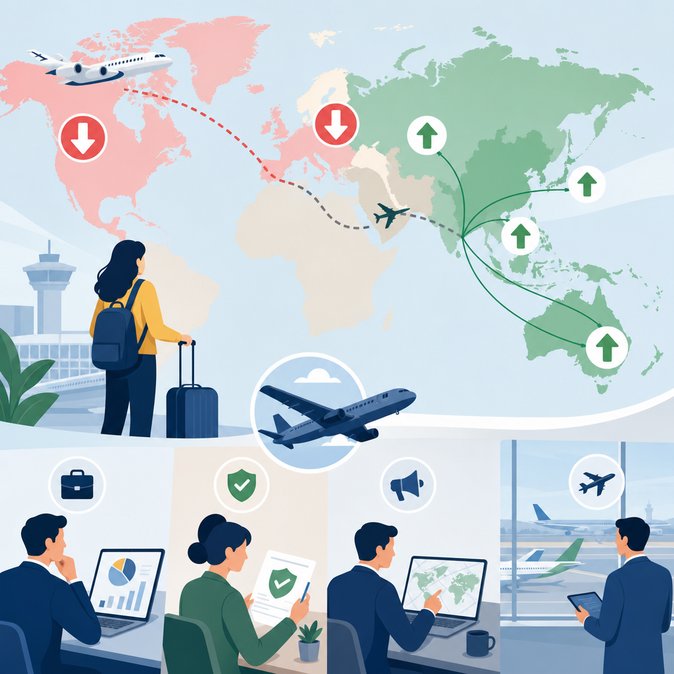
Summer 2026 is rewriting India’s outbound leisure map. According to data shared with The Economic Times on 31 May, bookings to traditional long-haul favourites in the US and Europe are down 15–20 percent, while demand for ‘visa-friendly’ destinations in Southeast Asia, North Asia and Australia has spiked. Travel platforms Cleartrip, Thomas Cook India and SOTC report a three-fold jump in bookings to the Philippines, strong double-digit growth to Thailand, Malaysia and Vietnam, and a surge in search interest for Japan and South Korea. Industry executives cite two primary drivers: soaring airfares on trans-Atlantic and trans-Pacific routes—fueled by elevated jet-fuel prices and capacity constraints—and continuing flight disruptions linked to Middle-East airspace rerouting. With families reluctant to cancel holidays altogether, they are substituting with shorter direct flights of four-to-six hours.
![High Airfares and Geopolitical Turbulence Push Indian Leisure Travellers Toward Short-Haul Asia-Pacific Routes]()
For Indian travellers weighing these changing options, streamlining paperwork is half the battle. VisaHQ’s India portal (https://www.visahq.com/india/) lets users check requirements, book courier pick-ups and track applications online for more than 200 destinations—including the Southeast Asian and Pacific nations now topping summer wish-lists—helping families and corporate “bleisure” planners pivot quickly as prices and routes evolve.
The shift carries practical implications for mobility planners. Companies that combine business meetings with leisure travel (“bleisure”) may need to recalibrate cost projections, as average trip budgets drop but frequency rises. Travel insurers are seeing higher uptake of products with ‘trip interruption’ cover as travellers hedge against sudden schedule changes. Destination boards are also moving quickly: Tourism Australia has relaunched a targeted digital campaign in India, while Japan has instructed VFS Global to expand appointment slots at its six Indian visa centres to meet demand. Analysts expect the trend to persist into the peak Dussehra-Diwali season unless trans-Atlantic fares ease. For airlines, the message is clear: capacity realignment toward high-growth Asia-Pacific sectors could capture pent-up Indian demand that is simply sidestepping the West—at least for now.

For Indian travellers weighing these changing options, streamlining paperwork is half the battle. VisaHQ’s India portal (https://www.visahq.com/india/) lets users check requirements, book courier pick-ups and track applications online for more than 200 destinations—including the Southeast Asian and Pacific nations now topping summer wish-lists—helping families and corporate “bleisure” planners pivot quickly as prices and routes evolve.
The shift carries practical implications for mobility planners. Companies that combine business meetings with leisure travel (“bleisure”) may need to recalibrate cost projections, as average trip budgets drop but frequency rises. Travel insurers are seeing higher uptake of products with ‘trip interruption’ cover as travellers hedge against sudden schedule changes. Destination boards are also moving quickly: Tourism Australia has relaunched a targeted digital campaign in India, while Japan has instructed VFS Global to expand appointment slots at its six Indian visa centres to meet demand. Analysts expect the trend to persist into the peak Dussehra-Diwali season unless trans-Atlantic fares ease. For airlines, the message is clear: capacity realignment toward high-growth Asia-Pacific sectors could capture pent-up Indian demand that is simply sidestepping the West—at least for now.