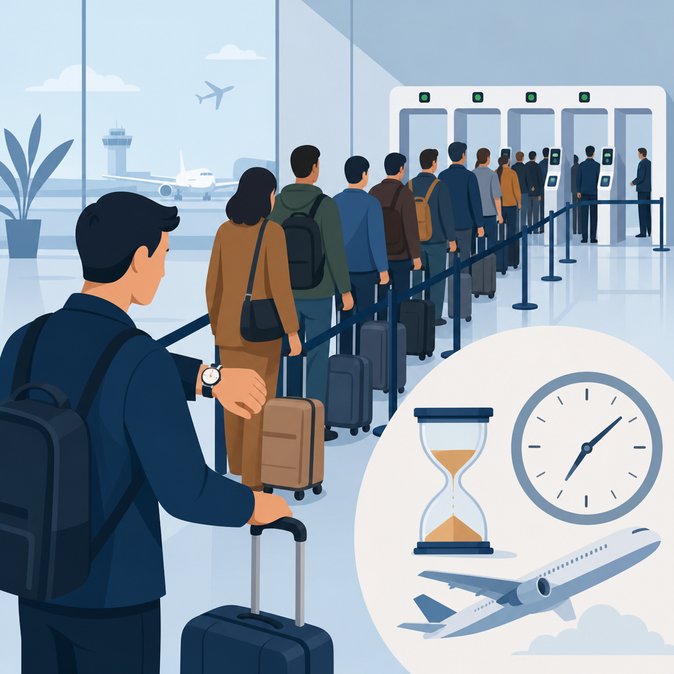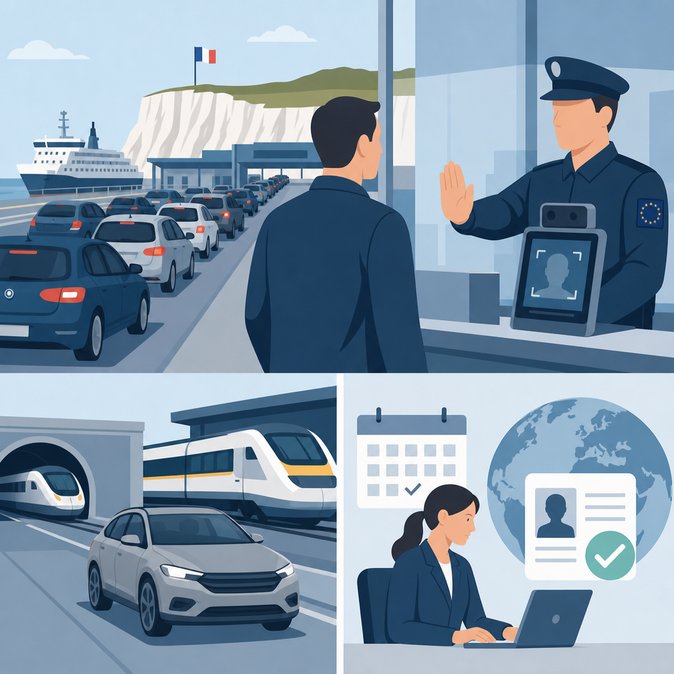
British holidaymakers got an unwelcome preview of the European Union’s new Entry/Exit System (EES) when queues of up to six hours built at the Port of Dover over the late-May bank-holiday weekend. French Police aux Frontières eventually switched the fingerprint-and-facial-scan booths off and reverted to manual passport stamping to clear the backlog, a contingency allowed under EU rules for emergencies. A written parliamentary answer published on 28 May confirms that the UK had negotiated minimum French staffing levels and a rapid-response plan in advance – but even those measures could not keep traffic moving when volumes peaked. The incident matters because Dover was the first juxtaposed UK frontier to feel the full force of EES, which went live across the Schengen area on 10 April. Eurotunnel at Folkestone and Eurostar at London St Pancras will introduce the same biometric capture in the coming weeks.
![Six-hour Dover queues signal summer test for EU biometric border checks on UK routes]()
Businesses and individual travellers who need help navigating these new border formalities can lean on VisaHQ’s UK team for up-to-date guidance. The service tracks EES developments, pre-checks passport validity and will manage forthcoming ETIAS applications on behalf of staff or leisure travellers; details are available at https://www.visahq.com/united-kingdom/
Both carry a high proportion of business passengers and operate on tight dwell times, meaning even modest delays quickly cascade into missed meetings, broken supply-chain timetables and duty-of-care headaches for corporate travel managers. Operators can legally suspend biometric collection for six-hour blocks – and for up to 90 days over the summer with a 60-day extension – but travel-trade groups warn that such stop-gap waivers undermine the point of a system that is supposed to add security while speeding the border. The European Commission says it has extended the flexibility precisely to avoid “summer travel chaos”, yet carriers complain that repeated suspensions leave them juggling staffing and passenger communications at short notice. For UK-based multinational companies the advice is two-fold. First, build longer lay-overs into July-August itineraries that rely on Dover, LeShuttle or Eurostar until the systems bed in. Second, start employee education on the next layer of change – the ETIAS travel authorisation that will sit on top of EES from late 2026 and will require British passport holders to apply at least 96 hours before departure. HR and mobility teams that fail to capture these lead-times risk trips being refused boarding, a particular threat for last-minute client visits or emergency engineering call-outs.

Businesses and individual travellers who need help navigating these new border formalities can lean on VisaHQ’s UK team for up-to-date guidance. The service tracks EES developments, pre-checks passport validity and will manage forthcoming ETIAS applications on behalf of staff or leisure travellers; details are available at https://www.visahq.com/united-kingdom/
Both carry a high proportion of business passengers and operate on tight dwell times, meaning even modest delays quickly cascade into missed meetings, broken supply-chain timetables and duty-of-care headaches for corporate travel managers. Operators can legally suspend biometric collection for six-hour blocks – and for up to 90 days over the summer with a 60-day extension – but travel-trade groups warn that such stop-gap waivers undermine the point of a system that is supposed to add security while speeding the border. The European Commission says it has extended the flexibility precisely to avoid “summer travel chaos”, yet carriers complain that repeated suspensions leave them juggling staffing and passenger communications at short notice. For UK-based multinational companies the advice is two-fold. First, build longer lay-overs into July-August itineraries that rely on Dover, LeShuttle or Eurostar until the systems bed in. Second, start employee education on the next layer of change – the ETIAS travel authorisation that will sit on top of EES from late 2026 and will require British passport holders to apply at least 96 hours before departure. HR and mobility teams that fail to capture these lead-times risk trips being refused boarding, a particular threat for last-minute client visits or emergency engineering call-outs.