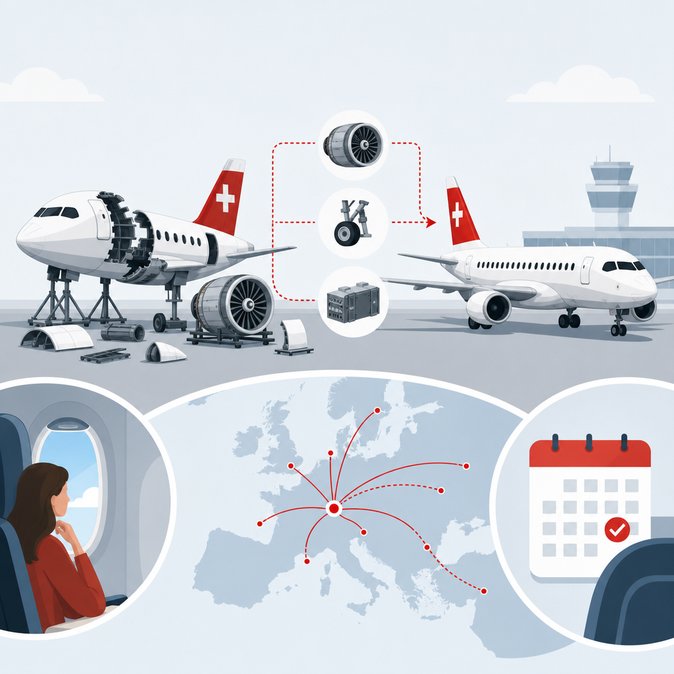
Swiss International Air Lines (SWISS) has confirmed that it will permanently withdraw two of its nine Airbus A220-100 aircraft, using the airframes as a ‘parts bank’ to keep its larger A220-300 fleet flying through the busy summer season. The move, announced on 29 May 2026, is the airline’s most radical response yet to the prolonged shortage of Pratt & Whitney PW1500G geared-turbofan (GTF) engines that has forced carriers worldwide to ground dozens of narrow-body jets.
![SWISS retires two Airbus A220-100s to cannibalise parts, safeguarding summer capacity]()
For travellers who suddenly find their itineraries shifting because of aircraft groundings or re-routing, making sure visa paperwork is accurate and up to date can remove one more source of stress. VisaHQ’s Switzerland page (https://www.visahq.com/switzerland/) lets business and leisure passengers quickly check requirements, complete online applications and track approvals in real time, providing a buffer against the operational surprises now rippling through European aviation.
The two ten-year-old aircraft (registrations HB-JBD and HB-JBC) were already in storage in Toulouse after SWISS placed all nine A220-100s on long-term ground stop earlier this year. By dismantling them, the airline will harvest serviceable engines, landing-gear components and avionics that are fully interchangeable with the 145-seat A220-300s that form the backbone of its European network. Management says part-out will begin immediately, with the first engines scheduled to be ferried to Zurich for installation by mid-June. SWISS became the A220 launch operator in 2016 and has generally praised the type’s fuel efficiency, but reliability issues with the PW1500G have escalated since 2024. Industry sources estimate that as many as one-third of the global A220 engine fleet is now in maintenance shops awaiting replacement high-pressure turbine blades. By creating an in-house spares pool, SWISS believes it can maintain schedule integrity without resorting to expensive wet-leases or widespread flight cancellations. For business travellers, the decision should translate into fewer last-minute disruptions on core Zurich and Geneva services to European financial centres. However, capacity on thinner regional routes—traditionally served by the smaller A220-100—will remain limited at least until the grounded airframes are re-activated, which management says is unlikely before late 2027. Travel managers are therefore advised to book early and build extra slack into itineraries that rely on feeder flights within Switzerland. The episode underscores a broader lesson for global mobility managers: supply-chain fragility—in this case in the aero-engine sector—can quickly cascade into route-network instability. Organisations with high volumes of intra-European travel may wish to diversify airline suppliers or consider rail alternatives for journeys under four hours.

For travellers who suddenly find their itineraries shifting because of aircraft groundings or re-routing, making sure visa paperwork is accurate and up to date can remove one more source of stress. VisaHQ’s Switzerland page (https://www.visahq.com/switzerland/) lets business and leisure passengers quickly check requirements, complete online applications and track approvals in real time, providing a buffer against the operational surprises now rippling through European aviation.
The two ten-year-old aircraft (registrations HB-JBD and HB-JBC) were already in storage in Toulouse after SWISS placed all nine A220-100s on long-term ground stop earlier this year. By dismantling them, the airline will harvest serviceable engines, landing-gear components and avionics that are fully interchangeable with the 145-seat A220-300s that form the backbone of its European network. Management says part-out will begin immediately, with the first engines scheduled to be ferried to Zurich for installation by mid-June. SWISS became the A220 launch operator in 2016 and has generally praised the type’s fuel efficiency, but reliability issues with the PW1500G have escalated since 2024. Industry sources estimate that as many as one-third of the global A220 engine fleet is now in maintenance shops awaiting replacement high-pressure turbine blades. By creating an in-house spares pool, SWISS believes it can maintain schedule integrity without resorting to expensive wet-leases or widespread flight cancellations. For business travellers, the decision should translate into fewer last-minute disruptions on core Zurich and Geneva services to European financial centres. However, capacity on thinner regional routes—traditionally served by the smaller A220-100—will remain limited at least until the grounded airframes are re-activated, which management says is unlikely before late 2027. Travel managers are therefore advised to book early and build extra slack into itineraries that rely on feeder flights within Switzerland. The episode underscores a broader lesson for global mobility managers: supply-chain fragility—in this case in the aero-engine sector—can quickly cascade into route-network instability. Organisations with high volumes of intra-European travel may wish to diversify airline suppliers or consider rail alternatives for journeys under four hours.