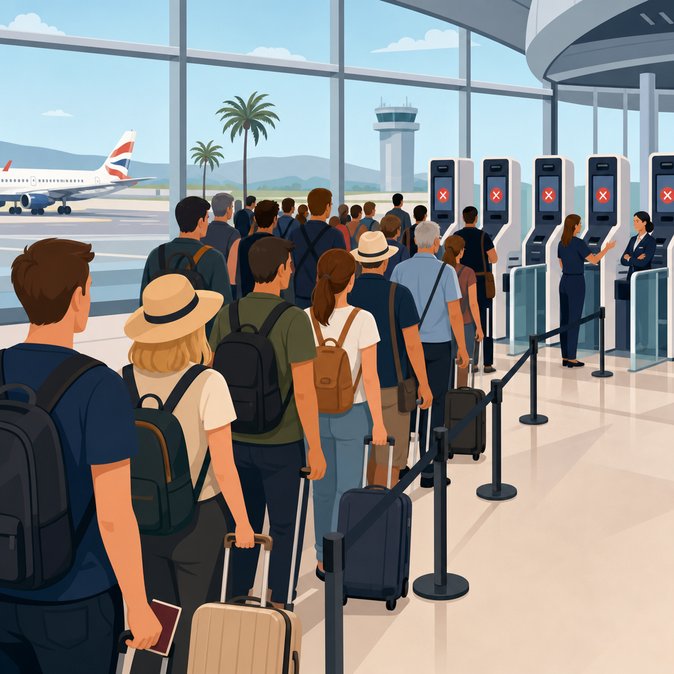
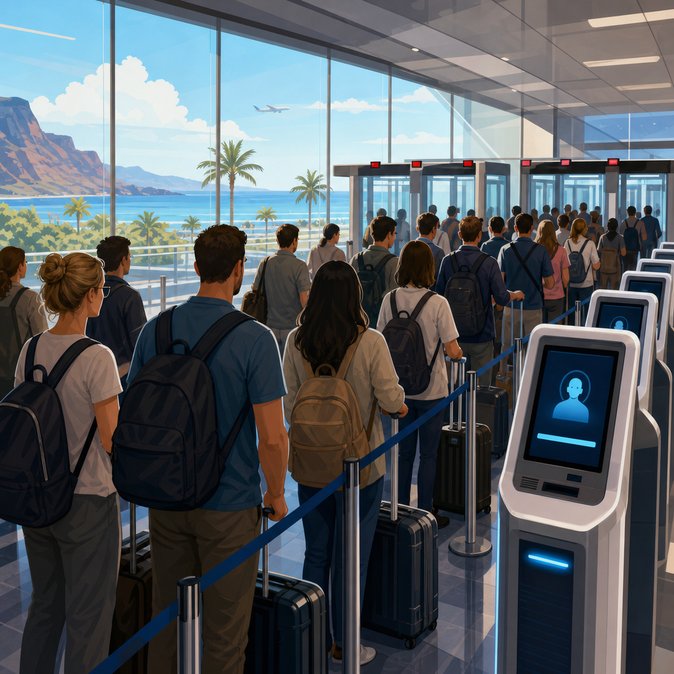
Barely six weeks after the EU’s biometric Entry/Exit System (EES) went live, Spain is facing its first high-season stress test. On 27 May 2026 British holiday-makers arriving in Gran Canaria reported passport-control lines of up to three hours as border officers struggled with repeated fingerprint scans and facial-recognition failures. The Olive Press photographed arrival halls where non-EU passengers were funnelled through just four EES kiosks, some of which repeatedly crashed and forced manual re-enrolment. Under EES, every third-country national must provide four fingerprints and a live photo the first time they enter the Schengen zone, replacing the old passport stamp. While the system is designed to speed up subsequent crossings, airports that serve large numbers of first-time visitors—such as the Canary Islands—are being hit hardest. Airlines warned that turn-around times are ballooning, with knock-on delays for departures as crews wait for outbound passengers stuck in arrivals processing. Local business leaders fear the queues could discourage British tourists, who account for 38 % of Canarian visitors and inject an estimated €5 billion into the regional economy each year.
![Biometric Entry/Exit System sparks three-hour queues for non-EU travellers at Gran Canaria Airport]()
Travellers who want extra certainty before flying can tap services like VisaHQ (https://www.visahq.com/spain/), which keeps real-time tabs on EES requirements, pre-screens documents and books expedited appointments, helping both holiday-makers and corporate teams minimise time spent in airport queues.
The Canary government is lobbying Madrid and Brussels for a summer derogation similar to the one Greece negotiated, arguing that tourism generates 35 % of island GDP. For mobility managers, the episode is a reminder to build extra buffer time into itineraries for staff, clients and assignees arriving from outside the EU. Employers should brief travellers on the biometric capture process and consider fast-track services where available. Multinationals moving equipment or time-sensitive personnel through the Canaries may also want contingency plans via mainland hubs until bottlenecks ease. Aena, Spain’s airport operator, has pledged to add staff “ambassadors” to help travellers navigate the kiosks and says software patches from Frontex are expected before the July peak. In the meantime, travel-risk teams should monitor wait-time feeds and adjust transfers accordingly.
Travellers who want extra certainty before flying can tap services like VisaHQ (https://www.visahq.com/spain/), which keeps real-time tabs on EES requirements, pre-screens documents and books expedited appointments, helping both holiday-makers and corporate teams minimise time spent in airport queues.
The Canary government is lobbying Madrid and Brussels for a summer derogation similar to the one Greece negotiated, arguing that tourism generates 35 % of island GDP. For mobility managers, the episode is a reminder to build extra buffer time into itineraries for staff, clients and assignees arriving from outside the EU. Employers should brief travellers on the biometric capture process and consider fast-track services where available. Multinationals moving equipment or time-sensitive personnel through the Canaries may also want contingency plans via mainland hubs until bottlenecks ease. Aena, Spain’s airport operator, has pledged to add staff “ambassadors” to help travellers navigate the kiosks and says software patches from Frontex are expected before the July peak. In the meantime, travel-risk teams should monitor wait-time feeds and adjust transfers accordingly.