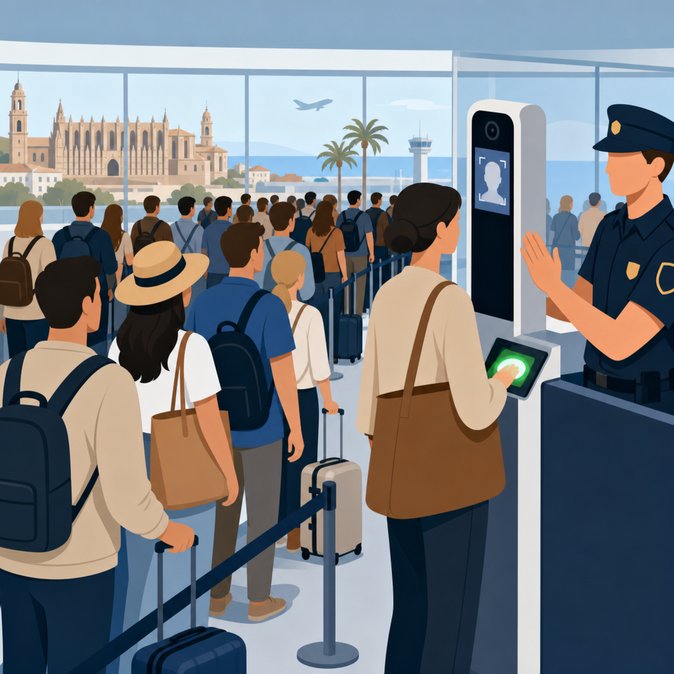
Spanish airports faced their first critical stress-test of the EU’s new biometric Entry/Exit System (EES) on Saturday, 23 May, as the U.K. spring bank-holiday exodus collided with peak tourist arrivals. Euro Weekly News reported queues of over two hours at Málaga-Costa del Sol and Palma de Mallorca, with non-EU passengers—including thousands of British holiday-makers—held in snaking lines while fingerprints and facial templates were captured.
![Bank-Holiday Gridlock at Málaga and Palma as EU Entry/Exit System Strains Spanish Borders]()
For travelers looking to eliminate some of the guesswork around documentation, the experts at VisaHQ can streamline the pre-travel checklist and advise on requirements tied to Spain’s implementation of EES. Their online platform—https://www.visahq.com/spain/—lets passengers verify visa obligations, upload supporting documents in advance and receive reminders that help avoid last-minute surprises at the border.
Unlike the U.K.–France ferry terminal at Dover, where French officers temporarily suspended extra data collection to clear a backlog the same afternoon, Spanish border police kept EES fully operational. Industry groups warn that Spain’s insistence on running the system “at 100 percent” could amplify delays once summer volumes hit their July–August zenith. Budget carriers have already sounded alarms over the limited number of kiosks and staff trained to shepherd families through the five-step process. Travel-risk managers are advising corporate travellers to build three-hour buffers into itineraries for flights into Spain until further notice, and to carry hard copies of onward Schengen-area bookings to demonstrate the 90/180-day compliance that EES now calculates automatically. Insurers likewise anticipate a spike in delay claims, with some underwriters exploring explicit EES clauses for the 2026 holiday season. From a policy standpoint, the episode showcases the flexibility article 32 of the EES Regulation affords member states: border authorities may temporarily “pause” biometric capture when queues jeopardise safety or critical infrastructure. With Spain opting not to pause, pressure is shifting to Aena and police unions to add staffing before July. The Ministry of the Interior has so far ruled out large-scale exemptions but admits it may review procedures if average processing times exceed 45 minutes. For now, travellers have little choice but to prepare: complete the pre-registration on airlines’ apps where offered, keep fingers dry for reliable prints, and expect sporadic manual stamping if local supervisors decide to revert to legacy processes during surges.

For travelers looking to eliminate some of the guesswork around documentation, the experts at VisaHQ can streamline the pre-travel checklist and advise on requirements tied to Spain’s implementation of EES. Their online platform—https://www.visahq.com/spain/—lets passengers verify visa obligations, upload supporting documents in advance and receive reminders that help avoid last-minute surprises at the border.
Unlike the U.K.–France ferry terminal at Dover, where French officers temporarily suspended extra data collection to clear a backlog the same afternoon, Spanish border police kept EES fully operational. Industry groups warn that Spain’s insistence on running the system “at 100 percent” could amplify delays once summer volumes hit their July–August zenith. Budget carriers have already sounded alarms over the limited number of kiosks and staff trained to shepherd families through the five-step process. Travel-risk managers are advising corporate travellers to build three-hour buffers into itineraries for flights into Spain until further notice, and to carry hard copies of onward Schengen-area bookings to demonstrate the 90/180-day compliance that EES now calculates automatically. Insurers likewise anticipate a spike in delay claims, with some underwriters exploring explicit EES clauses for the 2026 holiday season. From a policy standpoint, the episode showcases the flexibility article 32 of the EES Regulation affords member states: border authorities may temporarily “pause” biometric capture when queues jeopardise safety or critical infrastructure. With Spain opting not to pause, pressure is shifting to Aena and police unions to add staffing before July. The Ministry of the Interior has so far ruled out large-scale exemptions but admits it may review procedures if average processing times exceed 45 minutes. For now, travellers have little choice but to prepare: complete the pre-registration on airlines’ apps where offered, keep fingers dry for reliable prints, and expect sporadic manual stamping if local supervisors decide to revert to legacy processes during surges.