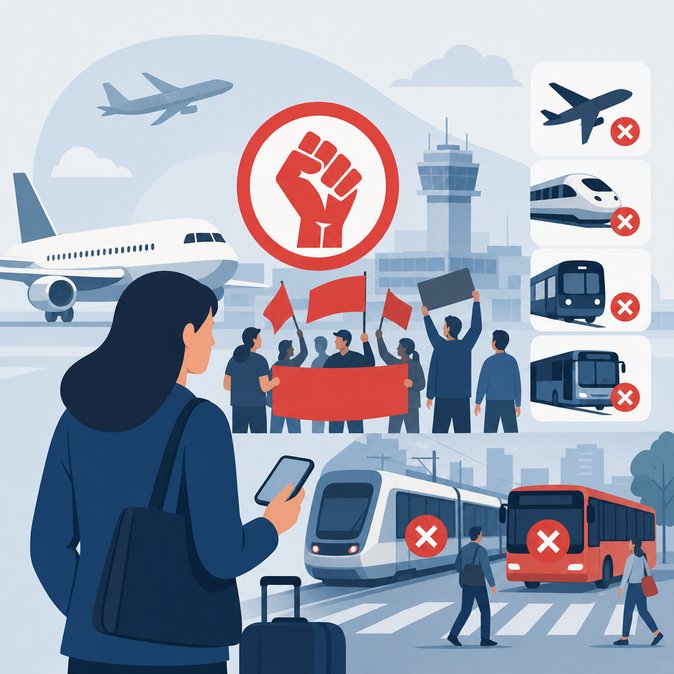
Italy is bracing for a 24-hour general strike on Friday, 29 May 2026, after five grassroots unions (CUB, SGB, SI Cobas, ADL Varese and USI-CIT) called a walk-out over wages, welfare cuts and military spending. The Florentine and several regional outlets report that the action will hit public and private sectors alike, with transport expected to suffer the most significant impact. The Italian Civil Aviation Authority (ENAC) has already published its list of “voli garantiti”—flights that airlines must operate even during strikes—so that passengers can verify whether their itinerary is protected. Services outside the guaranteed time-bands (07:00-10:00 and 18:00-21:00) face cancellations or severe delays at airports from Milan Malpensa to Palermo. Rail operator Trenitalia has issued a similar notice, while local transit companies in Rome, Milan, Florence and Naples warn of reduced bus, tram and metro frequencies.
![Nation-Wide General Strike on 29 May to Disrupt Air, Rail and Local Transport Across Italy]()
For international staff and visitors who still need to secure the correct entry documents amid this uncertainty, VisaHQ can streamline the process. The company’s Italy portal (https://www.visahq.com/italy/) offers up-to-date visa requirements, digital applications and courier options, letting travellers focus on contingency planning rather than paperwork delays.
Business travellers, assignees and global mobility teams should consider advancing or postponing trips, booking flexible fares and arranging remote work options where possible. Companies with time-sensitive cargo should liaise with freight forwarders early, as customs processing could slow down when handling agents join the strike. Employees already in Italy should carry letters explaining any critical work activities that qualify for “minimum essential services”, a category often granted waivers by prefectural authorities. Although Italian law obliges operators to maintain skeleton services, past experience shows widespread knock-on effects that can last beyond the official strike window—particularly if aircraft are out of rotation or evening trains are cancelled. Travellers connecting to onward long-haul flights should build in generous layovers or route through alternative hubs such as Zurich or Vienna. Unions have linked the protest to international issues, including criticism of the government’s defence spending and support for Israel’s war in Gaza, suggesting that further industrial actions could follow if talks stall. HR and risk managers should therefore monitor Italian labour-relations bulletins ahead of the busy summer season, when even short strikes can cascade into multi-day disruption.

For international staff and visitors who still need to secure the correct entry documents amid this uncertainty, VisaHQ can streamline the process. The company’s Italy portal (https://www.visahq.com/italy/) offers up-to-date visa requirements, digital applications and courier options, letting travellers focus on contingency planning rather than paperwork delays.
Business travellers, assignees and global mobility teams should consider advancing or postponing trips, booking flexible fares and arranging remote work options where possible. Companies with time-sensitive cargo should liaise with freight forwarders early, as customs processing could slow down when handling agents join the strike. Employees already in Italy should carry letters explaining any critical work activities that qualify for “minimum essential services”, a category often granted waivers by prefectural authorities. Although Italian law obliges operators to maintain skeleton services, past experience shows widespread knock-on effects that can last beyond the official strike window—particularly if aircraft are out of rotation or evening trains are cancelled. Travellers connecting to onward long-haul flights should build in generous layovers or route through alternative hubs such as Zurich or Vienna. Unions have linked the protest to international issues, including criticism of the government’s defence spending and support for Israel’s war in Gaza, suggesting that further industrial actions could follow if talks stall. HR and risk managers should therefore monitor Italian labour-relations bulletins ahead of the busy summer season, when even short strikes can cascade into multi-day disruption.