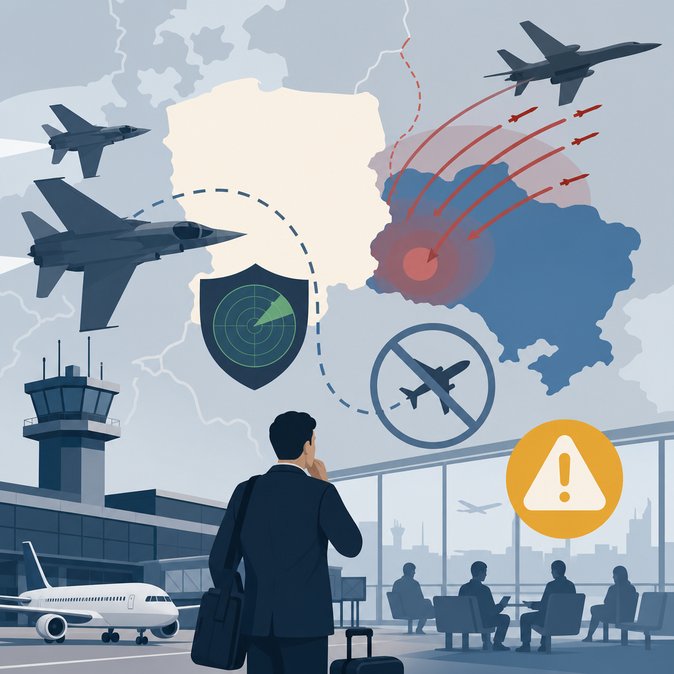
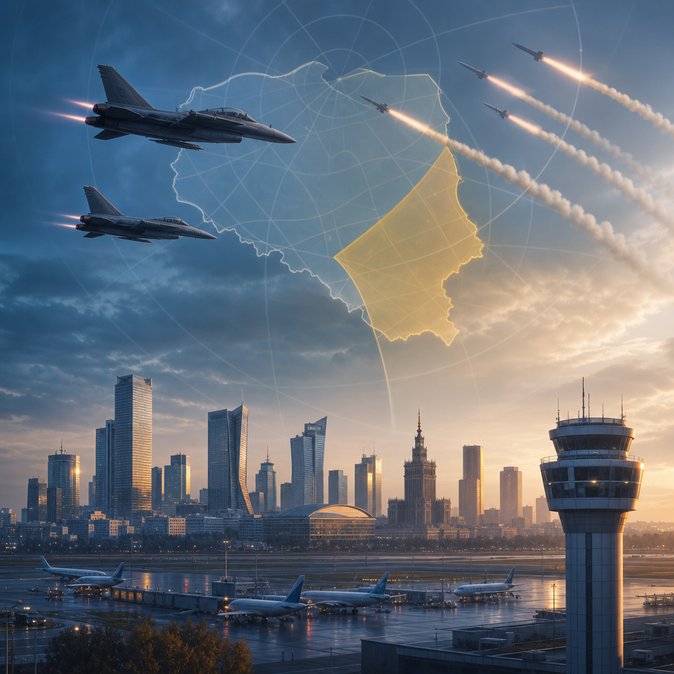
A pre-dawn barrage of Russian cruise missiles against cities across Ukraine triggered an immediate military response on the Polish side of the border in the early hours of Sunday, 24 May. Poland’s Operational Command ordered all available F-16 and newly-delivered F-35 fighters into the air and activated nationwide radar and air-defence networks in what officials described as a ‘preventive shield’ for NATO’s eastern flank. The army simultaneously issued a safety bulletin on social media advising residents in the south-east to expect unusual aircraft noise and urging them to keep emergency shelters accessible.
Although no projectile breached Polish airspace, the scramble had an immediate knock-on effect on commercial aviation. Warsaw Chopin Airport’s tower instructed several inbound flights from the Middle East and Asia to enter holding patterns, while LOT Polish Airlines briefly delayed departures to Frankfurt and Amsterdam until the military cleared civilian corridors. Eurocontrol’s Network Manager classified the situation as “yellow” for two hours, meaning carriers needed to file alternate routings around the Lublin–Rzeszów flight information region.
![Poland Sounds Air-Raid Alert, Scrambles Jets as Russian Missiles Approach—Civil Aviation Warned]()
The incident underscores how closely linked Poland’s security posture is to mobility across Central Europe. Since Russia’s full-scale invasion of Ukraine, Poland has repeatedly closed sections of its eastern airspace and imposed NOTAMs that reroute overflights, forcing airlines to burn extra fuel or cancel rotations. Insurance premiums for aircraft transiting Polish skies rose 12 percent in the first quarter of 2026, according to broker Marsh, and carriers such as Qatar Airways have already suspended Warsaw services citing operational uncertainty.
For travelers and mobility planners navigating these uncertainties, VisaHQ can smooth at least one aspect of the journey. Its platform (https://www.visahq.com/poland/) offers real-time visa requirement checks, expedited processing, and passport renewal services for Poland and neighboring states, ensuring passengers and flight crews can reroute or extend stays without paperwork delays when sudden NOTAMs or cancellations disrupt itineraries.
For corporate mobility managers the takeaway is clear: journeys to, from and over Poland remain vulnerable to sudden military escalations. Companies are being advised to activate real-time flight-tracking tools, brief assignees on shelter procedures in border regions, and build extra lay-over time into itineraries for crews operating long-haul sectors that would normally use Polish airspace as a shortcut to Northern Europe. Travel-risk consultants also recommend revisiting insurance clauses. Many policies exclude war-related disruptions unless an additional ‘high-risk territory’ rider is purchased. Organisations with rotational staff in Lublin Voivodeship or along the E40 highway near the frontier should rehearse evacuation and remote-work contingencies while tensions persist. A new NOTAM (EPZZ/24-05-X) remains in force until 06:00 CET on 25 May, urging pilots to monitor 121.5 MHz for potential further alerts.
Although no projectile breached Polish airspace, the scramble had an immediate knock-on effect on commercial aviation. Warsaw Chopin Airport’s tower instructed several inbound flights from the Middle East and Asia to enter holding patterns, while LOT Polish Airlines briefly delayed departures to Frankfurt and Amsterdam until the military cleared civilian corridors. Eurocontrol’s Network Manager classified the situation as “yellow” for two hours, meaning carriers needed to file alternate routings around the Lublin–Rzeszów flight information region.
The incident underscores how closely linked Poland’s security posture is to mobility across Central Europe. Since Russia’s full-scale invasion of Ukraine, Poland has repeatedly closed sections of its eastern airspace and imposed NOTAMs that reroute overflights, forcing airlines to burn extra fuel or cancel rotations. Insurance premiums for aircraft transiting Polish skies rose 12 percent in the first quarter of 2026, according to broker Marsh, and carriers such as Qatar Airways have already suspended Warsaw services citing operational uncertainty.
For travelers and mobility planners navigating these uncertainties, VisaHQ can smooth at least one aspect of the journey. Its platform (https://www.visahq.com/poland/) offers real-time visa requirement checks, expedited processing, and passport renewal services for Poland and neighboring states, ensuring passengers and flight crews can reroute or extend stays without paperwork delays when sudden NOTAMs or cancellations disrupt itineraries.
For corporate mobility managers the takeaway is clear: journeys to, from and over Poland remain vulnerable to sudden military escalations. Companies are being advised to activate real-time flight-tracking tools, brief assignees on shelter procedures in border regions, and build extra lay-over time into itineraries for crews operating long-haul sectors that would normally use Polish airspace as a shortcut to Northern Europe. Travel-risk consultants also recommend revisiting insurance clauses. Many policies exclude war-related disruptions unless an additional ‘high-risk territory’ rider is purchased. Organisations with rotational staff in Lublin Voivodeship or along the E40 highway near the frontier should rehearse evacuation and remote-work contingencies while tensions persist. A new NOTAM (EPZZ/24-05-X) remains in force until 06:00 CET on 25 May, urging pilots to monitor 121.5 MHz for potential further alerts.