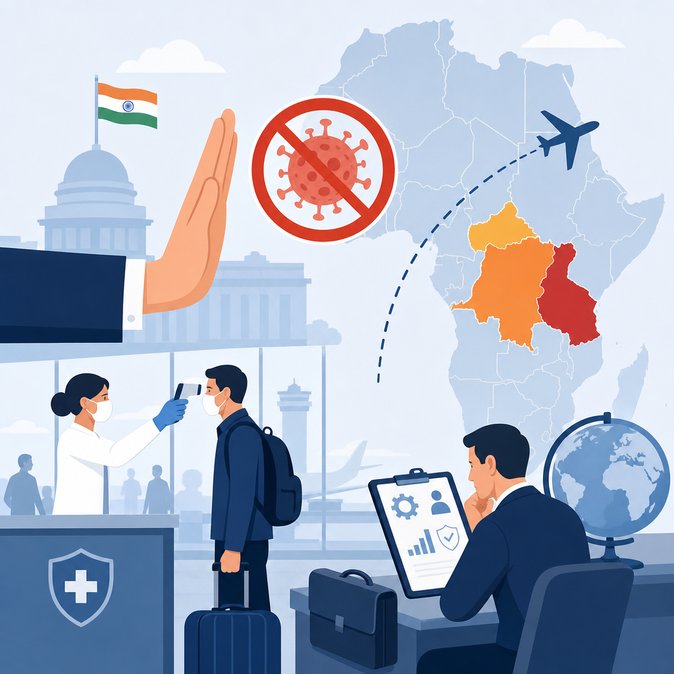
India’s Ministry of Health and Family Welfare issued an urgent travel advisory on the morning of 24 May after the World Health Organization declared the Bundibugyo-strain Ebola outbreak in the Democratic Republic of the Congo (DRC) and Uganda a Public Health Emergency of International Concern. Citing WHO risk assessments and an Africa CDC continental alert, the advisory "strongly discourages" all non-essential travel to the DRC, Uganda and neighbouring South Sudan until further notice. Airlines and travel-management companies report that India-to-Africa traffic is still less than 40 % of pre-pandemic levels, but project cargo specialists, mining consultants and NGO staff frequently route through Kampala and Kinshasa. Employers are now re-evaluating upcoming assignments and activating medical-evacuation contracts.
![Government Issues Ebola-Linked Travel Advisory for Indian Nationals]()
For travellers who must proceed despite the warning, VisaHQ can help simplify the logistics by arranging expedited visas, transit permits and WHO-required vaccination documentation for Indian passport holders heading to or through Central Africa. Their team tracks real-time health advisories and offers secure courier collection of passports, saving applicants a trip to crowded counters; see details at https://www.visahq.com/india/
Travellers already in the region have been told to maintain “heightened precautions,” register with the closest Indian mission and be prepared for screening at Points of Entry on return. The advisory empowers Indian airports to conduct secondary health checks on passengers arriving from Central Africa and allows immigration officers to refer symptomatic travellers to quarantine facilities. Business houses have begun circulating guidance: postpone non-critical trips, shift meetings online, and, where travel is unavoidable, ensure staff receive pre-departure health briefings and carry WHO-compliant yellow cards. While no Ebola cases have ever been recorded in India, the government is keen to avoid a repeat of the 2024 Nipah scare that triggered temporary flight suspensions and multimillion-rupee losses for exporters. Industry bodies such as FIEO and CII urged members to factor possible cargo delays through Nairobi and Addis Ababa into supply-chain timelines. The advisory will be reviewed every two weeks, but epidemiologists warn containment could take months, suggesting the restrictions may disrupt project mobilisation schedules through Q3 2026.

For travellers who must proceed despite the warning, VisaHQ can help simplify the logistics by arranging expedited visas, transit permits and WHO-required vaccination documentation for Indian passport holders heading to or through Central Africa. Their team tracks real-time health advisories and offers secure courier collection of passports, saving applicants a trip to crowded counters; see details at https://www.visahq.com/india/
Travellers already in the region have been told to maintain “heightened precautions,” register with the closest Indian mission and be prepared for screening at Points of Entry on return. The advisory empowers Indian airports to conduct secondary health checks on passengers arriving from Central Africa and allows immigration officers to refer symptomatic travellers to quarantine facilities. Business houses have begun circulating guidance: postpone non-critical trips, shift meetings online, and, where travel is unavoidable, ensure staff receive pre-departure health briefings and carry WHO-compliant yellow cards. While no Ebola cases have ever been recorded in India, the government is keen to avoid a repeat of the 2024 Nipah scare that triggered temporary flight suspensions and multimillion-rupee losses for exporters. Industry bodies such as FIEO and CII urged members to factor possible cargo delays through Nairobi and Addis Ababa into supply-chain timelines. The advisory will be reviewed every two weeks, but epidemiologists warn containment could take months, suggesting the restrictions may disrupt project mobilisation schedules through Q3 2026.