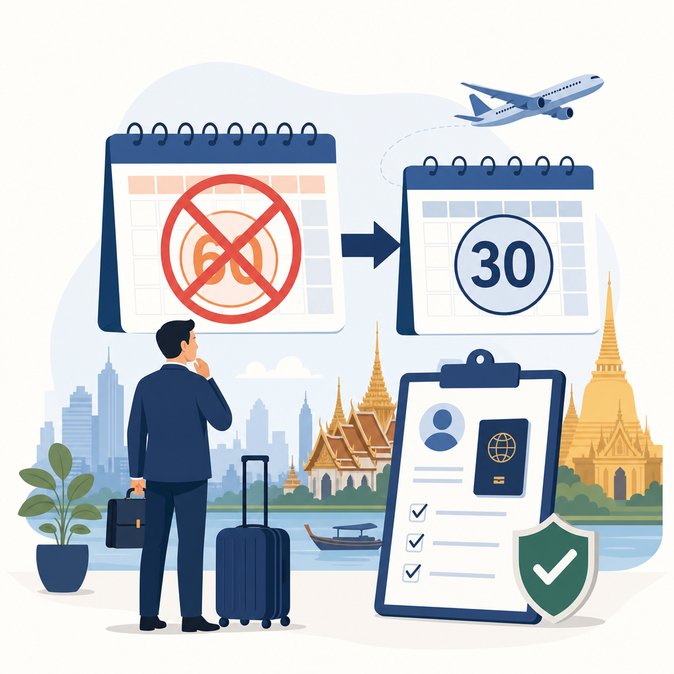
Thailand’s Cabinet has formally revoked the pandemic-era decision that gave citizens of 93 countries—including India—up to 60 days of visa-free stay. Effective immediately, Indian passport-holders entering on the visa-exempt facility will once again receive only 30 days on arrival, matching the pre-July 2024 bilateral arrangement. The reversal follows a series of security briefings to Bangkok that linked longer visa-free windows to an uptick in drug trafficking, human-trafficking rings and illegal business activity operated by foreigners. Officials said transnational crime networks were abusing the extra 30 days to “work under the tourist radar”, prompting police to call for tighter entry screening. For Indian travellers, the biggest change is time: conferences, weddings and longer leisure itineraries will now need either a pre-travel e-Visa or an in-country extension at Thai immigration offices.
![Thailand cuts visa-free stay for Indians back to 30 days]()
Travelers who prefer to secure their paperwork in advance can streamline the process through VisaHQ, whose online platform offers guided e-Visa applications, real-time status updates and dedicated support for Thailand and other ASEAN destinations; start your application at https://www.visahq.com/india/
Business mobility managers should update travel-approval tools and duty-of-care alerts to reflect the shorter authorised stay and advise assignees to retain proof of onward travel within 30 days. Thai tourism operators have downplayed revenue risks, noting that India is already the market most likely to combine beach holidays with short-haul trips to Vietnam, Malaysia and Singapore. Package-tour firms are bundling cross-border add-ons so Indian visitors can reset their 30-day clock without costly paperwork. Nevertheless, airlines expect a spike in last-minute date-change fees over the next few weeks as passengers rush to re-book return flights. Policy analysts also view the decision as a signal that Thailand intends to rely more heavily on its e-Visa system—which records biometric and financial data—than on blanket visa waivers. If that shift spreads across ASEAN, Indian companies could see slower, more document-heavy regional travel until new digital visa platforms mature.

Travelers who prefer to secure their paperwork in advance can streamline the process through VisaHQ, whose online platform offers guided e-Visa applications, real-time status updates and dedicated support for Thailand and other ASEAN destinations; start your application at https://www.visahq.com/india/
Business mobility managers should update travel-approval tools and duty-of-care alerts to reflect the shorter authorised stay and advise assignees to retain proof of onward travel within 30 days. Thai tourism operators have downplayed revenue risks, noting that India is already the market most likely to combine beach holidays with short-haul trips to Vietnam, Malaysia and Singapore. Package-tour firms are bundling cross-border add-ons so Indian visitors can reset their 30-day clock without costly paperwork. Nevertheless, airlines expect a spike in last-minute date-change fees over the next few weeks as passengers rush to re-book return flights. Policy analysts also view the decision as a signal that Thailand intends to rely more heavily on its e-Visa system—which records biometric and financial data—than on blanket visa waivers. If that shift spreads across ASEAN, Indian companies could see slower, more document-heavy regional travel until new digital visa platforms mature.