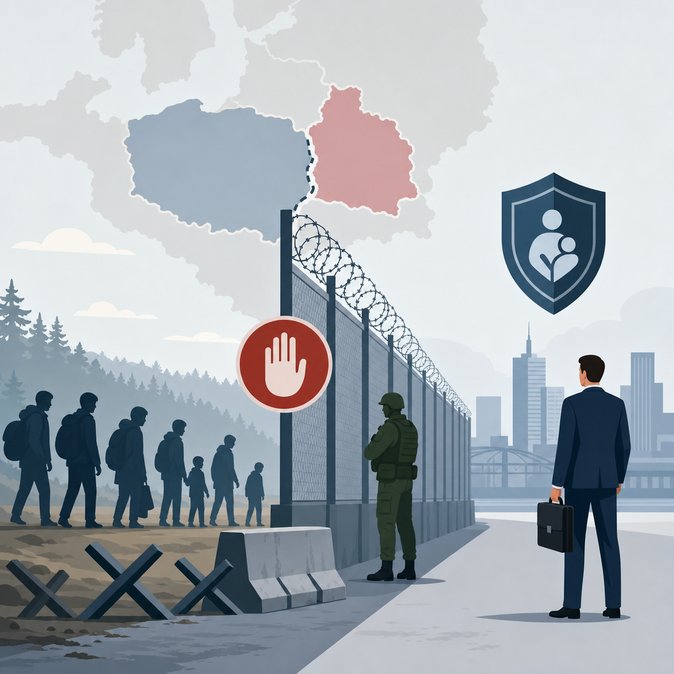
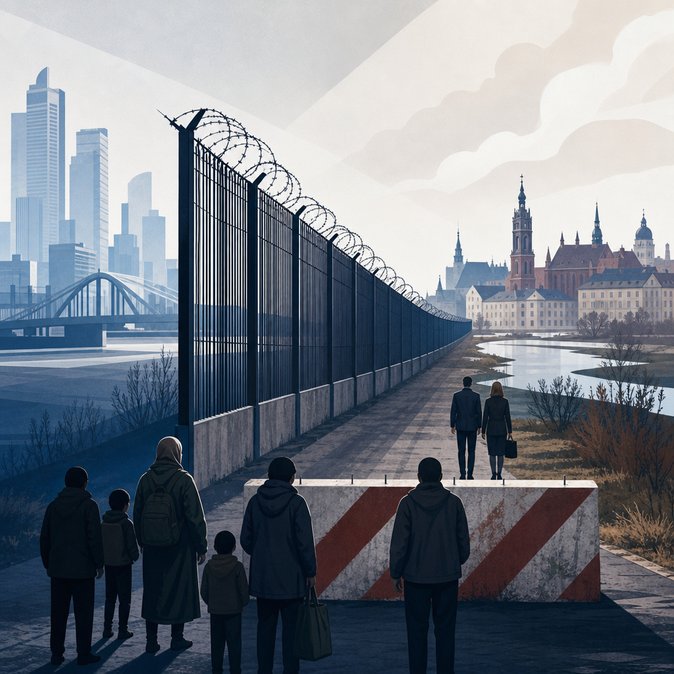
The Polish government has once again extended its extraordinary measure that blocks almost all requests for international protection at its land frontier with Belarus. A regulation published in the Journal of Laws on 20 May (item 660) entered into force at 00:00 on 21 May 2026 and keeps the restriction in place until 20 July 2026. Under the mechanism—first introduced in March 2025—Border Guard officers may simply refuse to register an asylum claim made at the fence, unless the applicant falls into one of a few narrowly defined “vulnerable” categories (unaccompanied minors, pregnant women or persons requiring urgent medical care). According to official statistics, 475 people have been turned back since the scheme began, while 141 vulnerable individuals were processed. The Tusk administration argues that Minsk continues to “instrumentalise migration” as a form of hybrid pressure on the EU. Briefings submitted to the Sejm ahead of the vote describe dozens of incidents in which organised groups pelted Polish patrols with stones, branches and laser pointers—often, Warsaw claims, with the direct assistance of Belarusian security forces. Human-rights NGOs and opposition MPs condemn the policy as a clear breach of Article 56(2) of the Polish Constitution and of the 1951 Geneva Convention’s principle of non-refoulement.
![Poland prolongs 60-day suspension of asylum applications at Belarus border]()
For travelers who still need to reach Poland despite the turbulent border environment, VisaHQ can streamline the process by offering real-time updates on entry policies, visa options and permissible humanitarian exemptions. The service’s dedicated Poland page (https://www.visahq.com/poland/) consolidates the latest official notices and enables both individuals and companies to obtain the correct documentation quickly, reducing the risk of last-minute complications at the frontier.
They warn that the measure is fast becoming a semi-permanent feature of the EU’s eastern frontier and could normalise similar practices elsewhere in the Schengen Area. For corporate mobility managers the extension means that humanitarian travel corridors, family-reunification cases and routine cross-border business trips between Poland and Belarus will remain heavily constrained for at least another two months. Logistics firms should also anticipate ad-hoc checks and longer transit times as the Border Guard reallocates staff to the crisis zone.
For travelers who still need to reach Poland despite the turbulent border environment, VisaHQ can streamline the process by offering real-time updates on entry policies, visa options and permissible humanitarian exemptions. The service’s dedicated Poland page (https://www.visahq.com/poland/) consolidates the latest official notices and enables both individuals and companies to obtain the correct documentation quickly, reducing the risk of last-minute complications at the frontier.
They warn that the measure is fast becoming a semi-permanent feature of the EU’s eastern frontier and could normalise similar practices elsewhere in the Schengen Area. For corporate mobility managers the extension means that humanitarian travel corridors, family-reunification cases and routine cross-border business trips between Poland and Belarus will remain heavily constrained for at least another two months. Logistics firms should also anticipate ad-hoc checks and longer transit times as the Border Guard reallocates staff to the crisis zone.