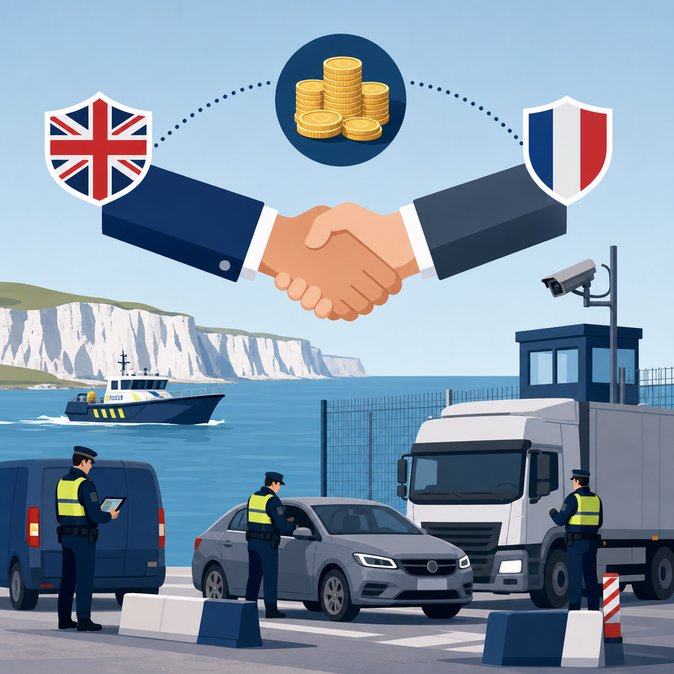
In a detailed report published on 21 May 2026, Brussels-based outlet Eunews revealed the financial contours of the latest three-year migration agreement signed by Paris and London. Under the deal, the United Kingdom will transfer £662 million (€767 million) to France between the 2026/27 and 2028/29 fiscal years—an increase of roughly 40 % on the €541 million package signed in March 2023. Around €501 million is earmarked for day-to-day policing of France’s northern coast, while €161 million will fund new “tactics”, including expanded aerial surveillance, additional detection technology and a planned detention centre in Dunkirk. The Anglo-French cooperation accords date back to the 1991 Sangatte Protocol and the 2003 Le Touquet Treaty, but Brexit has transformed them from informal understandings into binding, budget-backed programmes. French officers now conduct 500 extra coastal patrols daily and routinely coordinate with UK counterparts through the Joint Information and Coordination Centre in Calais.
![UK commits €767 million to French border operations in renewed Channel migration pact]()
For travellers and companies needing to secure the right travel documents amid these shifting border protocols, VisaHQ can streamline the process. Its France-specific portal (https://www.visahq.com/france/) offers real-time guidance, application support and status tracking, ensuring that staff and cargo crews remain compliant and avoid costly delays.
While the measures have reduced departures from hot spots such as Calais, Eunews notes a sharp uptick in launches from Belgian beaches, suggesting that people-smuggling networks are adapting faster than governments can respond. For global mobility managers the agreement signals tougher scrutiny of personnel and contractors who move goods or travel through northern France’s ports and Eurotunnel terminals. Heightened checks—ranging from vehicle searches on the A16 motorway to drone sweeps over industrial zones—can add hours to supply-chain schedules and complicate posted-worker logistics. Employers should counsel staff to carry proof of status and anticipate sporadic traffic disruption, especially during summer peaks. Human-rights groups are likely to challenge the new funding stream in French courts, arguing that UK money enables police practices—such as beach evictions and destruction of makeshift camps—that expose migrants to greater danger. Litigation could create legal uncertainty over how, and where, border officers are allowed to operate. Corporations running large distribution centres in Hauts-de-France should monitor local prefectural notices for sudden access restrictions or protest activity. In the medium term, the record-breaking sum entrenches France’s role as the UK’s outsourced border. Unless a broader EU-UK asylum treaty emerges—as floated by President Macron in 2022—business travel across the Channel will remain subject to an evolving patchwork of bilateral agreements, technological controls (such as the EU Entry/Exit System) and politically charged funding cycles.

For travellers and companies needing to secure the right travel documents amid these shifting border protocols, VisaHQ can streamline the process. Its France-specific portal (https://www.visahq.com/france/) offers real-time guidance, application support and status tracking, ensuring that staff and cargo crews remain compliant and avoid costly delays.
While the measures have reduced departures from hot spots such as Calais, Eunews notes a sharp uptick in launches from Belgian beaches, suggesting that people-smuggling networks are adapting faster than governments can respond. For global mobility managers the agreement signals tougher scrutiny of personnel and contractors who move goods or travel through northern France’s ports and Eurotunnel terminals. Heightened checks—ranging from vehicle searches on the A16 motorway to drone sweeps over industrial zones—can add hours to supply-chain schedules and complicate posted-worker logistics. Employers should counsel staff to carry proof of status and anticipate sporadic traffic disruption, especially during summer peaks. Human-rights groups are likely to challenge the new funding stream in French courts, arguing that UK money enables police practices—such as beach evictions and destruction of makeshift camps—that expose migrants to greater danger. Litigation could create legal uncertainty over how, and where, border officers are allowed to operate. Corporations running large distribution centres in Hauts-de-France should monitor local prefectural notices for sudden access restrictions or protest activity. In the medium term, the record-breaking sum entrenches France’s role as the UK’s outsourced border. Unless a broader EU-UK asylum treaty emerges—as floated by President Macron in 2022—business travel across the Channel will remain subject to an evolving patchwork of bilateral agreements, technological controls (such as the EU Entry/Exit System) and politically charged funding cycles.