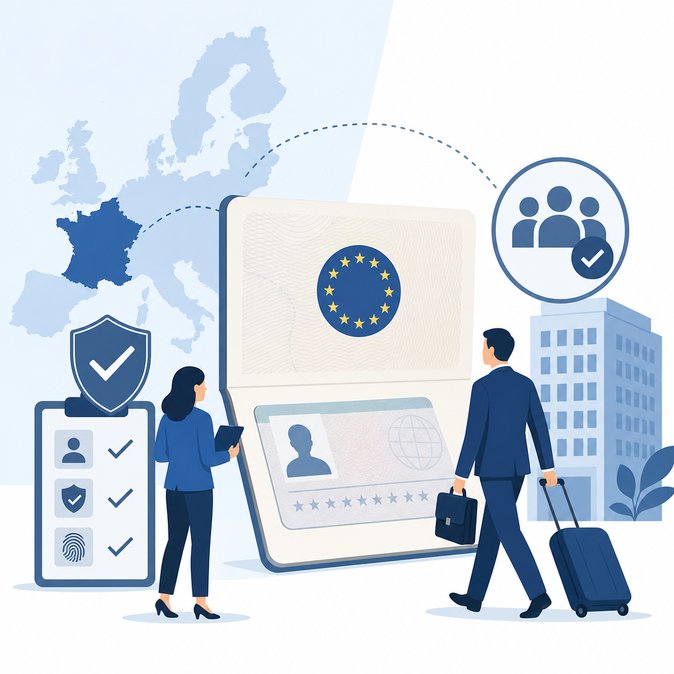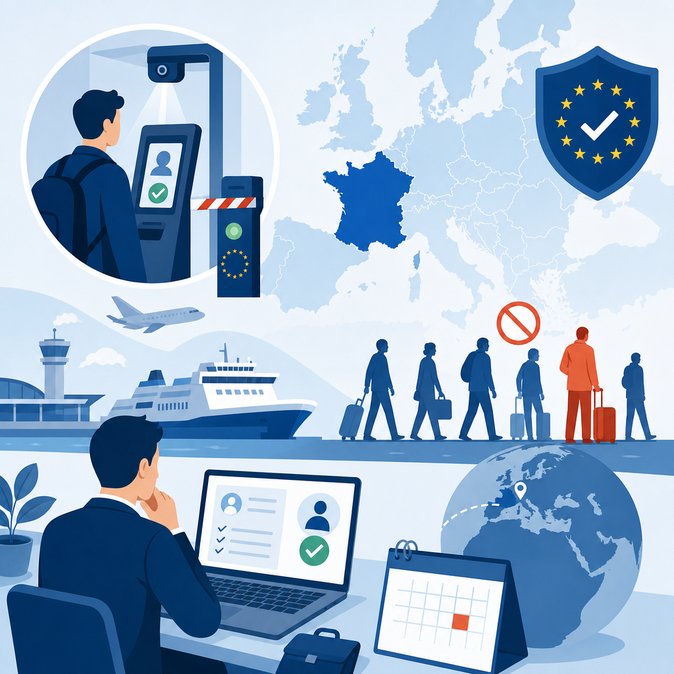
The European Commission on Monday, 18 May, published its fifth annual State of the Schengen Report – and the headline number is eye-catching. Since EES (Entry/Exit System) became fully operational across the bloc in April, border guards have logged more than 66 million crossings by third-country nationals and automatically refused entry to roughly 32 000 people who did not meet admission criteria. French airports and seaports, which handle around one-fifth of all Schengen external traffic, have been early beneficiaries: automatic biometric kiosks at Paris-Charles-de-Gaulle and the Channel ferry terminals were credited with cutting average verification times for arriving passengers by 40 %, according to officials briefed on the report.
Beyond the numbers, Brussels is using the data to argue that the digitalisation of border management is already enhancing security while preserving the principle of free movement. This is significant for France, which has repeatedly renewed temporary checks on its land borders with Belgium, Spain and Italy since 2015. In unusually direct language, the Commission “encourages” Paris and five other member states to phase out those internal controls and rely instead on real-time risk analysis generated by EES.
Travellers trying to stay on the right side of these fast-evolving rules can lighten the administrative load by turning to a specialist like VisaHQ. The company’s France portal (https://www.visahq.com/france/) offers live Schengen visa guidance, automated stay-calculator tools and end-to-end application support—services that help individuals and corporate mobility teams avoid the fines and travel disruptions that EES enforcement now makes all too easy.
![Brussels hails Schengen’s new Entry/Exit System after 32,000 inadmissible travellers stopped]()
For business travellers, the immediate impact will be new pre-departure obligations. Airlines, coach operators and cruise lines must now run passenger manifests through an EES web service hosted by eu-LISA before boarding. Carriers that load a traveller whose passport or Schengen-visa allowance has expired face automatic fines and the cost of repatriation. Several French carriers, including Air France-KLM and Brittany Ferries, told industry group FNAM they have added 30 seconds per passenger to their check-in scripts to comply.
Immigration counsel are already flagging downstream effects for corporate mobility programmes. “EES makes the 90/180-day Schengen rule effectively self-enforcing,” notes Anne-Sophie Durand, partner at EY Société d’Avocats in Paris. Employers that rotate non-EU staff in and out of France on short-stay missions will need airtight travel calendars – one extra weekend at a trade show could tip an employee over the limit and trigger an overstay record that will be visible to every Schengen border post.
Looking ahead, the Commission wants member states to build on EES by completing the long-delayed ETIAS travel-authorisation scheme for visa-exempt nationals in late 2026 and by digitising return orders for irregular migrants. Whether France will feel confident enough to lift its internal borders once those projects are live is now the key political question.
Beyond the numbers, Brussels is using the data to argue that the digitalisation of border management is already enhancing security while preserving the principle of free movement. This is significant for France, which has repeatedly renewed temporary checks on its land borders with Belgium, Spain and Italy since 2015. In unusually direct language, the Commission “encourages” Paris and five other member states to phase out those internal controls and rely instead on real-time risk analysis generated by EES.
Travellers trying to stay on the right side of these fast-evolving rules can lighten the administrative load by turning to a specialist like VisaHQ. The company’s France portal (https://www.visahq.com/france/) offers live Schengen visa guidance, automated stay-calculator tools and end-to-end application support—services that help individuals and corporate mobility teams avoid the fines and travel disruptions that EES enforcement now makes all too easy.

For business travellers, the immediate impact will be new pre-departure obligations. Airlines, coach operators and cruise lines must now run passenger manifests through an EES web service hosted by eu-LISA before boarding. Carriers that load a traveller whose passport or Schengen-visa allowance has expired face automatic fines and the cost of repatriation. Several French carriers, including Air France-KLM and Brittany Ferries, told industry group FNAM they have added 30 seconds per passenger to their check-in scripts to comply.
Immigration counsel are already flagging downstream effects for corporate mobility programmes. “EES makes the 90/180-day Schengen rule effectively self-enforcing,” notes Anne-Sophie Durand, partner at EY Société d’Avocats in Paris. Employers that rotate non-EU staff in and out of France on short-stay missions will need airtight travel calendars – one extra weekend at a trade show could tip an employee over the limit and trigger an overstay record that will be visible to every Schengen border post.
Looking ahead, the Commission wants member states to build on EES by completing the long-delayed ETIAS travel-authorisation scheme for visa-exempt nationals in late 2026 and by digitising return orders for irregular migrants. Whether France will feel confident enough to lift its internal borders once those projects are live is now the key political question.