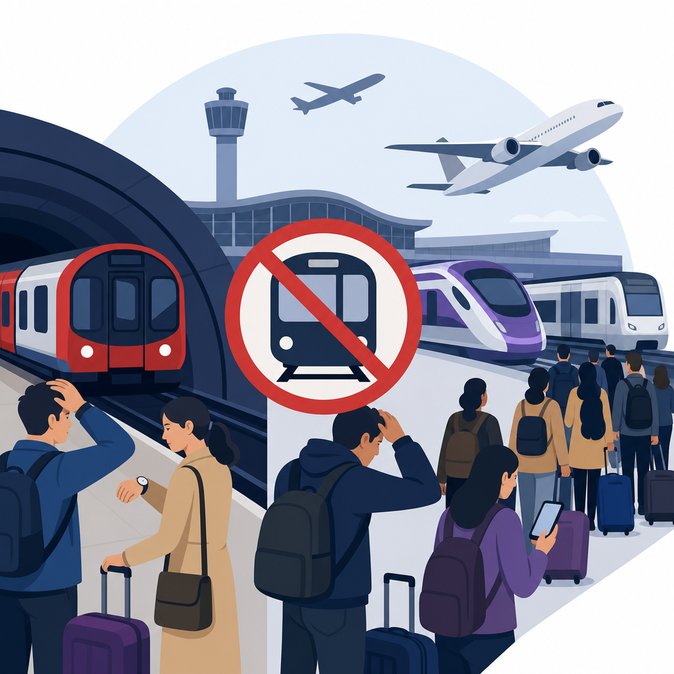
Business travellers heading to and from the United Kingdom face fresh transport headaches after the Rail, Maritime and Transport (RMT) union confirmed a new series of 24-hour London Underground strikes beginning on Tuesday 19 May and running on selected dates through 22 May and again in mid-June. The walk-outs will hit the Piccadilly line—the only Tube service that runs directly into Heathrow’s passenger terminals—as well as parts of the Circle, Central and Metropolitan lines. Transport for London (TfL) has warned that some lines may close completely during portions of the action, with residual disruption spilling into the mornings that follow each strike. Heathrow Airport will remain operational, but passengers are being told to expect far longer transfer times and to consider switching to alternative services such as the Elizabeth line, Heathrow Express coaches, pre-booked taxis or car-hire. TfL journey-planner tools and live-status pages are being updated in real time to help travellers re-route. Corporate mobility managers are advising travellers to allow at least an extra 60–90 minutes for journeys between central London and Heathrow.
![London Underground strikes set to snarl Heathrow access and disrupt international business travel]()
While you’re recalculating those extra minutes, remember that travel documents need to be just as seamless as ground transport. VisaHQ’s UK platform (https://www.visahq.com/united-kingdom/) can tell you in seconds whether you need a visa, help you file the application online, and even organise same-day passport couriering, trimming at least one layer of stress from an already disrupted itinerary.
Companies with large numbers of short-haul flyers—particularly on the busy Spain-UK market—are reviewing meeting schedules and encouraging the use of virtual appointments to avoid missed flights. Hotel operators around Heathrow are already reporting an uptick in same-day bookings from passengers choosing to stay overnight rather than risk early-morning delays. Although Gatwick, Stansted and Luton rely mainly on National Rail services and are expected to function more normally, those rail lines are likely to be busier as displaced Tube users seek alternatives. London City Airport, which depends heavily on the DLR and connections through Bank station, is also forecasting crowding. The latest industrial action stems from a long-running dispute over proposed staffing and roster changes that would introduce a voluntary four-day working week for drivers. With the RMT accusing management of “back-tracking” on earlier concessions, further strikes are pencilled in for 16 and 18 June, raising the prospect of another round of disruption at the start of the northern-hemisphere summer peak. Mobility planners should monitor union announcements closely; contingency budgets for ground transport and client schedule changes may be required if talks fail to break the deadlock.
While you’re recalculating those extra minutes, remember that travel documents need to be just as seamless as ground transport. VisaHQ’s UK platform (https://www.visahq.com/united-kingdom/) can tell you in seconds whether you need a visa, help you file the application online, and even organise same-day passport couriering, trimming at least one layer of stress from an already disrupted itinerary.
Companies with large numbers of short-haul flyers—particularly on the busy Spain-UK market—are reviewing meeting schedules and encouraging the use of virtual appointments to avoid missed flights. Hotel operators around Heathrow are already reporting an uptick in same-day bookings from passengers choosing to stay overnight rather than risk early-morning delays. Although Gatwick, Stansted and Luton rely mainly on National Rail services and are expected to function more normally, those rail lines are likely to be busier as displaced Tube users seek alternatives. London City Airport, which depends heavily on the DLR and connections through Bank station, is also forecasting crowding. The latest industrial action stems from a long-running dispute over proposed staffing and roster changes that would introduce a voluntary four-day working week for drivers. With the RMT accusing management of “back-tracking” on earlier concessions, further strikes are pencilled in for 16 and 18 June, raising the prospect of another round of disruption at the start of the northern-hemisphere summer peak. Mobility planners should monitor union announcements closely; contingency budgets for ground transport and client schedule changes may be required if talks fail to break the deadlock.