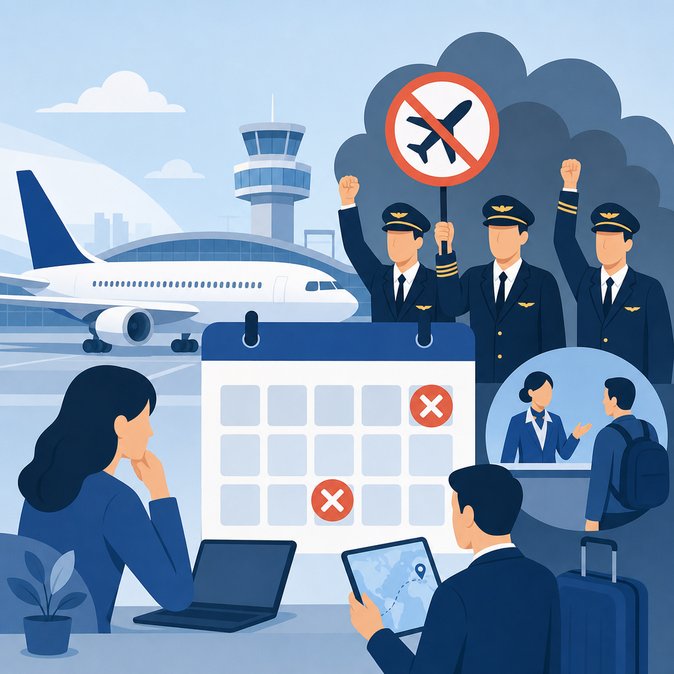
National carrier Finnair revealed on 17 May that it will pre-emptively cancel roughly 300 flights scheduled for 9 and 13 December after the Finnish Air Line Pilots’ Association (SLL) served official strike notices for those days. The cancellations affect both European and domestic sectors and represent around one-third of Finnair’s daily departures. Passengers will be rebooked or offered refunds; long-haul services are expected to operate but may face schedule changes. The dispute centres on wage progression and rostering rules.
![Finnair warns of major December disruption as pilots announce two-day strike]()
Travellers making last-minute changes to routings should also ensure that their visa or transit documentation is still valid. VisaHQ can provide fast online checks and processing support for Finland as well as neighbouring Schengen and non-Schengen countries, helping minimise additional disruption; see https://www.visahq.com/finland/ for details.
SLL argues that pilots’ real earnings have lagged other Nordic carriers since pandemic-era concessions and insists that back-to-back rest requirements be tightened to address fatigue. Finnair counters that its post-Covid recovery remains fragile and that additional fixed costs would jeopardise fleet-renewal plans. Finnair’s early announcement is designed to give corporate travel managers seven months’ notice to adapt winter-roster movements and holiday travel. Nonetheless, the airline hinted that a failure to reach agreement could trigger a broader two-week stoppage coinciding with Finland’s busy Independence Day long weekend. From a global-mobility perspective, companies with project teams in Finland during December should build contingency routings via Scandinavian hubs or consider rail alternatives on the key Helsinki–Tampere and Helsinki–Turku corridors. Travel-risk teams are advised to monitor ongoing mediation led by Finland’s National Conciliator. The strike threat adds to a year of industrial-relations turbulence at Helsinki Airport, where baggage-handlers and ground-service staff have staged four-hour warning walkouts almost monthly since January. Repeated labour action is eroding Helsinki’s on-time-performance ranking and forcing employers to expand remote-work options for inbound assignees.

Travellers making last-minute changes to routings should also ensure that their visa or transit documentation is still valid. VisaHQ can provide fast online checks and processing support for Finland as well as neighbouring Schengen and non-Schengen countries, helping minimise additional disruption; see https://www.visahq.com/finland/ for details.
SLL argues that pilots’ real earnings have lagged other Nordic carriers since pandemic-era concessions and insists that back-to-back rest requirements be tightened to address fatigue. Finnair counters that its post-Covid recovery remains fragile and that additional fixed costs would jeopardise fleet-renewal plans. Finnair’s early announcement is designed to give corporate travel managers seven months’ notice to adapt winter-roster movements and holiday travel. Nonetheless, the airline hinted that a failure to reach agreement could trigger a broader two-week stoppage coinciding with Finland’s busy Independence Day long weekend. From a global-mobility perspective, companies with project teams in Finland during December should build contingency routings via Scandinavian hubs or consider rail alternatives on the key Helsinki–Tampere and Helsinki–Turku corridors. Travel-risk teams are advised to monitor ongoing mediation led by Finland’s National Conciliator. The strike threat adds to a year of industrial-relations turbulence at Helsinki Airport, where baggage-handlers and ground-service staff have staged four-hour warning walkouts almost monthly since January. Repeated labour action is eroding Helsinki’s on-time-performance ranking and forcing employers to expand remote-work options for inbound assignees.