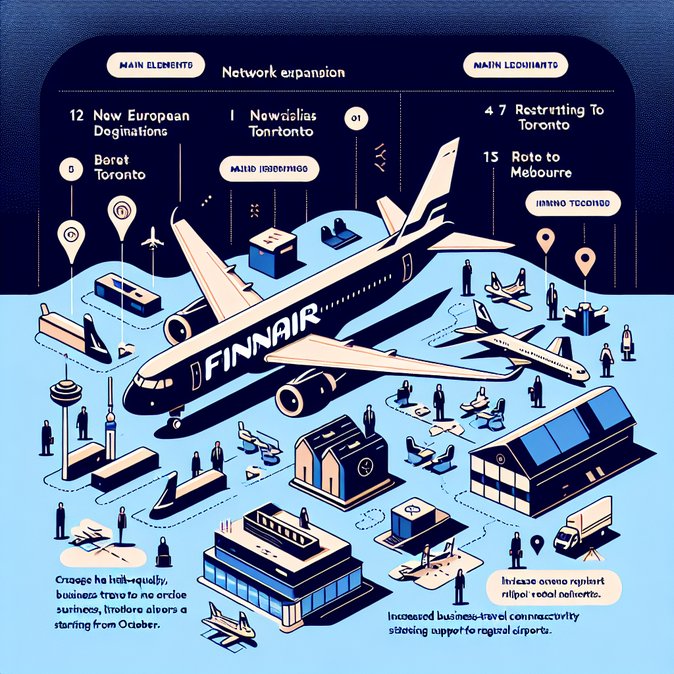
Finnair used a ceremony at Helsinki-Vantaa on 12 May to trumpet the launch of a dozen new routes that will roll out between now and October. The network expansion, celebrated with ribbon-cuttings for Tirana and Valencia, strengthens Finland’s point-to-point links across Europe and marks the flag-carrier’s return to Toronto after an eleven-year break.
A headline-grabbing novelty is the first-ever Helsinki–Melbourne service, due to start in October and giving Nordic exporters a direct conduit to Australia’s life-science and renewable-energy sectors. Within Europe, the additional cities—Alta, Catania, Firenze, Kos, Kuressaari, Luxembourg, Stavanger, Thessaloniki, Tirana, Torino, Umeå and Valencia—provide Finnish passengers with more non-stop options and, crucially, open new weekend city-pair permutations for corporate travellers needing two-day visits. Several flights are timed to connect seamlessly with Finnair’s domestic network, leveraging the airline’s decision to keep fourteen Finnish regional airports on year-round service.
![Finnair Unveils 12 New Routes from Finland for Summer–Autumn 2026]()
Finavia, which operates all Finnish civilian airports, said the expansion should lift Helsinki-Vantaa’s transfer throughput by at least 6 % over the summer peak, offsetting capacity lost on Asian routes curtailed by Russian airspace restrictions.
For passengers planning travel on these freshly announced routes—especially first-timers to destinations like Tirana or Melbourne—sorting out visas can be just as critical as booking the right connection. VisaHQ’s Finland portal (https://www.visahq.com/finland/) streamlines the process by showing travellers whether they need a visa, managing applications online and even providing courier services for passport renewals, helping Finnair customers avoid last-minute documentation snags.
The Toronto route, operating three times weekly with an Airbus A330-300, is expected to bolster trade missions linked to Finnish forestry technology and Canadian mining investment. The forthcoming Melbourne flight will position Helsinki as the fastest one-stop gateway between the Baltic region and Australia. The growth also carries HR implications: more direct city pairs mean fewer Schengen–non-Schengen transfers, simplifying duty-of-care calculations and reducing minimum connection times. Mobility managers should alert employees that some seasonal routes (e.g., Kos, Thessaloniki) end in October and that baggage-through-check policies differ depending on wet-leased aircraft on thinner routes. Finnair stressed that sustainability targets remain intact; the short-haul additions rely on fuel-efficient Airbus A321neos, while long-haul growth will be partly covered by the airline’s forthcoming Embraer E195-E2 order operated by Norra.
A headline-grabbing novelty is the first-ever Helsinki–Melbourne service, due to start in October and giving Nordic exporters a direct conduit to Australia’s life-science and renewable-energy sectors. Within Europe, the additional cities—Alta, Catania, Firenze, Kos, Kuressaari, Luxembourg, Stavanger, Thessaloniki, Tirana, Torino, Umeå and Valencia—provide Finnish passengers with more non-stop options and, crucially, open new weekend city-pair permutations for corporate travellers needing two-day visits. Several flights are timed to connect seamlessly with Finnair’s domestic network, leveraging the airline’s decision to keep fourteen Finnish regional airports on year-round service.

Finavia, which operates all Finnish civilian airports, said the expansion should lift Helsinki-Vantaa’s transfer throughput by at least 6 % over the summer peak, offsetting capacity lost on Asian routes curtailed by Russian airspace restrictions.
For passengers planning travel on these freshly announced routes—especially first-timers to destinations like Tirana or Melbourne—sorting out visas can be just as critical as booking the right connection. VisaHQ’s Finland portal (https://www.visahq.com/finland/) streamlines the process by showing travellers whether they need a visa, managing applications online and even providing courier services for passport renewals, helping Finnair customers avoid last-minute documentation snags.
The Toronto route, operating three times weekly with an Airbus A330-300, is expected to bolster trade missions linked to Finnish forestry technology and Canadian mining investment. The forthcoming Melbourne flight will position Helsinki as the fastest one-stop gateway between the Baltic region and Australia. The growth also carries HR implications: more direct city pairs mean fewer Schengen–non-Schengen transfers, simplifying duty-of-care calculations and reducing minimum connection times. Mobility managers should alert employees that some seasonal routes (e.g., Kos, Thessaloniki) end in October and that baggage-through-check policies differ depending on wet-leased aircraft on thinner routes. Finnair stressed that sustainability targets remain intact; the short-haul additions rely on fuel-efficient Airbus A321neos, while long-haul growth will be partly covered by the airline’s forthcoming Embraer E195-E2 order operated by Norra.