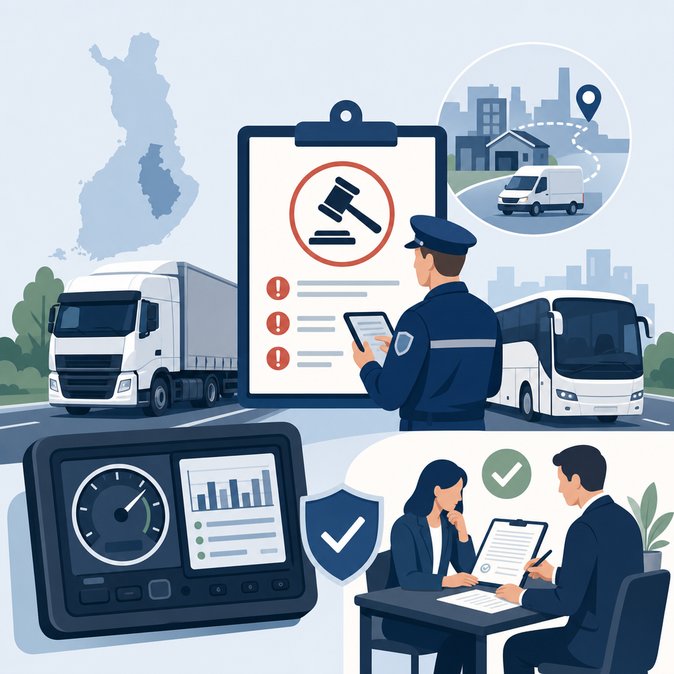
Finland’s Transport and Communications Agency (Traficom) has rolled out a major tightening of cabotage rules—domestic haulage or passenger trips performed by a foreign-registered vehicle—effective 15 May 2026. Although the underlying framework derives from EU Regulation 2020/1055, Helsinki’s implementing decree raises the compliance bar far above the continental minimums. The headline change is a hefty EUR 6,000 administrative fine for any trucking or coach company found in breach, with an extra EUR 3,000 on goods runs if the required driver attestation is missing. Enforcement teams will mine second-generation smart-tachograph (G2V2) data and consignment records in real time, while international coach operators must present fully completed EU journey forms from the first Finnish stop onward.
![Finland overhauls cabotage enforcement: new fines and digital monitoring start 15 May]()
Companies dispatching foreign drivers, on-site mechanics, or tour coordinators into Finland may also need to sort out entry permits swiftly. VisaHQ’s dedicated Finland portal (https://www.visahq.com/finland/) simplifies visa checks and applications, providing digital filing and expert review so teams can stay focused on meeting Traficom’s tougher cabotage controls.
Operational limits remain familiar—three domestic goods moves within seven days after an international drop-off, or a single job within three days if entering empty—but officers will now trigger a mandatory four-day ‘cool-off’ period during which the vehicle may not accept further Finnish loads. For passenger services, the ceiling is seven consecutive cabotage days in any 30-day period. Mobility programmes that rely on foreign charter buses for group moves, factory transfers or project work must therefore audit suppliers urgently. Failure to update service contracts with the new penalty clauses could expose corporate clients to cascading costs or schedule failures if a coach is impounded. Logistics managers should also confirm that driver smart-cards are upgraded to G2V2 and that back-office staff can transmit consignment data on request. Traficom says the stricter regime is designed to shield Finnish labour standards and level the playing field against so-called ‘letterbox’ companies. With spot checks already increasing on E18 and E75 corridors, global employers moving goods or personnel inside Finland should expect more roadside inspections and plan for potential clearance delays.

Companies dispatching foreign drivers, on-site mechanics, or tour coordinators into Finland may also need to sort out entry permits swiftly. VisaHQ’s dedicated Finland portal (https://www.visahq.com/finland/) simplifies visa checks and applications, providing digital filing and expert review so teams can stay focused on meeting Traficom’s tougher cabotage controls.
Operational limits remain familiar—three domestic goods moves within seven days after an international drop-off, or a single job within three days if entering empty—but officers will now trigger a mandatory four-day ‘cool-off’ period during which the vehicle may not accept further Finnish loads. For passenger services, the ceiling is seven consecutive cabotage days in any 30-day period. Mobility programmes that rely on foreign charter buses for group moves, factory transfers or project work must therefore audit suppliers urgently. Failure to update service contracts with the new penalty clauses could expose corporate clients to cascading costs or schedule failures if a coach is impounded. Logistics managers should also confirm that driver smart-cards are upgraded to G2V2 and that back-office staff can transmit consignment data on request. Traficom says the stricter regime is designed to shield Finnish labour standards and level the playing field against so-called ‘letterbox’ companies. With spot checks already increasing on E18 and E75 corridors, global employers moving goods or personnel inside Finland should expect more roadside inspections and plan for potential clearance delays.