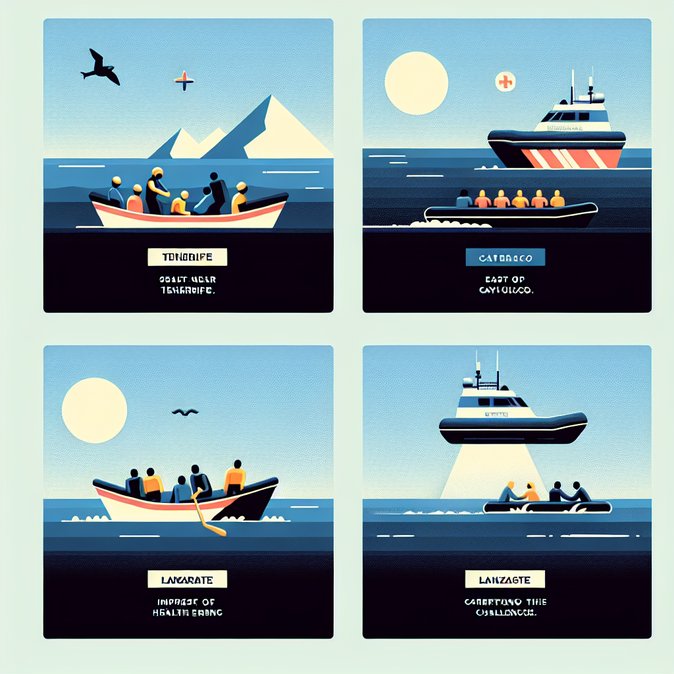
Spanish search-and-rescue agency Salvamento Marítimo conducted two separate operations on Sunday 10 May 2026 that saved the lives of more than 150 people attempting the perilous Atlantic crossing to the Canary Islands. The first call arrived at 10:25 h (Canary time) when the merchant vessel Bentayga spotted a heavily-overloaded cayuco drifting 3.7 kilometres off Las Galletas, south Tenerife. Rescue craft Alpheratz and Menkalinan escorted the wooden boat—carrying more than 100 migrants, including women and minors believed to have departed Gambia a week earlier—into Los Cristianos harbour, where Red Cross and Policía Nacional teams provided first aid and initiated identification and asylum procedures. Barely two hours later, the Airbus-C295 surveillance aircraft Sasemar 103 located a semi-submerged Zodiac with 55 occupants east of Lanzarote. The fast-response boat Al Nair reached the scene shortly after 14:00 h, transferring all passengers—reportedly in stable condition—to Arrecife port for medical triage. Maritime officials noted that one of the craft’s flotation tubes had deflated and that none of the migrants wore life-jackets, illustrating the journey’s lethal risks. The rescues occurred during an already high-pressure weekend for Canary emergency services, which were simultaneously managing the quarantined cruise ship MV Hondius. Authorities praised the “textbook coordination” between coast-guard units, port police and ambulance services that allowed both crises to be handled without resource conflicts.
![Spain’s Salvamento Marítimo rescues over 150 migrants from two vessels off Canary Islands]()
Amid such surges in maritime arrivals, travellers and businesses with legitimate plans to enter Spain can simplify their own paperwork through VisaHQ. The platform guides users through up-to-date Schengen and national-visa requirements, schedules consular appointments and provides real-time application tracking—services that are especially useful when local offices face backlogs. Full details are available at https://www.visahq.com/spain/
For global-mobility and corporate-compliance teams, the spike in arrivals has practical consequences: processing centres in Tenerife and Lanzarote are nearing capacity, which can delay appointments for residence renewals and work-permit modifications. Companies relocating talent to the archipelago should anticipate longer lead times for NIE issuance and be prepared for ad-hoc security checks as Frontex reinforces maritime surveillance in the region.

Amid such surges in maritime arrivals, travellers and businesses with legitimate plans to enter Spain can simplify their own paperwork through VisaHQ. The platform guides users through up-to-date Schengen and national-visa requirements, schedules consular appointments and provides real-time application tracking—services that are especially useful when local offices face backlogs. Full details are available at https://www.visahq.com/spain/
For global-mobility and corporate-compliance teams, the spike in arrivals has practical consequences: processing centres in Tenerife and Lanzarote are nearing capacity, which can delay appointments for residence renewals and work-permit modifications. Companies relocating talent to the archipelago should anticipate longer lead times for NIE issuance and be prepared for ad-hoc security checks as Frontex reinforces maritime surveillance in the region.
More From Spain
View all
Spain mounts unprecedented air-sea operation to evacuate hantavirus-hit cruise ship MV Hondius in Tenerife

Balearic President Calls for Stronger EU Support to Secure Island Borders Amid Migrant Arrivals