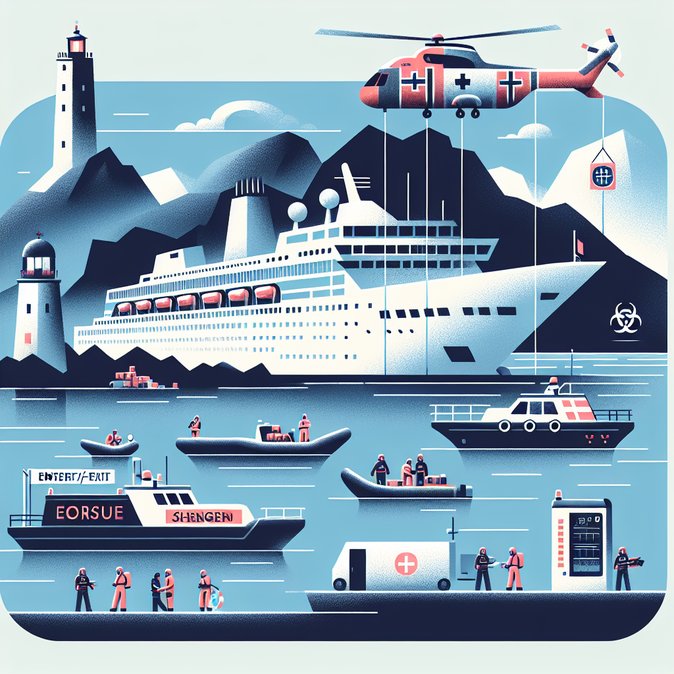
Spanish authorities completed one of the most complex public-health and border-control missions in recent memory on Sunday 10 May 2026, when the expedition cruise vessel MV Hondius anchored off the commercial port of Granadilla de Abona (Tenerife) after a fortnight sailing under quarantine because of a confirmed outbreak of Andes-variant hantavirus onboard. The Ministries of Health, Interior and Transport activated a joint civil-military plan that involved the Guardia Civil’s maritime service, the Spanish Navy, the Unidad Militar de Emergencias (UME), airport operator AENA and ground handlers at Tenerife South Airport, located ten kilometres from the pier. Passengers—147 people of 23 nationalities—were medically screened on the ship, then ferried in groups of fewer than ten by rigid inflatables to a sterile corridor on the quay. From there, dedicated “bubble” coaches transferred them directly to charter aircraft for repatriation or, in the case of the fourteen Spanish nationals, to Madrid’s Hospital Gómez Ulla for 42 days of observation. Madrid requested assistance through the EU Civil Protection Mechanism; within hours, a Norwegian “rescue EU” air-ambulance arrived, together with an EU liaison officer who coordinated offers of evacuation flights from France, Germany and the United Kingdom. World Health Organization Director-General Tedros Adhanom Ghebreyesus flew to Tenerife on Saturday evening to inspect the command post and reassure residents that the risk to the wider population was “very low”.
![Spain mounts unprecedented air-sea operation to evacuate hantavirus-hit cruise ship MV Hondius in Tenerife]()
At a practical level, individual travellers and corporate mobility departments can keep ahead of these fast-changing Spanish entry rules by using VisaHQ’s dedicated Spain page (https://www.visahq.com/spain/), where real-time visa, ETIAS and health-declaration requirements are updated and applications can be completed online.
Although Spain has decades of experience handling maritime medical emergencies—most recently during the COVID-19 pandemic—officials described the Hondius case as the first to combine an airborne zoonotic pathogen with multi-country evacuations and biometric border procedures introduced under the new Schengen Entry/Exit System (EES). Immigration police used mobile EES terminals on the quay to register the departing foreigners, averting potential fines airlines face for boarding passengers without exit records. For corporate travel and global mobility managers, the episode underscores the need for robust crisis plans that integrate health protocols, immigration formalities and employee-tracking tools. Cruise lines and tour operators will likely face tighter health-declaration requirements when calling at Spanish ports, and Canary Islands authorities have already announced drills to test the interface between public-health containment and the EES during the upcoming high-season arrival of trans-Atlantic repositioning cruises.

At a practical level, individual travellers and corporate mobility departments can keep ahead of these fast-changing Spanish entry rules by using VisaHQ’s dedicated Spain page (https://www.visahq.com/spain/), where real-time visa, ETIAS and health-declaration requirements are updated and applications can be completed online.
Although Spain has decades of experience handling maritime medical emergencies—most recently during the COVID-19 pandemic—officials described the Hondius case as the first to combine an airborne zoonotic pathogen with multi-country evacuations and biometric border procedures introduced under the new Schengen Entry/Exit System (EES). Immigration police used mobile EES terminals on the quay to register the departing foreigners, averting potential fines airlines face for boarding passengers without exit records. For corporate travel and global mobility managers, the episode underscores the need for robust crisis plans that integrate health protocols, immigration formalities and employee-tracking tools. Cruise lines and tour operators will likely face tighter health-declaration requirements when calling at Spanish ports, and Canary Islands authorities have already announced drills to test the interface between public-health containment and the EES during the upcoming high-season arrival of trans-Atlantic repositioning cruises.