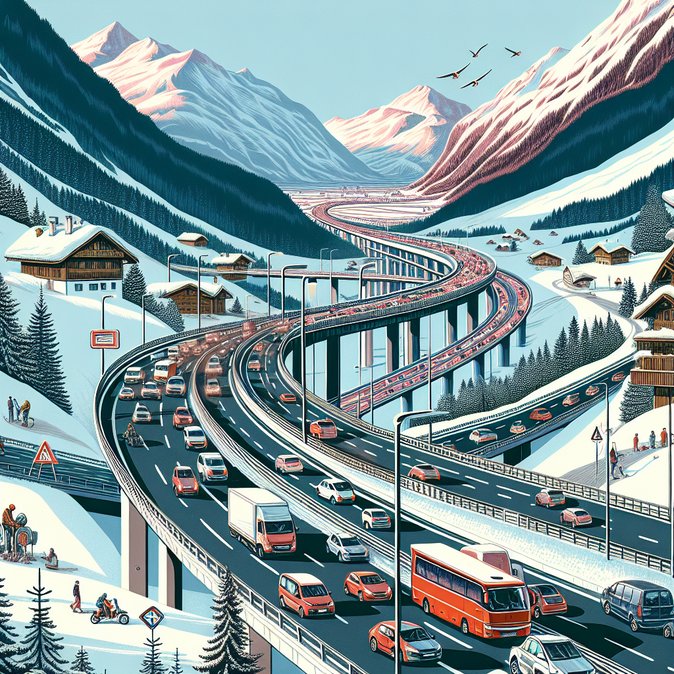
From 7 May 2026 the Province of Salzburg is re-activating its “Abfahrtssperren” (motorway exit bans) on key junctions of the A10 Tauern Autobahn between Puch-Urstein and Zederhaus. The measure, announced by the motoring association ÖAMTC and confirmed by the provincial traffic authority, prevents foreign transit vehicles—primarily cars with non-Austrian plates—from leaving the motorway to shortcut through local villages during peak travel weekends. The restrictions will be in force every Friday 15:00–19:00, Saturday 07:00–15:00 and Sunday 10:00–20:00 until 8 September. Police checkpoints at slip roads check registration documents; only motorists whose destination is inside Austria (e.g., hotels, business appointments or relatives) are allowed to exit.
![Salzburg introduces summer exit bans on Tauern Autobahn to keep transit traffic on A10]()
For international drivers wondering whether their paperwork is sufficient, VisaHQ can help take the guesswork out of Austrian entry requirements. Through its Austria portal (https://www.visahq.com/austria/), the service offers up-to-date guidance on Schengen visas, transit rules and digital registration forms, so travelers arrive at checkpoints with every document ready—minimizing delays and avoiding fines.
Heavy-goods vehicles are unaffected because they are already subject to separate weekend driving bans. Local mayors argue the policy is essential to protect residents from noise, pollution and gridlock created when holidaymakers bound from Germany to Croatia divert onto minor roads. Last summer, traffic volumes in some Alpine valleys rose by 60 percent on peak Saturdays, choking emergency-service access and hindering cross-border supply routes. For corporate mobility managers the key message is clear: keep rental cars and project vehicles on the A10, even if navigation apps suggest alternative routes. Fines for illegal exits start at €150; repeat offenders risk the vehicle being impounded. Logistics planners moving time-critical goods via the Tauern corridor should schedule night-time or mid-week slots, or consider rail options such as the Rolling Highway service between Wörgl and Trento. The exit-ban regime, first trialled in 2019, has survived several legal challenges and is endorsed by the Federal Transport Ministry as a proportionate response to transit congestion, provided signs are clearly visible in German, English and Italian. Salzburg will evaluate traffic data weekly and may relax restrictions on rain-soaked weekends, when traffic is lighter.
For international drivers wondering whether their paperwork is sufficient, VisaHQ can help take the guesswork out of Austrian entry requirements. Through its Austria portal (https://www.visahq.com/austria/), the service offers up-to-date guidance on Schengen visas, transit rules and digital registration forms, so travelers arrive at checkpoints with every document ready—minimizing delays and avoiding fines.
Heavy-goods vehicles are unaffected because they are already subject to separate weekend driving bans. Local mayors argue the policy is essential to protect residents from noise, pollution and gridlock created when holidaymakers bound from Germany to Croatia divert onto minor roads. Last summer, traffic volumes in some Alpine valleys rose by 60 percent on peak Saturdays, choking emergency-service access and hindering cross-border supply routes. For corporate mobility managers the key message is clear: keep rental cars and project vehicles on the A10, even if navigation apps suggest alternative routes. Fines for illegal exits start at €150; repeat offenders risk the vehicle being impounded. Logistics planners moving time-critical goods via the Tauern corridor should schedule night-time or mid-week slots, or consider rail options such as the Rolling Highway service between Wörgl and Trento. The exit-ban regime, first trialled in 2019, has survived several legal challenges and is endorsed by the Federal Transport Ministry as a proportionate response to transit congestion, provided signs are clearly visible in German, English and Italian. Salzburg will evaluate traffic data weekly and may relax restrictions on rain-soaked weekends, when traffic is lighter.