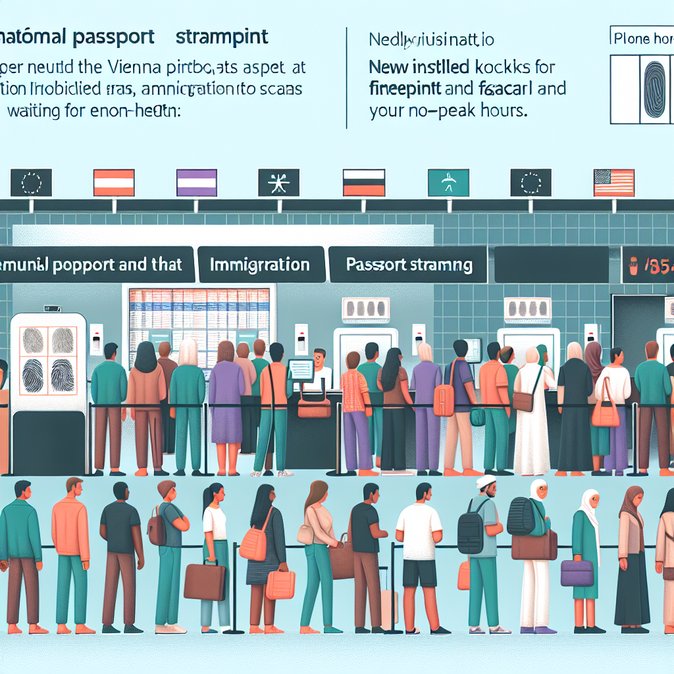
During Foreign-Minister-level talks in Astana on 5 May, Austria and Kazakhstan agreed to implement a suite of mobility measures aimed at boosting two-way trade and investment. Chief among them is a reciprocal visa-facilitation arrangement that exempts holders of diplomatic passports from short-stay visa requirements and sets out a fast-track channel for business travellers. In parallel, Vienna will donate 25 state-of-the-art passport-reader terminals to Astana International Airport, allowing Kazakh border guards to process Austrian and other EU passengers faster and to integrate with the EU’s Entry/Exit System database. The move comes as Austrian manufacturers look eastwards for critical minerals and as Kazakhstan courts European capital for its logistics projects along the so-called Middle Corridor. By smoothing entry rules and modernising border infrastructure, both sides hope to push annual bilateral trade beyond the current €1 billion mark. Austrian heavy-equipment firms such as Andritz and voestalpine, which already maintain regional sales offices in Almaty, are expected to be early beneficiaries, gaining quicker access for engineering teams dispatched on installation and maintenance contracts. For mobility managers the agreement reduces lead times. Previously, Austrian assignees often waited up to ten working days for a Kazakh single-entry business visa; under the new system, a multiple-entry permit can be issued in three, and diplomatic-passport holders travel visa-free for up to 90 days per half-year.
![Kazakhstan and Austria Seal Visa Facilitation Deal and Airport Security Upgrade]()
For travellers who would rather outsource the paperwork entirely, VisaHQ can streamline the process. The company consolidates the latest Austrian and Kazakh consular updates, pre-screens application packets, and offers door-to-door courier or electronic filing services—whether you hold an ordinary, business or diplomatic passport. You can explore their Austria-specific offerings at https://www.visahq.com/austria/
Companies should update their global-mobility policies to reflect the simplified documentation and incorporate the new e-gate functionality at Astana, which is slated to go live before the end of June. Strategically, the partnership underscores Austria’s support for the EU’s Global Gateway initiative, which prioritises connectivity with Central Asia as an alternative to Russian transit routes. Analysts note that providing technology rather than direct aid allows Austria to showcase its security-tech sector while advancing broader geopolitical goals of diversifying supply chains away from sanctioned territories. Travellers should note that tourist visas for ordinary passport holders remain unchanged for now, and biometric data may still be collected manually at secondary Kazakh airports. Nevertheless, the headline message is clear: Austria-Kazakhstan travel just became markedly easier for government and corporate stakeholders.

For travellers who would rather outsource the paperwork entirely, VisaHQ can streamline the process. The company consolidates the latest Austrian and Kazakh consular updates, pre-screens application packets, and offers door-to-door courier or electronic filing services—whether you hold an ordinary, business or diplomatic passport. You can explore their Austria-specific offerings at https://www.visahq.com/austria/
Companies should update their global-mobility policies to reflect the simplified documentation and incorporate the new e-gate functionality at Astana, which is slated to go live before the end of June. Strategically, the partnership underscores Austria’s support for the EU’s Global Gateway initiative, which prioritises connectivity with Central Asia as an alternative to Russian transit routes. Analysts note that providing technology rather than direct aid allows Austria to showcase its security-tech sector while advancing broader geopolitical goals of diversifying supply chains away from sanctioned territories. Travellers should note that tourist visas for ordinary passport holders remain unchanged for now, and biometric data may still be collected manually at secondary Kazakh airports. Nevertheless, the headline message is clear: Austria-Kazakhstan travel just became markedly easier for government and corporate stakeholders.