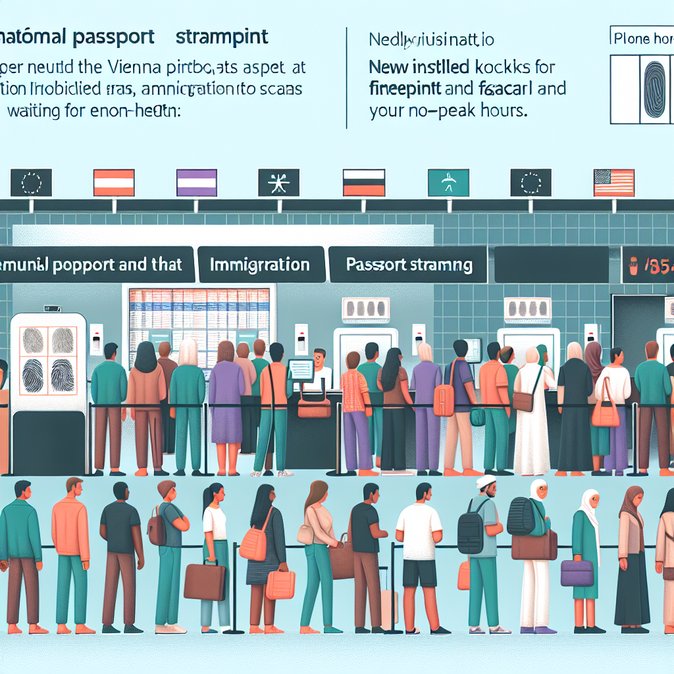
Late on 4 May the European Commission quietly authorised all Schengen members, including Austria, to pause mandatory fingerprint and facial scans under the new Entry/Exit System (EES) during peak travel surges. The emergency “flex mode” is designed to prevent the hours-long queues that have plagued airports since the system became fully operational on 10 April. For Vienna International Airport, where daily non-EU passenger volumes have climbed to 18,000 ahead of the Eurovision influx, the waiver is a lifeline. Border-police unions had warned that limited biometric kiosks could double processing times during the evening bank of long-haul arrivals. Under the new guidance, officers may revert to manual passport stamping for predefined waves of passengers—typically the 06:00–09:00 and 18:00–21:00 peaks—while still transmitting Advance Passenger Information to the central EES database. The reprieve is temporary and will be reviewed weekly in Brussels. Travellers should still expect full biometric enrolment if arriving outside the exempt windows or if flagged for secondary screening. Mobility managers are advised to:
• Notify non-EU assignees to build extra time into tight connections;
• Check airline departure banks, as carriers remain liable for passengers who overstay 90/180-day limits now monitored digitally;
• Ensure that employees’ first EES registration takes place on an inbound leg with sufficient buffer time.
![EU Allows Temporary Suspension of EES Biometrics—Relief in Sight for Vienna Airport]()
For travelers seeking extra certainty amid these shifting procedures, VisaHQ can secure the necessary visas and keep you informed of Austria’s evolving border rules—EES flex-mode included—through its real-time advisory platform. Corporate mobility teams and individual passengers can start the process in minutes at https://www.visahq.com/austria/
Austria’s Interior Ministry welcomed the flexibility but stressed that the country remains committed to biometric border management. Officials confirmed that Vienna-Schwechat and Salzburg airports will continue installing additional self-service kiosks, with full capacity targeted by mid-July—coinciding with Austria’s main holiday exodus. Industry bodies ACI Europe and Airlines for Europe have urged Brussels to extend the derogation through the end of the summer, warning that a snap return to full biometrics could cause “chaos.” For now, Austrian holiday-makers and visiting executives may find the border experience smoother—but only if they hit the right time-slot.
• Notify non-EU assignees to build extra time into tight connections;
• Check airline departure banks, as carriers remain liable for passengers who overstay 90/180-day limits now monitored digitally;
• Ensure that employees’ first EES registration takes place on an inbound leg with sufficient buffer time.

For travelers seeking extra certainty amid these shifting procedures, VisaHQ can secure the necessary visas and keep you informed of Austria’s evolving border rules—EES flex-mode included—through its real-time advisory platform. Corporate mobility teams and individual passengers can start the process in minutes at https://www.visahq.com/austria/
Austria’s Interior Ministry welcomed the flexibility but stressed that the country remains committed to biometric border management. Officials confirmed that Vienna-Schwechat and Salzburg airports will continue installing additional self-service kiosks, with full capacity targeted by mid-July—coinciding with Austria’s main holiday exodus. Industry bodies ACI Europe and Airlines for Europe have urged Brussels to extend the derogation through the end of the summer, warning that a snap return to full biometrics could cause “chaos.” For now, Austrian holiday-makers and visiting executives may find the border experience smoother—but only if they hit the right time-slot.