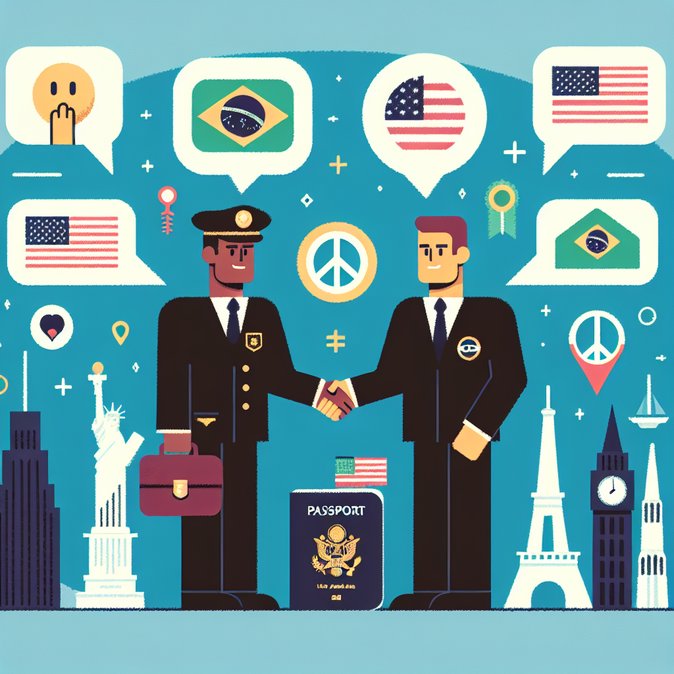
President Luiz Inácio Lula da Silva departed Brasília on 6 May for Washington, bringing with him Federal Police director-general Andrei Rodrigues and four cabinet ministers for talks with U.S. President Donald Trump. The unusual inclusion of Brazil’s top law-enforcement official follows a tit-for-tat expulsion of liaison officers after U.S. Immigration and Customs Enforcement removed Brazilian attaché Marcelo Ivo and Brasília withdrew the credentials of U.S. agent Michael Myers. The episode has heightened tensions over Brazil’s decision last year to re-impose visitor-visa requirements on U.S., Canadian and Australian nationals, reversing a 2019 waiver.
![Lula adds federal-police chief to U.S. mission amid escalating visa-reciprocity row]()
For travelers and corporate mobility teams suddenly facing new paperwork, VisaHQ can streamline the process by offering real-time visa guidance, appointment scheduling and document concierge services through its Brazil portal (https://www.visahq.com/brazil/), helping companies avoid costly delays while the two governments hash out a long-term solution.
Sources in both capitals link the expulsions to the stalled negotiations on restoring reciprocal visa-free access. Corporate travel managers report A-2 and B-1 visa interview slots stretching to 60 days and more intrusive secondary screening for Brazilian executives landing at U.S. airports. During the two-day visit the Brazilian delegation will also seek cooperation on organised-crime investigations and rare-earth supply chains, areas directly overseen by the accompanying justice and industry ministers. Observers note that placing the PF chief at the table signals Lula’s intent to couple security concessions with progress on visa facilitation. If the talks unlock a roadmap toward mutual visa easing, companies on both sides could see faster project-deployment cycles and lower compliance costs. Conversely, failure could entrench the go-slow that is already prompting some multinationals to reroute meetings through third-country hubs such as Panama City and Bogotá.
For travelers and corporate mobility teams suddenly facing new paperwork, VisaHQ can streamline the process by offering real-time visa guidance, appointment scheduling and document concierge services through its Brazil portal (https://www.visahq.com/brazil/), helping companies avoid costly delays while the two governments hash out a long-term solution.
Sources in both capitals link the expulsions to the stalled negotiations on restoring reciprocal visa-free access. Corporate travel managers report A-2 and B-1 visa interview slots stretching to 60 days and more intrusive secondary screening for Brazilian executives landing at U.S. airports. During the two-day visit the Brazilian delegation will also seek cooperation on organised-crime investigations and rare-earth supply chains, areas directly overseen by the accompanying justice and industry ministers. Observers note that placing the PF chief at the table signals Lula’s intent to couple security concessions with progress on visa facilitation. If the talks unlock a roadmap toward mutual visa easing, companies on both sides could see faster project-deployment cycles and lower compliance costs. Conversely, failure could entrench the go-slow that is already prompting some multinationals to reroute meetings through third-country hubs such as Panama City and Bogotá.