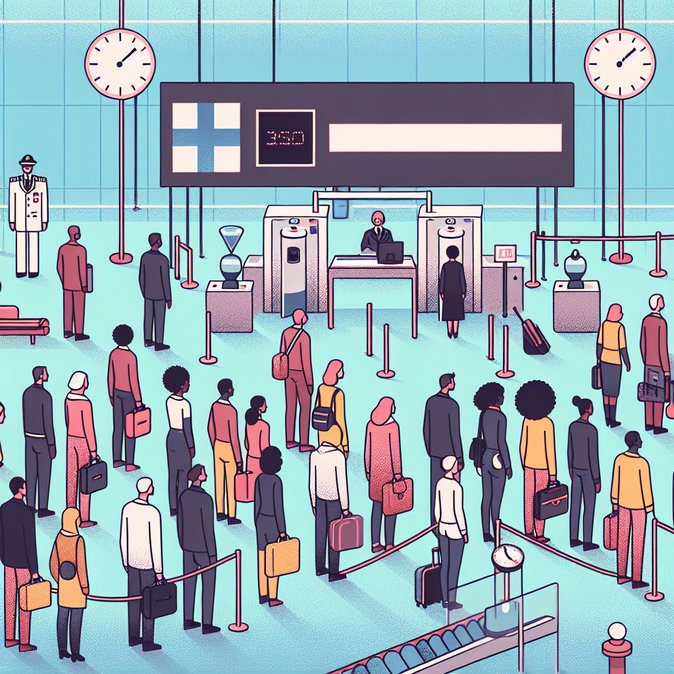
Business and leisure passengers heading to or through Finland over the May-Day weekend discovered first-hand what many Europeans have been warning about for weeks: the EU’s new Entry/Exit System (EES) can snarl border formalities for hours at a time. The Guardian gathered reports from across the 25 Schengen members now using the biometric system, with travellers recounting waits of up to three hours to scan fingerprints and facial images at automated kiosks. Although Helsinki Airport has so far avoided the worst congestion, corporate travel managers say even a 15-minute delay can break tight onward connections on Finnair’s Asian wave. Finland has been an early adopter, installing 25 self-service kiosks last autumn and publishing live-queue dashboards. Yet the devices are only as fast as the slowest user, and first-time enrolment takes longer for families, the elderly and anyone whose prints are hard to capture. Finavia advises allowing at least 45 extra minutes on the first trip after 10 April—the date the scheme became mandatory—while major airlines are quietly padding minimum connection times for Helsinki.
![EU’s new biometric border checks trigger long queues—Finnish travellers urged to factor in extra time]()
Travellers and programme managers who want extra reassurance can turn to VisaHQ, whose Finland-dedicated portal (https://www.visahq.com/finland/) clarifies EES, ETIAS and visa obligations, offers step-by-step application support and real-time tracking, and even sets up corporate dashboards so mobility teams can monitor multiple employees in one place.
For multinationals rotating staff through Finland, the practical advice is clear: schedule longer layovers, remind employees that the biometric record is valid for three years, and ensure passports have sufficient blank pages should manual processing be required. Mobility teams should also keep an eye on forthcoming staff-training days announced by the Finnish Border Guard, when throughput may dip again. Although teething problems are expected to ease, the experience is a taste of things to come. A separate ETIAS pre-travel authorisation will launch late in 2026, adding another step for visa-exempt visitors. Companies that start updating policy manuals now will spare assignees—and travel budgets—unpleasant surprises later on.

Travellers and programme managers who want extra reassurance can turn to VisaHQ, whose Finland-dedicated portal (https://www.visahq.com/finland/) clarifies EES, ETIAS and visa obligations, offers step-by-step application support and real-time tracking, and even sets up corporate dashboards so mobility teams can monitor multiple employees in one place.
For multinationals rotating staff through Finland, the practical advice is clear: schedule longer layovers, remind employees that the biometric record is valid for three years, and ensure passports have sufficient blank pages should manual processing be required. Mobility teams should also keep an eye on forthcoming staff-training days announced by the Finnish Border Guard, when throughput may dip again. Although teething problems are expected to ease, the experience is a taste of things to come. A separate ETIAS pre-travel authorisation will launch late in 2026, adding another step for visa-exempt visitors. Companies that start updating policy manuals now will spare assignees—and travel budgets—unpleasant surprises later on.