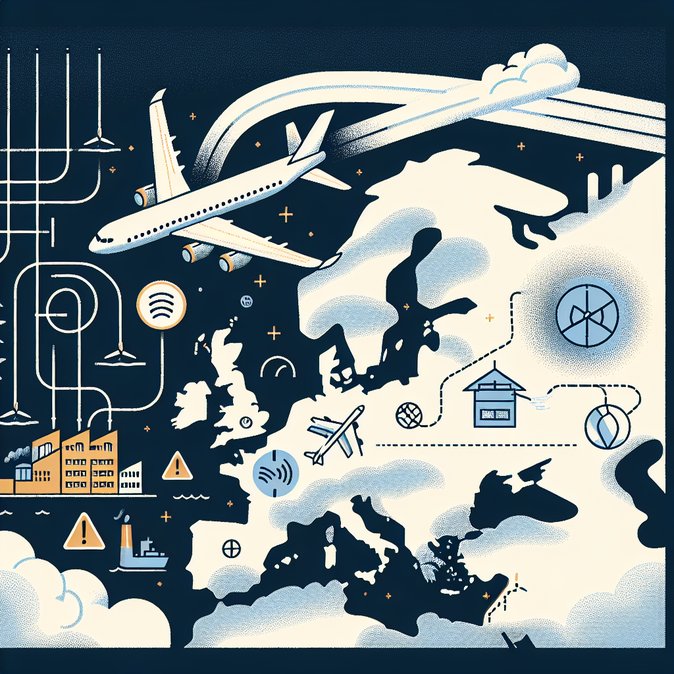
Fintraffic, the state-owned traffic-management company, reports that the temporary closure of St. Petersburg’s air-space is already reshaping flight patterns over Finland. According to statistics released on 27 April, international flights that would normally pass north of Russia’s second-largest city are now being vectored into Finnish—and, to a lesser extent, Estonian—airspace. The rerouting is producing a “slight but measurable” uptick in overflights handled by Finnish air-traffic controllers. Airline schedules show that wide-body services from the Gulf, South-East Asia and the Caucasus are making the detour on both westbound and eastbound legs. While the diversion adds five to fifteen minutes of flying time on typical long-haul routes, Helsinki’s en-route charges remain lower than those of most central-European countries. That financial calculus, coupled with Finland’s modernised radar and data-link infrastructure, has made the country an attractive corridor during previous Russian air-space disruptions—most notably after the 2022 invasion of Ukraine and the 2023 drone incidents around Leningrad Oblast. Airlines such as Emirates, Turkish Airlines and Qatar Airways have historically ramped up frequencies through Finnish skies when neighbouring airways closed.
![St. Petersburg air-space closures push more overflights into Finnish skies]()
For international visitors suddenly finding themselves with an unplanned stop in Helsinki—or those keen to turn a layover into a short business visit—VisaHQ can streamline the visa process. The company’s Finland portal (https://www.visahq.com/finland/) offers up-to-date guidance on Schengen entry requirements, online application tools and expedited services, ensuring travellers have the right documentation well before departure.
For business travellers the change has two immediate implications. First, passengers transiting Helsinki or other Nordic hubs may experience improved on-time performance, because the extra distance is absorbed in cruise rather than in congested central-European sectors. Second, forward-looking corporates should review their carbon-reporting baselines: although the detour is short, the cumulative fuel burn across hundreds of flights magnifies Scope 3 emissions. Fintraffic stresses that its air-navigation service (ANS) has sufficient capacity to absorb the additional traffic. The agency is, however, redeploying contingency controllers to eastern radar stations and coordinating with Estonian ANS to balance sector loads. Municipalities under newly busy flight paths—particularly in South Karelia—have already raised noise-abatement concerns, and Fintraffic has opened a public consultation on night-time altitudes and track dispersion. Beyond aviation, Fintraffic’s quarterly bulletin paints a mixed picture for other modes. Road traffic volumes are flat year-on-year, with heavy-goods vehicle movements slipping 0.7 percent amid higher diesel prices, while commuter-rail ridership is up 0.9 percent. Digital mobility tools are booming: the Fintraffic app logged a record 1.4 million uses in January alone, underscoring Finland’s growing dependence on real-time travel data.

For international visitors suddenly finding themselves with an unplanned stop in Helsinki—or those keen to turn a layover into a short business visit—VisaHQ can streamline the visa process. The company’s Finland portal (https://www.visahq.com/finland/) offers up-to-date guidance on Schengen entry requirements, online application tools and expedited services, ensuring travellers have the right documentation well before departure.
For business travellers the change has two immediate implications. First, passengers transiting Helsinki or other Nordic hubs may experience improved on-time performance, because the extra distance is absorbed in cruise rather than in congested central-European sectors. Second, forward-looking corporates should review their carbon-reporting baselines: although the detour is short, the cumulative fuel burn across hundreds of flights magnifies Scope 3 emissions. Fintraffic stresses that its air-navigation service (ANS) has sufficient capacity to absorb the additional traffic. The agency is, however, redeploying contingency controllers to eastern radar stations and coordinating with Estonian ANS to balance sector loads. Municipalities under newly busy flight paths—particularly in South Karelia—have already raised noise-abatement concerns, and Fintraffic has opened a public consultation on night-time altitudes and track dispersion. Beyond aviation, Fintraffic’s quarterly bulletin paints a mixed picture for other modes. Road traffic volumes are flat year-on-year, with heavy-goods vehicle movements slipping 0.7 percent amid higher diesel prices, while commuter-rail ridership is up 0.9 percent. Digital mobility tools are booming: the Fintraffic app logged a record 1.4 million uses in January alone, underscoring Finland’s growing dependence on real-time travel data.