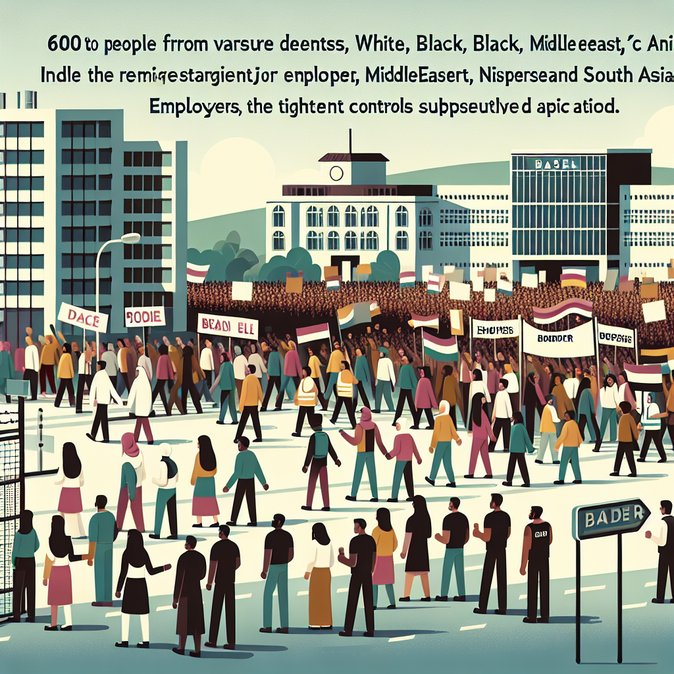
Roughly 600 activists from Switzerland, Germany and France converged on the Basel/Weil-am-Rhein border triangle on 22 April to protest the forthcoming overhaul of the EU’s Common European Asylum System (GEAS). Two processions—one starting in Basel, the other in Weil—snaked past the Bässlergut removal centre, where several detainees are on hunger strike, before meeting for a joint rally in the Rhinepark. Speakers from Swiss group Pikett Asyl, German network Aktion Bleiberecht and French NGO La Cimade warned that the GEAS package, due to enter force on 12 June 2026, will normalise detention-like border procedures and expand the list of “safe third countries,” effectively blocking many asylum claims. They also criticised Switzerland for endorsing tougher Dublin return rules despite not being an EU member.
![Basel–Weil Tri-National March Denounces EU GEAS Asylum Reforms]()
For travellers, companies and NGOs navigating this evolving regulatory landscape, expert visa and travel-document support can be invaluable. VisaHQ, for instance, provides up-to-date guidance on Swiss entry requirements, Schengen regulations and work permits, helping humanitarian staff or cross-border employees manage paperwork likely to be affected by the GEAS changes—more information is available at https://www.visahq.com/switzerland/
For mobility and relocation teams the reforms matter because they will tighten secondary-movement controls inside the Schengen Area. As soon as the new rules apply, asylum seekers transferred back to the first EU country of entry may be detained for up to two years—a factor that could complicate humanitarian secondments or corporate-sponsored talent-programmes for refugees. Companies operating across the Upper Rhine region should anticipate an uptick in identity checks at the normally open Basel–Weil and Basel–Saint-Louis crossings, as French and German authorities test drive their GEAS-compliant screening procedures. Cross-border commuters—particularly those holding non-EU passports—should carry proof of Swiss residence and employment to avoid delays. Swiss officials reiterate that Schengen open-border provisions remain intact, but acknowledge that “targeted, risk-based checks” are compatible with EU law. Activists, meanwhile, vow to keep the pressure on Bern and Brussels, planning additional demonstrations in Strasbourg and Konstanz ahead of the June rollout.

For travellers, companies and NGOs navigating this evolving regulatory landscape, expert visa and travel-document support can be invaluable. VisaHQ, for instance, provides up-to-date guidance on Swiss entry requirements, Schengen regulations and work permits, helping humanitarian staff or cross-border employees manage paperwork likely to be affected by the GEAS changes—more information is available at https://www.visahq.com/switzerland/
For mobility and relocation teams the reforms matter because they will tighten secondary-movement controls inside the Schengen Area. As soon as the new rules apply, asylum seekers transferred back to the first EU country of entry may be detained for up to two years—a factor that could complicate humanitarian secondments or corporate-sponsored talent-programmes for refugees. Companies operating across the Upper Rhine region should anticipate an uptick in identity checks at the normally open Basel–Weil and Basel–Saint-Louis crossings, as French and German authorities test drive their GEAS-compliant screening procedures. Cross-border commuters—particularly those holding non-EU passports—should carry proof of Swiss residence and employment to avoid delays. Swiss officials reiterate that Schengen open-border provisions remain intact, but acknowledge that “targeted, risk-based checks” are compatible with EU law. Activists, meanwhile, vow to keep the pressure on Bern and Brussels, planning additional demonstrations in Strasbourg and Konstanz ahead of the June rollout.