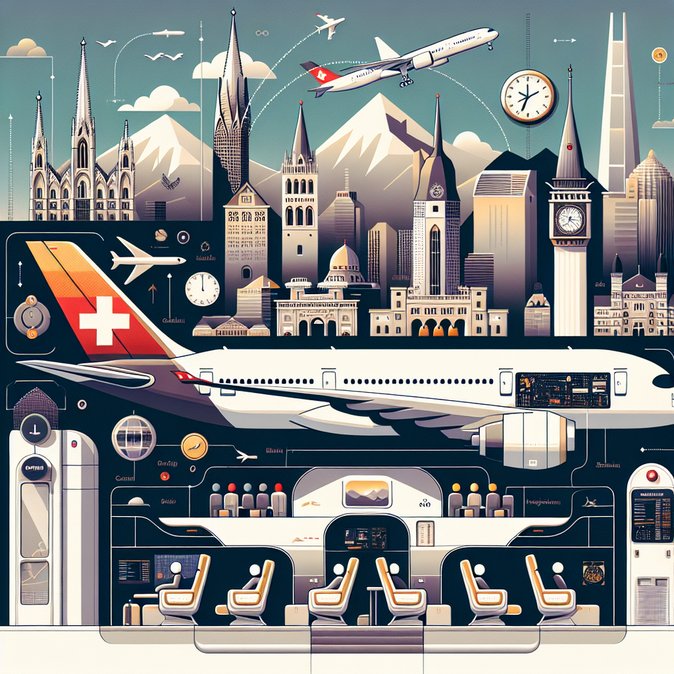
Swiss International Air Lines (SWISS) has chosen the South-Korean market to premiere “SWISS Senses”, a completely redesigned long-haul cabin concept that will gradually roll out across the flag-carrier’s network. At a media event in Seoul on 19 April 2026, Chief Commercial Officer Heike Birlenbach confirmed that the airline’s first Airbus A350—delivered in March—will enter scheduled service on the thrice-weekly Zurich–Seoul Incheon rotation from the start of the summer timetable. The new product is more than a seat refresh. Lighting schemes that adapt to circadian rhythms, tactile Swiss materials and a four-class layout (First, Business, Premium Economy and Economy) are designed to raise comfort while shortening perceived jet-lag on 11-hour trans-Eurasian sectors. First-class passengers can select between enclosed “Single Suite” and “Suite Plus” options, while business-class customers have five seat types, ranging from extra-long beds to private “business suites”.
![SWISS Unveils ‘Senses’ Premium Cabin and Deploys Airbus A350 on Seoul–Zurich Route]()
Whether you are a corporate road warrior testing out the new A350 cabin or an expatriate arranging a family visit, VisaHQ can simplify the paperwork that gets you on board. The platform’s step-by-step tools cover both Swiss Schengen and Korean visa requirements, offer real-time tracking, and can even courier completed passports back to your desk—saving mobility managers and travelers hours of administrative effort. Explore the options at https://www.visahq.com/switzerland/
From a global-mobility perspective, the investment signals that Switzerland intends to defend its position as an intercontinental hub despite regional geopolitical turbulence that has forced capacity cuts to parts of the Middle East. Korea is Switzerland’s sixth-largest Asian trading partner and an important source of pharmaceutical, precision-engineering and luxury-tourism traffic. Bilateral passenger numbers grew 14 % in 2025, according to Zurich Airport statistics, and corporates in both countries lobbied for additional premium-class availability after pandemic-era downsizing. Travel managers should note that the A350 introduces a unified power-USB-C charging standard and larger overhead bins, reducing the risk of hand-baggage gate checks that can delay premium travellers. SWISS also confirmed that Korea-originating passengers holding Schengen multiple-entry visas can continue to connect air-side in Zurich without document re-inspection—a significant time saver for onward business travel into Europe. The airline hinted that a fourth weekly frequency could follow once a second A350 arrives in early 2027. For expatriate assignments, the upgrade may ease talent-mobility programmes between Swiss multinationals and their Korean subsidiaries by offering more consistent premium-seat inventory and enhanced wellbeing features that shrink post-arrival recovery times. HR leaders planning 2027 mobility budgets should factor in a likely 5-to-8 % fare premium once the cabin is fully bedded-in and demand strengthens.
Whether you are a corporate road warrior testing out the new A350 cabin or an expatriate arranging a family visit, VisaHQ can simplify the paperwork that gets you on board. The platform’s step-by-step tools cover both Swiss Schengen and Korean visa requirements, offer real-time tracking, and can even courier completed passports back to your desk—saving mobility managers and travelers hours of administrative effort. Explore the options at https://www.visahq.com/switzerland/
From a global-mobility perspective, the investment signals that Switzerland intends to defend its position as an intercontinental hub despite regional geopolitical turbulence that has forced capacity cuts to parts of the Middle East. Korea is Switzerland’s sixth-largest Asian trading partner and an important source of pharmaceutical, precision-engineering and luxury-tourism traffic. Bilateral passenger numbers grew 14 % in 2025, according to Zurich Airport statistics, and corporates in both countries lobbied for additional premium-class availability after pandemic-era downsizing. Travel managers should note that the A350 introduces a unified power-USB-C charging standard and larger overhead bins, reducing the risk of hand-baggage gate checks that can delay premium travellers. SWISS also confirmed that Korea-originating passengers holding Schengen multiple-entry visas can continue to connect air-side in Zurich without document re-inspection—a significant time saver for onward business travel into Europe. The airline hinted that a fourth weekly frequency could follow once a second A350 arrives in early 2027. For expatriate assignments, the upgrade may ease talent-mobility programmes between Swiss multinationals and their Korean subsidiaries by offering more consistent premium-seat inventory and enhanced wellbeing features that shrink post-arrival recovery times. HR leaders planning 2027 mobility budgets should factor in a likely 5-to-8 % fare premium once the cabin is fully bedded-in and demand strengthens.
More From Switzerland
View all
Gotthard Tunnel Weekend Congestion Peaks at 6 km but Clears by Evening
Swiss and Baden-Württemberg leaders pledge deeper cross-border cooperation on mobility and skilled-labour flows