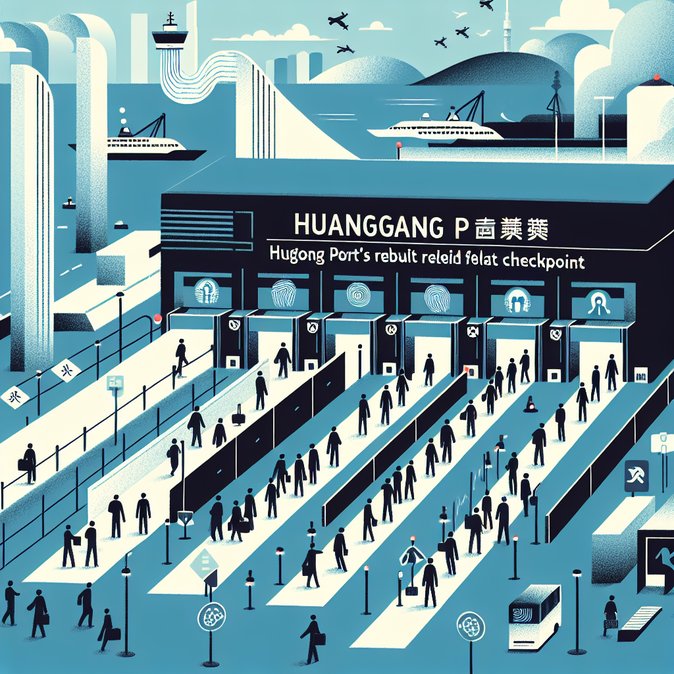
Business and leisure travellers who regularly shuttle between Hong Kong and Shenzhen are about to gain a huge productivity dividend. Hong Kong’s Security Bureau confirmed this week that the rebuilt Huanggang Port will adopt a fully integrated “collaborative inspection and joint-clearance” model that puts Hong Kong and mainland officers under one roof. Instead of queuing twice, passengers will walk through a single set of e-gates where documents, fingerprints and facial biometrics are captured once and shared instantly with both jurisdictions. The hardware is formidable: 134 automated e-channels and 68 manned counters, plus a special drive-through lane that scans a driver’s temperature, passport data, fingerprint and face while the vehicle is still moving. An optional contact-less path lets pre-registered travellers clear purely by face-scan—no physical passport required—cutting the average clearance time from 30 minutes to about five. Eligibility has been set broadly: Hong Kong ID-card holders from age 7, holders of Home Return Permits, foreign residents enrolled in the Mainland e-Channel programme, and PRC passport holders will all be able to use the fast lanes. The reform answers years of complaints that the Futian–Huanggang corridor acts as a bottleneck in the Greater Bay Area’s promised “one-hour living circle”. Daily cross-boundary commuter traffic already tops 600,000 movements, and peaks at more than a million during holidays; developers of Qianhai and Shenzhen’s tech campuses have long argued that cumbersome clearance was eroding the region’s competitiveness. For corporates the implications are immediate. Shenzhen offices can now be reached in roughly the same door-to-door time as Central-to-Kowloon commutes, making same-day client calls, inter-office meetings and talent rotation far easier. Logistics providers anticipate smoother cargo inspection once joint-clearance lanes for goods vehicles come online. The government’s target is to finish the new complex before the current administration ends in 2027, but sources say test runs of the e-gates will start later this year, giving cross-border businesses a head-start on staff registration and system integration. Companies with frequent Hong Kong–mainland traffic should begin identifying eligible staff and encouraging early biometric enrolment; once the system switches on, those travellers will have an immediate fast-track advantage that could shave hours off each week’s schedule.
![New ‘One-Stop’ Immigration Hall at Huanggang Port to Slash Hong Kong–Shenzhen Border Queues]()
If your team still needs to secure or renew China visas before taking advantage of Huanggang’s lightning-fast e-gates, VisaHQ can streamline the entire process. Its China specialists (https://www.visahq.com/china/) handle application reviews, appointment scheduling and document couriering, helping travellers obtain the correct permits quickly so they’re ready to walk straight through the new one-stop clearance lanes.

If your team still needs to secure or renew China visas before taking advantage of Huanggang’s lightning-fast e-gates, VisaHQ can streamline the entire process. Its China specialists (https://www.visahq.com/china/) handle application reviews, appointment scheduling and document couriering, helping travellers obtain the correct permits quickly so they’re ready to walk straight through the new one-stop clearance lanes.