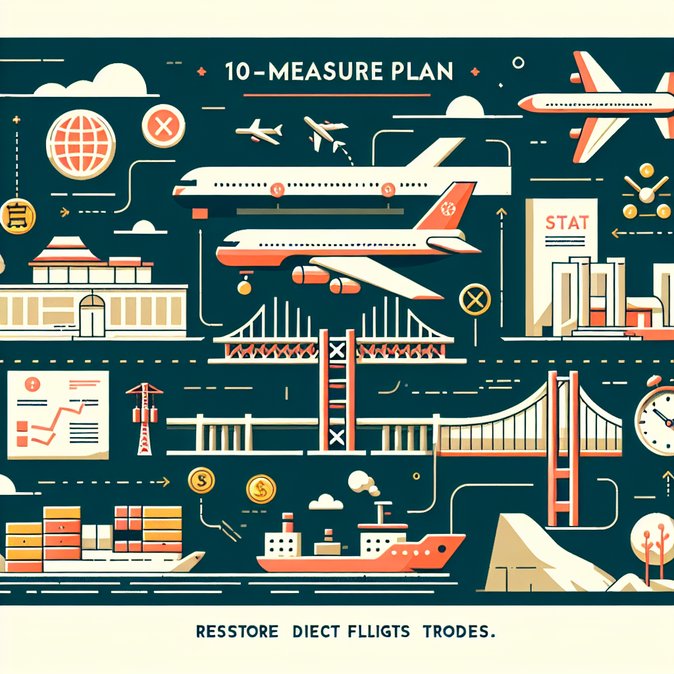
Beijing’s Taiwan Work Office surprised observers on 12 April by releasing a sweeping package of 10 measures aimed at making the Taiwan Strait easier to cross—for people, goods and data. The headline mobility element is a fast-track plan to “fully resume” regular direct flights between the mainland and Taiwan. Beyond perennial trunk routes such as Shanghai–Taipei, authorities explicitly name Urumqi, Xi’an, Harbin, Kunming and Lanzhou as cities slated to regain nonstop access to Taiwanese airports. For business-travel managers this would restore valuable point-to-point capacity that disappeared during the pandemic and never fully returned.
![Beijing unveils 10-point mobility package to reboot cross-Strait travel and trade]()
As airlines and travellers prepare for the resurgence of cross-Strait traffic, VisaHQ can streamline the paperwork needed for mainland China or Taiwan trips, guiding users through visa types, requirements and processing times in one intuitive portal (https://www.visahq.com/china/). Whether your executives are flying nonstop from Urumqi to Taoyuan or engineers are shuttling between Fujian factories and Taipei design centres, the service’s digital application tools and expert support help ensure everyone’s travel documents are ready long before boarding.
Combined with the reopening of individual tourist travel for residents of Shanghai and Fujian, airlines on both sides will be pressed to ramp up schedules ahead of the summer peak. Infrastructure pledges go further. Fujian’s coastal counties are instructed to “share water, electricity and gas” with Taiwan’s Kinmen and Matsu islands and to study building road-bridge links once conditions allow. If realised, such links would create the first permanent surface crossings of the Strait—potentially game-changing for freight forwarders and for Taiwanese SMEs that maintain factories in Fujian. Other clauses target friction in trade compliance: simplified quarantine channels for Taiwanese fish and farm products, new piers for Taiwan deep-sea fishing vessels, accelerated registration for food manufacturers, and micro-marketplaces where Taiwan’s small businesses can sell on the mainland with reduced paperwork. Cultural provisions let Taiwanese TV dramas and micro-videos secure mainland screening licences more easily, further boosting two-way creative-talent mobility. For global companies with supply-chain nodes on both sides of the Strait, the package signals official backing for deeper integration despite political tensions. The next milestone will be the joint CPC–KMT communication mechanism promised in the document, which—if institutionalised—should give businesses a predictable forum to flag mobility bottlenecks before they become crises.
As airlines and travellers prepare for the resurgence of cross-Strait traffic, VisaHQ can streamline the paperwork needed for mainland China or Taiwan trips, guiding users through visa types, requirements and processing times in one intuitive portal (https://www.visahq.com/china/). Whether your executives are flying nonstop from Urumqi to Taoyuan or engineers are shuttling between Fujian factories and Taipei design centres, the service’s digital application tools and expert support help ensure everyone’s travel documents are ready long before boarding.
Combined with the reopening of individual tourist travel for residents of Shanghai and Fujian, airlines on both sides will be pressed to ramp up schedules ahead of the summer peak. Infrastructure pledges go further. Fujian’s coastal counties are instructed to “share water, electricity and gas” with Taiwan’s Kinmen and Matsu islands and to study building road-bridge links once conditions allow. If realised, such links would create the first permanent surface crossings of the Strait—potentially game-changing for freight forwarders and for Taiwanese SMEs that maintain factories in Fujian. Other clauses target friction in trade compliance: simplified quarantine channels for Taiwanese fish and farm products, new piers for Taiwan deep-sea fishing vessels, accelerated registration for food manufacturers, and micro-marketplaces where Taiwan’s small businesses can sell on the mainland with reduced paperwork. Cultural provisions let Taiwanese TV dramas and micro-videos secure mainland screening licences more easily, further boosting two-way creative-talent mobility. For global companies with supply-chain nodes on both sides of the Strait, the package signals official backing for deeper integration despite political tensions. The next milestone will be the joint CPC–KMT communication mechanism promised in the document, which—if institutionalised—should give businesses a predictable forum to flag mobility bottlenecks before they become crises.