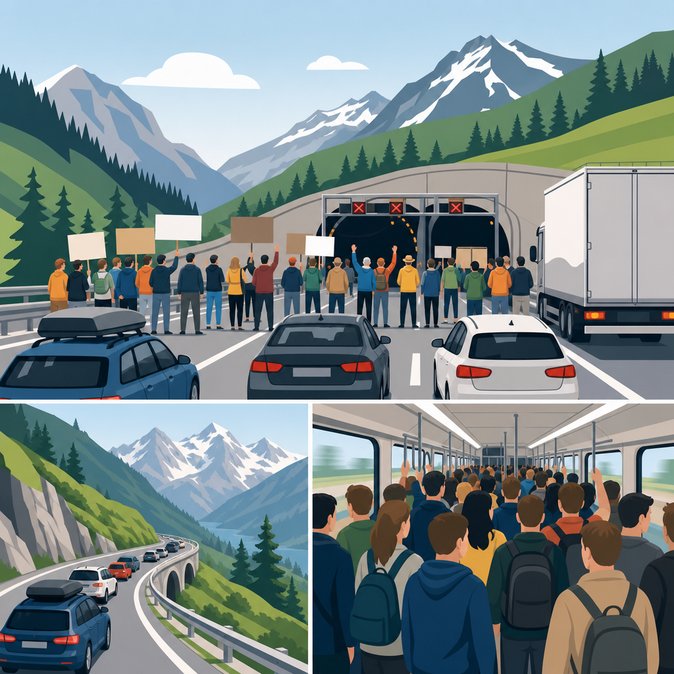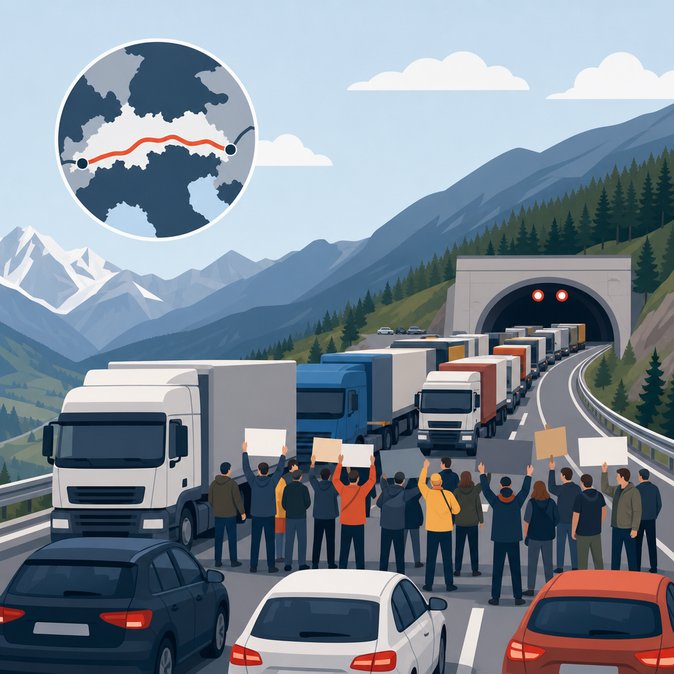
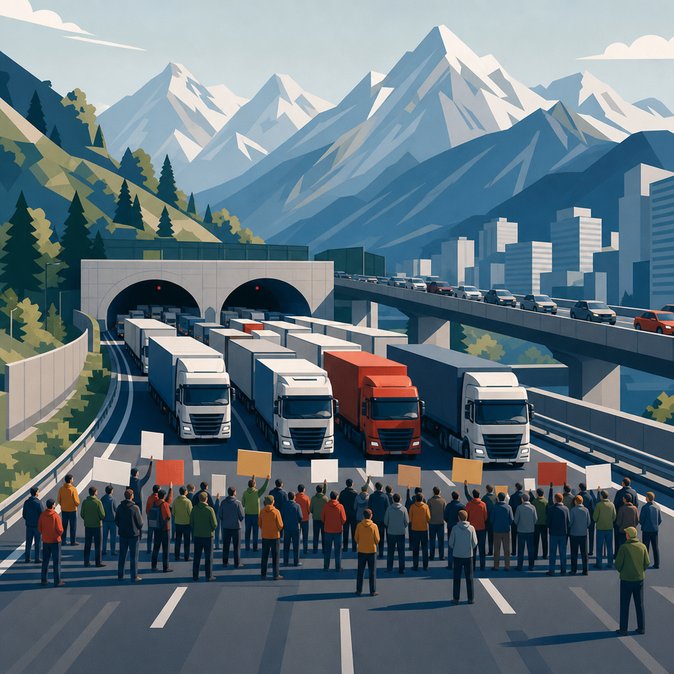
One of central Europe’s most heavily travelled freight and holiday corridors ground to a halt on Saturday, 30 May, when around 3 000 Austrian residents formed a human chain across the Brenner motorway (A 13) at the German-Italian frontier. Police closed both the motorway and the parallel Brennerstrasse (B 182) from 11:00 to 19:00, forcing passenger cars over the congestion-prone Fern Pass and sending lorries on 120-kilometre detours via the Tauern and Pyhrn routes. Although the protest took place on Austrian soil, the impact was felt immediately by German exporters and tour operators. The Brenner corridor is the principal road artery linking Bavaria with northern Italy; on a typical Saturday in late May it carries up to 7 000 trucks and 25 000 holidaymakers’ cars. Industry group BGL told reporters the closure left hundreds of German-plated trucks idling at service areas south of Munich, racking up an estimated €2 million an hour in driver overtime, missed delivery slots and penalty charges. German motorists had been warned. On 29 May the ADAC Südbayern automobile club issued an extraordinary ‘Stau-Alarm’, predicting “holiday-weekend gridlock” because the demonstration coincided with the Whitsun getaway and more than 1 000 road-works sites on German motorways. ADAC traffic expert Alexander Kreipl noted that re-routing all Brenner traffic to the Tauern Autobahn was “utopian”, as that alpine tunnel is already operating at its legal capacity.
For global mobility teams the incident is a reminder that land-border disruptions can be as costly as airport strikes.
![Protest Blocks Brenner Motorway, Disrupting Germany-Italy Road Corridor]()
If such sudden closures leave your travellers scrambling for updated documents or alternate routes, VisaHQ can help. Our dedicated Germany portal (https://www.visahq.com/germany/) lets drivers, tourists, and corporate mobility managers arrange visas and travel permits online, track applications in real time, and secure consular appointments without the usual red tape—keeping itineraries flexible when every hour of transit counts.
Companies moving time-critical cargo between Germany and Italy are advised to build in at least 24 hours’ buffer, diversify routings via Switzerland, and brief drivers about Tyrol’s 2026 weekend ‘Dosage Days’, when trucks are metered onto the Brenner at 300-vehicle intervals. Business travellers should expect spot checks at German and Italian motorway service areas in the coming days while police clear residual queues and look for vehicles that ignored diversion signs. Longer-term, the episode will add urgency to ongoing talks between Berlin, Rome and Vienna about shifting more transalpine freight to electric rail. The Brenner Base Tunnel—now delayed until 2030—cannot open soon enough for German logistics planners seeking a reliable, climate-friendly alternative to an alpine road that is increasingly shut by protests, snow or local traffic bans.
For global mobility teams the incident is a reminder that land-border disruptions can be as costly as airport strikes.
If such sudden closures leave your travellers scrambling for updated documents or alternate routes, VisaHQ can help. Our dedicated Germany portal (https://www.visahq.com/germany/) lets drivers, tourists, and corporate mobility managers arrange visas and travel permits online, track applications in real time, and secure consular appointments without the usual red tape—keeping itineraries flexible when every hour of transit counts.
Companies moving time-critical cargo between Germany and Italy are advised to build in at least 24 hours’ buffer, diversify routings via Switzerland, and brief drivers about Tyrol’s 2026 weekend ‘Dosage Days’, when trucks are metered onto the Brenner at 300-vehicle intervals. Business travellers should expect spot checks at German and Italian motorway service areas in the coming days while police clear residual queues and look for vehicles that ignored diversion signs. Longer-term, the episode will add urgency to ongoing talks between Berlin, Rome and Vienna about shifting more transalpine freight to electric rail. The Brenner Base Tunnel—now delayed until 2030—cannot open soon enough for German logistics planners seeking a reliable, climate-friendly alternative to an alpine road that is increasingly shut by protests, snow or local traffic bans.