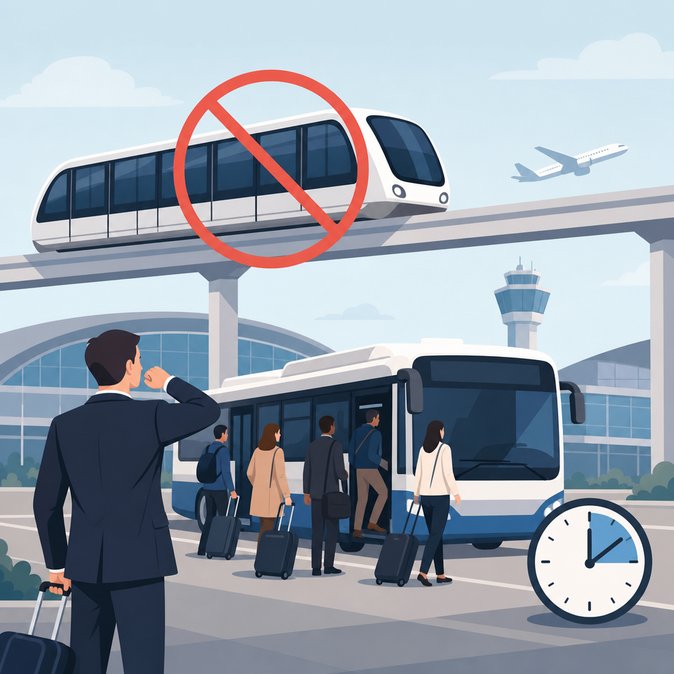
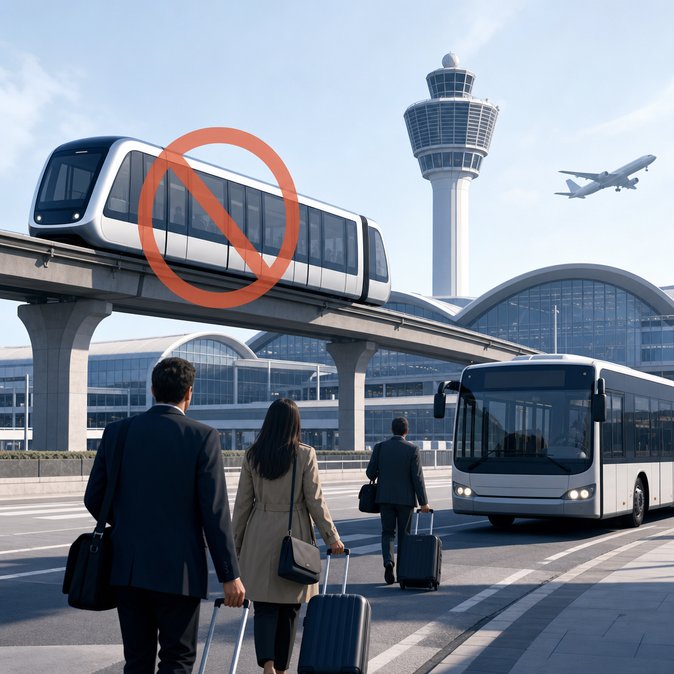
Frankfurt Airport’s state-of-the-art Sky Line people-mover – opened barely five weeks ago to link the newly inaugurated Terminal 3 with the existing Terminals 1 and 2 – ground to a halt on 29 May after a series of reliability hiccups. Fraport AG said it is pausing public operations for “comprehensive technical inspections and optimisation” in cooperation with system builder Siemens Mobility. The 5.6-kilometre automated shuttle had already been carrying up to 25,000 passengers a day and is a critical plank of the hub’s expansion strategy: with Terminal 3 adding an eventual 25 million passengers of annual capacity, friction-free transfers between terminals are vital for Lufthansa’s connecting timetable and for scores of international carriers that rely on inter-terminal code-share flows.
![Frankfurt Airport Temporarily Suspends New Sky Line People-Mover]()
For travellers suddenly facing longer layovers or unexpected rerouting as a result of the Sky Line suspension, VisaHQ can streamline the visa side of the journey. Whether you need a fast-track German or broader Schengen visa, the platform handles the entire application process online and provides real-time status alerts—crucial when your plans keep shifting. Learn more at https://www.visahq.com/germany/
During the outage a landside replacement fleet of 20 articulated buses will run every two to three minutes during peak hours, while five airside shuttles will move transfer passengers who cannot re-enter the public area. Fraport advises travellers to build in at least 20 extra minutes when planning connections and warns corporate travel managers that minimum-connection times in global distribution systems may not yet reflect the contingency plan. Airlines with tightly banked evening wave departures – notably Lufthansa, United, Singapore Airlines and Emirates – are issuing proactive SMS alerts to premium passengers and crew. The suspension also draws attention to the delicate choreography behind Frankfurt’s wider infrastructure overhaul. The legacy Sky Line line between Terminals 1 and 2 remains in service, but the new spur to Terminal 3 shares parts, control software and maintenance teams, meaning teething troubles were widely expected. Still, European hub airports increasingly depend on automated people-movers to maintain competitive minimum connection times, and any disruption ripples through global itineraries. For mobility professionals the incident is a reminder to revisit Frankfurt contingency plans: travel buyers should check interline agreements for mis-connect protection, ensure VIP meet-and-assist vendors are aware of the bus routings, and update crisis-management playbooks that assume air-side automated transport. Multinational assignees arriving on inbound flights may need ground-handler escorts if they are carrying duty-free goods that must clear customs in a different terminal from their onward flight. If inspections take the forecast “couple of weeks”, the disruption will overlap with the start of the European football championships in mid-June, when Frankfurt will host group-stage matches and passenger volumes will spike further.
For travellers suddenly facing longer layovers or unexpected rerouting as a result of the Sky Line suspension, VisaHQ can streamline the visa side of the journey. Whether you need a fast-track German or broader Schengen visa, the platform handles the entire application process online and provides real-time status alerts—crucial when your plans keep shifting. Learn more at https://www.visahq.com/germany/
During the outage a landside replacement fleet of 20 articulated buses will run every two to three minutes during peak hours, while five airside shuttles will move transfer passengers who cannot re-enter the public area. Fraport advises travellers to build in at least 20 extra minutes when planning connections and warns corporate travel managers that minimum-connection times in global distribution systems may not yet reflect the contingency plan. Airlines with tightly banked evening wave departures – notably Lufthansa, United, Singapore Airlines and Emirates – are issuing proactive SMS alerts to premium passengers and crew. The suspension also draws attention to the delicate choreography behind Frankfurt’s wider infrastructure overhaul. The legacy Sky Line line between Terminals 1 and 2 remains in service, but the new spur to Terminal 3 shares parts, control software and maintenance teams, meaning teething troubles were widely expected. Still, European hub airports increasingly depend on automated people-movers to maintain competitive minimum connection times, and any disruption ripples through global itineraries. For mobility professionals the incident is a reminder to revisit Frankfurt contingency plans: travel buyers should check interline agreements for mis-connect protection, ensure VIP meet-and-assist vendors are aware of the bus routings, and update crisis-management playbooks that assume air-side automated transport. Multinational assignees arriving on inbound flights may need ground-handler escorts if they are carrying duty-free goods that must clear customs in a different terminal from their onward flight. If inspections take the forecast “couple of weeks”, the disruption will overlap with the start of the European football championships in mid-June, when Frankfurt will host group-stage matches and passenger volumes will spike further.