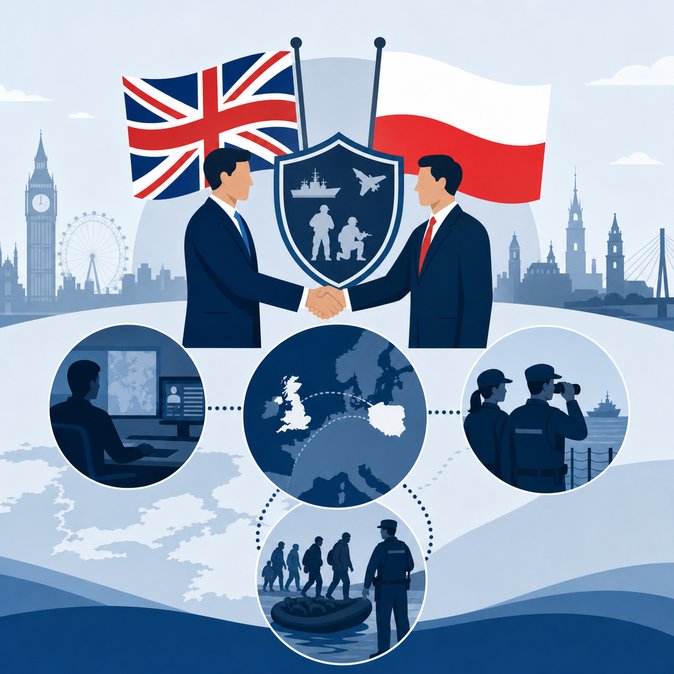
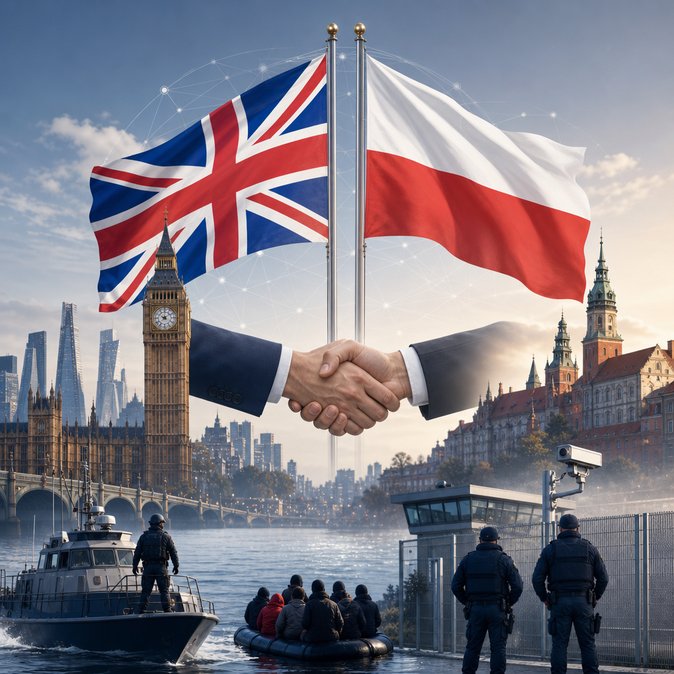
At RAF Northolt outside London, Prime Minister Keir Starmer and his Polish counterpart Donald Tusk inked a sweeping Security and Defence Partnership—dubbed the Northolt Treaty—that goes well beyond military cooperation. Article 3 of the text commits both countries to coordinate on migrant-smuggling networks, share advance cargo information and deepen operational cooperation on border security. The two NATO allies will establish a Joint Action Plan on Irregular Migration that includes intelligence-led targeting of organised crime groups operating along the Western Balkan and Belarus routes. The treaty also pledges joint capacity-building projects in countries of origin and transit and explicit cooperation to counter the “instrumentalisation of migration by external actors,” a reference to Russia-aligned operations on the EU’s eastern flank. For UK businesses, the agreement signals closer alignment with an EU member state on mobility-security issues despite broader post-Brexit frictions. Logistics firms moving goods between the UK and Central Europe can expect more integrated customs risk analysis, potentially reducing random inspections for compliant operators while tightening scrutiny of high-risk consignments. Border-security consultants say the deal could pave the way for reciprocal fast-track lanes for authorised economic operators and for information sharing on visa overstays.
![UK and Poland sign Northolt Treaty with joint plan to combat irregular migration]()
As travellers and companies adjust to these evolving mobility requirements, VisaHQ can simplify visa and documentation processes. Through its digital portal (https://www.visahq.com/united-kingdom/), the service offers real-time guidance on UK, Polish and wider Schengen entry rules, manages applications end-to-end and provides tailored support for corporate clients—helping users stay compliant amid new security frameworks like those emerging from the Northolt Treaty.
It may also influence future Home Office statements of changes, especially around carrier liability and due-diligence requirements for haulage companies. The treaty will now proceed to ratification in both parliaments. Once in force, an annual strategic dialogue will review progress on migration, defence procurement and hybrid-threat resilience.
As travellers and companies adjust to these evolving mobility requirements, VisaHQ can simplify visa and documentation processes. Through its digital portal (https://www.visahq.com/united-kingdom/), the service offers real-time guidance on UK, Polish and wider Schengen entry rules, manages applications end-to-end and provides tailored support for corporate clients—helping users stay compliant amid new security frameworks like those emerging from the Northolt Treaty.
It may also influence future Home Office statements of changes, especially around carrier liability and due-diligence requirements for haulage companies. The treaty will now proceed to ratification in both parliaments. Once in force, an annual strategic dialogue will review progress on migration, defence procurement and hybrid-threat resilience.