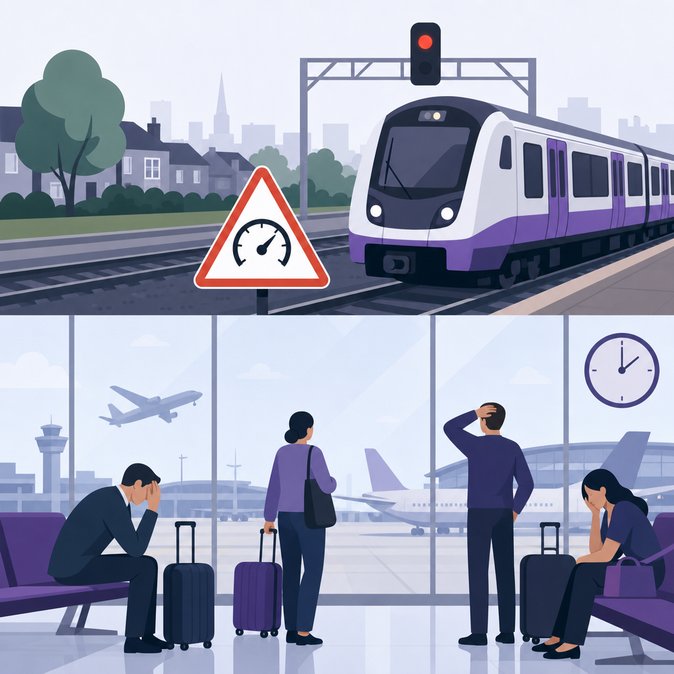
Travellers heading to and from London Heathrow on the busiest weekend of the UK’s spring travel calendar faced unexpected rail disruption on Sunday morning, 24 May. National Rail’s service-status bulletin reported “residual delays” on the Elizabeth line between Paddington and Heathrow Terminals after Network Rail imposed an emergency speed restriction through Hanwell at 07:54. Although the fault was cleared at 09:17, knock-on delays continued into the late morning, compressing connection times for long-haul departures.
The incident highlighted the fragility of the capital’s airport-rail links just a year after the Elizabeth line replaced most Heathrow Express services. With Heathrow operating close to slot capacity, even short rail hiccups can ripple across global itineraries, leaving tight-turnaround business travellers scrambling for alternatives. Car-hire queues at Terminals 3 and 5 lengthened as some passengers abandoned rail for road, while ride-hail surge pricing briefly exceeded 2.8× the usual Sunday-morning fare.
While rail disruptions are largely a domestic operational headache, international visitors should remember that the right travel documents are an equally critical part of any contingency plan. If your team needs help expediting UK visas or transit permits at short notice, VisaHQ’s London-based specialists can handle the paperwork end-to-end, track consular turnaround times in real time and deliver passports back via same-day courier. Details are at https://www.visahq.com/united-kingdom/
![Elizabeth line speed restriction causes Heathrow rail delays on peak getaway day]()
For mobility teams the message is clear: bank-holiday weekends now combine peak leisure volumes with a reduced engineering window, making contingency planning essential. Corporates with fly-in contractors were advised to build at least a 90-minute buffer between scheduled touchdown and onward rail commitments, and to remind staff that Oyster pay-as-you-go caps do not apply west of West Drayton during Elizabeth line disruptions.
Looking ahead, Transport for London is due to publish its summer maintenance schedule next week. Early drafts seen by industry groups indicate three overnight closures of the tunnel section in July, plus reduced Sunday frequencies in August to accommodate signalling upgrades. Employers should map those windows against project deadlines now so that flight bookings can be retimed while inventory is still available.
From a policy perspective, Sunday’s hiccup will feed the wider conversation about surface-access resilience at Heathrow as arguments over expansion rumble on. Ministers have promised a dedicated inter-modal taskforce before the summer recess, but operators warn that without additional track capacity west of London, punctuality will remain hostage to the smallest infrastructure glitch.
The incident highlighted the fragility of the capital’s airport-rail links just a year after the Elizabeth line replaced most Heathrow Express services. With Heathrow operating close to slot capacity, even short rail hiccups can ripple across global itineraries, leaving tight-turnaround business travellers scrambling for alternatives. Car-hire queues at Terminals 3 and 5 lengthened as some passengers abandoned rail for road, while ride-hail surge pricing briefly exceeded 2.8× the usual Sunday-morning fare.
While rail disruptions are largely a domestic operational headache, international visitors should remember that the right travel documents are an equally critical part of any contingency plan. If your team needs help expediting UK visas or transit permits at short notice, VisaHQ’s London-based specialists can handle the paperwork end-to-end, track consular turnaround times in real time and deliver passports back via same-day courier. Details are at https://www.visahq.com/united-kingdom/

For mobility teams the message is clear: bank-holiday weekends now combine peak leisure volumes with a reduced engineering window, making contingency planning essential. Corporates with fly-in contractors were advised to build at least a 90-minute buffer between scheduled touchdown and onward rail commitments, and to remind staff that Oyster pay-as-you-go caps do not apply west of West Drayton during Elizabeth line disruptions.
Looking ahead, Transport for London is due to publish its summer maintenance schedule next week. Early drafts seen by industry groups indicate three overnight closures of the tunnel section in July, plus reduced Sunday frequencies in August to accommodate signalling upgrades. Employers should map those windows against project deadlines now so that flight bookings can be retimed while inventory is still available.
From a policy perspective, Sunday’s hiccup will feed the wider conversation about surface-access resilience at Heathrow as arguments over expansion rumble on. Ministers have promised a dedicated inter-modal taskforce before the summer recess, but operators warn that without additional track capacity west of London, punctuality will remain hostage to the smallest infrastructure glitch.