
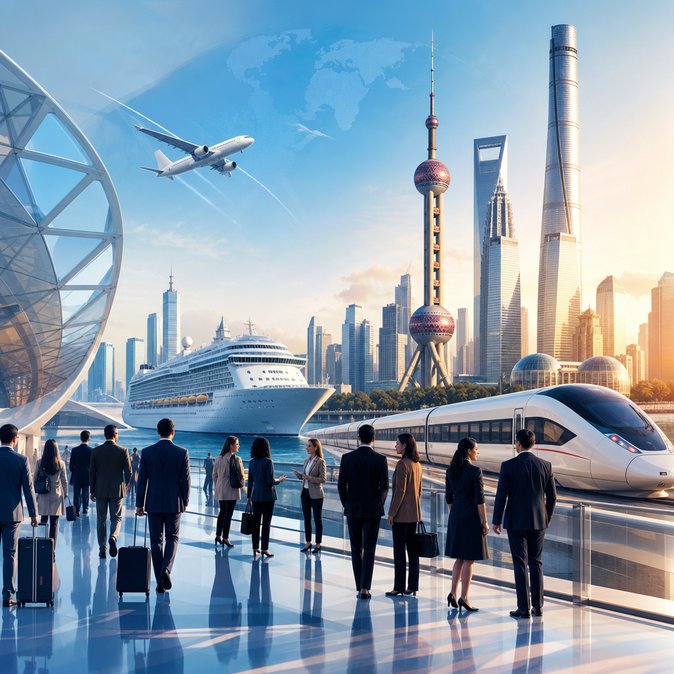
Shanghai’s sprawling World Expo Center turned into a micro-cosm of global tourism on 27 May 2026 when ITB China—the mainland’s largest pure business-to-business travel fair—opened its doors. More than 900 tourism boards, airlines, hotel groups and destination-management companies from 85 countries set up shop alongside 1,700 vetted Chinese buyers. Organisers estimate that some 46,000 one-to-one meetings will be concluded over the three-day event, almost double last year’s tally.
Behind the bullish turnout lies China’s 18-month drive to make the country easier to enter. Since November 2025 Beijing has waived short-stay visas for nationals of 50 countries and stretched its transit-visa-free scheme from 144 to 240 hours at 62 international gateways. According to the Shanghai General Station of Immigration Inspection, inbound foreign arrivals through the city’s ports hit 1.17 million by mid-March—20 percent higher than the same period of 2025—with two-thirds entering visa-free.
Exhibitors at ITB said those policies were already reshaping demand: Royal Caribbean’s spring sailings from Shanghai counted up to 88 percent international passengers, while Abu Dhabi’s tourism authority announced it would boost weekly air seats to China by 400 percent from October.
Chinese buyers were equally upbeat. Gautam Kumar Bakuly, an Indian operator courting mainland agencies, said bookings for Beijing-Shanghai-Xi’an circuits had "doubled in six months" and that companies now routinely arrange incentive trips to China thanks to simpler paperwork.
![ITB China 2026 opens in Shanghai as relaxed visa rules lure record foreign exhibitors]()
For travel managers still navigating the evolving Chinese entry rules, visa-processing specialists like VisaHQ can smooth the path. Its online platform (https://www.visahq.com/china/) consolidates the latest exemptions, turnaround times and document checklists, and can even lodge group applications on behalf of corporate travellers—handy when a last-minute sales delegation needs confirmed entry clearance.
European regions such as Friuli Venezia Giulia and Malta used the fair to pitch immersive, off-the-beaten-track products to an audience that is “increasingly experiential,” as one Italian delegate put it.
For corporate mobility managers, the show offered two takeaways. First, China’s visa liberalisation appears durable; officials hinted during a side-forum that the current waiver regime, valid through 31 December 2026, could become permanent if inbound numbers keep rising. Second, the cruise industry is rapidly integrating into the country’s travel mix. Royal Caribbean confirmed it will base a second Quantum-class vessel in Shanghai next summer and is negotiating streamlined immigration channels for transit crews—an initiative likely to spill over into business-charter operations.
Practical implications are immediate. Multinationals can now plan regional conferences and client events in Shanghai, Shenzhen or Hainan with far less lead time. Travel teams should still verify nationality-specific rules (length-of-stay caps remain 30 days for visa-free entrants) but can safely assume that most G20 passports will be covered. Procurement managers may also wish to lock in 2027 hotel blocks before rates rebound to pre-pandemic peaks, as inbound volumes accelerate.
Behind the bullish turnout lies China’s 18-month drive to make the country easier to enter. Since November 2025 Beijing has waived short-stay visas for nationals of 50 countries and stretched its transit-visa-free scheme from 144 to 240 hours at 62 international gateways. According to the Shanghai General Station of Immigration Inspection, inbound foreign arrivals through the city’s ports hit 1.17 million by mid-March—20 percent higher than the same period of 2025—with two-thirds entering visa-free.
Exhibitors at ITB said those policies were already reshaping demand: Royal Caribbean’s spring sailings from Shanghai counted up to 88 percent international passengers, while Abu Dhabi’s tourism authority announced it would boost weekly air seats to China by 400 percent from October.
Chinese buyers were equally upbeat. Gautam Kumar Bakuly, an Indian operator courting mainland agencies, said bookings for Beijing-Shanghai-Xi’an circuits had "doubled in six months" and that companies now routinely arrange incentive trips to China thanks to simpler paperwork.
For travel managers still navigating the evolving Chinese entry rules, visa-processing specialists like VisaHQ can smooth the path. Its online platform (https://www.visahq.com/china/) consolidates the latest exemptions, turnaround times and document checklists, and can even lodge group applications on behalf of corporate travellers—handy when a last-minute sales delegation needs confirmed entry clearance.
European regions such as Friuli Venezia Giulia and Malta used the fair to pitch immersive, off-the-beaten-track products to an audience that is “increasingly experiential,” as one Italian delegate put it.
For corporate mobility managers, the show offered two takeaways. First, China’s visa liberalisation appears durable; officials hinted during a side-forum that the current waiver regime, valid through 31 December 2026, could become permanent if inbound numbers keep rising. Second, the cruise industry is rapidly integrating into the country’s travel mix. Royal Caribbean confirmed it will base a second Quantum-class vessel in Shanghai next summer and is negotiating streamlined immigration channels for transit crews—an initiative likely to spill over into business-charter operations.
Practical implications are immediate. Multinationals can now plan regional conferences and client events in Shanghai, Shenzhen or Hainan with far less lead time. Travel teams should still verify nationality-specific rules (length-of-stay caps remain 30 days for visa-free entrants) but can safely assume that most G20 passports will be covered. Procurement managers may also wish to lock in 2027 hotel blocks before rates rebound to pre-pandemic peaks, as inbound volumes accelerate.
More From China
View all
China’s aviation gridlock on 27 May strands thousands and exposes corporate travel vulnerabilities

MFA press briefing outlines busy outbound agenda as senior Chinese officials embark on post-pandemic diplomacy push