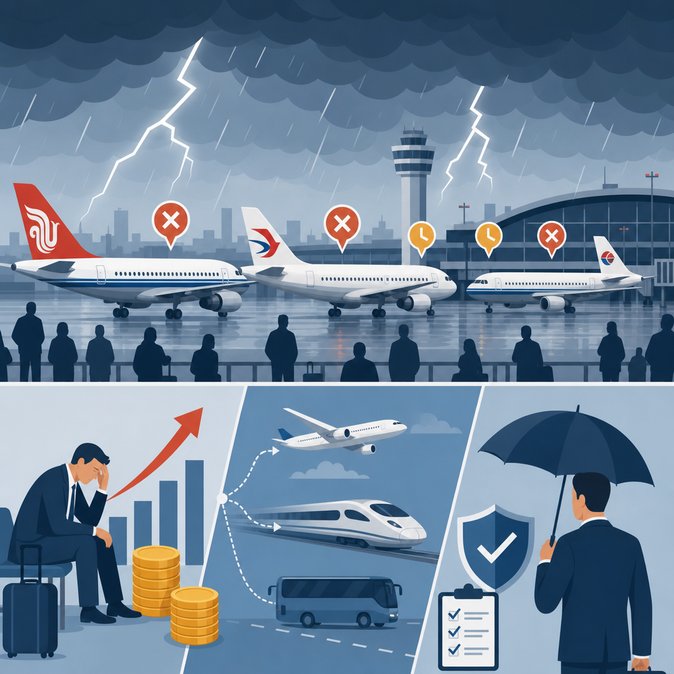
Chinese airports suffered their worst single-day disruption in two years on 27 May 2026, when a cascade of weather-related air-traffic-control restrictions triggered 734 delays and 118 cancellations across eight major hubs. Guangzhou Baiyun led the misery with 193 delayed departures, while Beijing Capital, Chengdu Shuangliu and Chongqing Jiangbei each logged more than 100 off-schedule movements. Legacy carriers Air China and China Eastern were hardest hit, forcing emergency ground-handling protocols and leaving transit halls packed well past midnight. The immediate cause was a stalled subtropical front that blanketed eastern and southern air corridors in thunderstorms, but analysts say systemic factors magnified the chaos. China funnels an outsized share of domestic and international traffic through a handful of megahubs; when Beijing’s airspace slows, ripple effects propagate nationwide. A recent Civil Aviation Administration report warned that peak-hour utilisation at the country’s top ten airports already exceeds safe-capacity design by 18 percent.
For multinationals the knock-on costs were severe. A German automotive supplier convoyed 40 engineers from Shenzhen to Wuhan by high-speed rail after their Shenzhen-Air China connection was scrubbed, averting a production halt but adding ¥120,000 in last-minute rail and hotel fees. A Fortune 500 consultancy said four partners missed an IPO roadshow in Singapore after their Guangzhou-Hong Kong shuttle was delayed six hours, triggering penalty clauses.
![China’s aviation gridlock on 27 May strands thousands and exposes corporate travel vulnerabilities]()
Travel-risk consultants recommend three mitigation steps. First, pad mainland layovers to at least three hours to protect long-haul connections. Second, pre-book refundable high-speed-rail tickets as a backup; Beijing–Shanghai services depart every 15 minutes and can be cancelled for a ¥5 fee. Third, ensure travel-insurance policies cover "extraordinary delay" expenses—many corporate policies cap payouts at 6-hour thresholds, which 27 May disruptions exceeded by a wide margin.
For travelers who suddenly need to reroute through third countries or extend their stay in China because of unexpected delays, VisaHQ can streamline emergency visa applications and passport renewals. The company’s online portal (https://www.visahq.com/china/) offers quick, sometimes same-day processing for many destinations, giving mobility managers a reliable way to secure transit or entry permits when schedules unravel.
Long-term, the incident reopens debate over China’s slot-allocation model and the need for secondary airports to absorb overflow. The CAAC is piloting a summer-autumn schedule that shifts 8 percent of Zhengzhou-bound cargo flights to Luoyang and Xinzheng, and similar de-peaking experiments are planned for Chengdu’s Tianfu airport. Until such reforms bite, mobility managers should expect volatile punctuality at tier-one hubs, especially during late-spring thunderstorm season.
For multinationals the knock-on costs were severe. A German automotive supplier convoyed 40 engineers from Shenzhen to Wuhan by high-speed rail after their Shenzhen-Air China connection was scrubbed, averting a production halt but adding ¥120,000 in last-minute rail and hotel fees. A Fortune 500 consultancy said four partners missed an IPO roadshow in Singapore after their Guangzhou-Hong Kong shuttle was delayed six hours, triggering penalty clauses.
Travel-risk consultants recommend three mitigation steps. First, pad mainland layovers to at least three hours to protect long-haul connections. Second, pre-book refundable high-speed-rail tickets as a backup; Beijing–Shanghai services depart every 15 minutes and can be cancelled for a ¥5 fee. Third, ensure travel-insurance policies cover "extraordinary delay" expenses—many corporate policies cap payouts at 6-hour thresholds, which 27 May disruptions exceeded by a wide margin.
For travelers who suddenly need to reroute through third countries or extend their stay in China because of unexpected delays, VisaHQ can streamline emergency visa applications and passport renewals. The company’s online portal (https://www.visahq.com/china/) offers quick, sometimes same-day processing for many destinations, giving mobility managers a reliable way to secure transit or entry permits when schedules unravel.
Long-term, the incident reopens debate over China’s slot-allocation model and the need for secondary airports to absorb overflow. The CAAC is piloting a summer-autumn schedule that shifts 8 percent of Zhengzhou-bound cargo flights to Luoyang and Xinzheng, and similar de-peaking experiments are planned for Chengdu’s Tianfu airport. Until such reforms bite, mobility managers should expect volatile punctuality at tier-one hubs, especially during late-spring thunderstorm season.