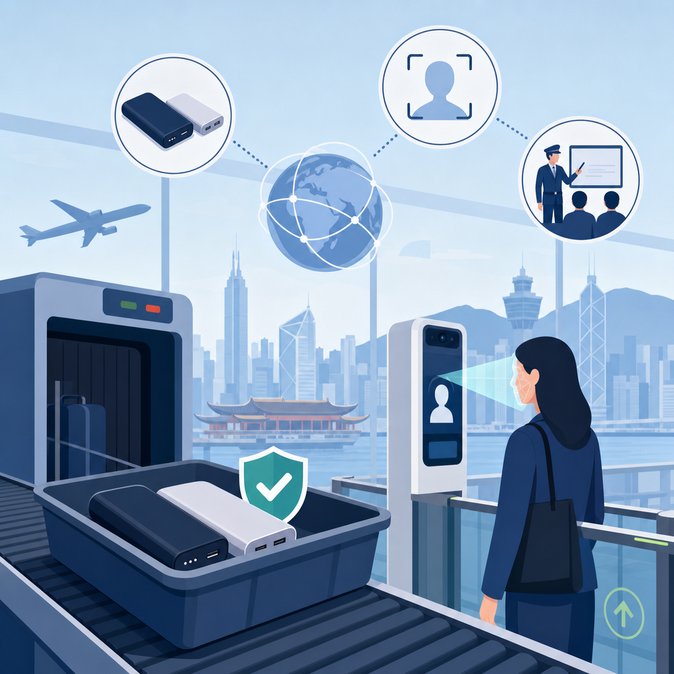
Twenty-plus security leaders from airports on five continents gathered in Hong Kong from 6 to 8 May for the 59th meeting of Airports Council International’s World Security Standing Committee (WSSC/59), but the outcomes of that closed-door summit were only published on 26 May. Top of the agenda: how to implement a fresh International Civil Aviation Organization (ICAO) mandate that limits passengers to two power-bank units in carry-on bags. Delegates warned the rule could slow X-ray lines unless airports invest in staff training and automated detection tools.
![Global airport-security chiefs meet in Hong Kong to align on new ICAO rules and biometrics]()
Corporate mobility teams looking to stay ahead of these fast-moving regulatory tweaks can lean on VisaHQ’s Hong Kong office, which tracks airport security advisories alongside visa and health-declaration requirements. Through self-service dashboards and on-call specialists, VisaHQ (https://www.visahq.com/hong-kong/) can push real-time alerts to travellers, help them upload the biometric data some airports now require, and consolidate documentation needed for smooth passage, ensuring the power-bank limit is only one of many compliance boxes ticked.
Hong Kong International Airport, the host venue, used the occasion to showcase its newly installed smart-lane checkpoints and contactless e-Channels that rely on facial recognition rather than fingerprints—technology that many participants see as the future of secure, high-throughput processing. Case studies from Doha, Istanbul and Los Angeles highlighted parallel trials of “one-stop security” concepts that remove repetitive screening for transfer passengers, a change business travellers have long lobbied for. The committee also spent significant time on human-factors challenges: attracting and retaining security staff in high-cost cities, mitigating burnout and embedding diversity into recruitment pipelines. Members endorsed a proposal for ACI to create a global curriculum of micro-credential courses that smaller airports can deliver online, helping to standardise skill levels without the expense of overseas training. For mobility managers, the immediate takeaway is foresight. The power-bank restriction becomes applicable worldwide on 1 July 2026, meaning corporate travellers passing through Hong Kong and other major hubs should be briefed now. Meanwhile, airports will be rolling out more biometric corridors, so assignees may need to pre-enrol their passports and faces to keep fast-track privileges. ACI will circulate formal guidance notes to its 700-plus member airports next month, and the Hong Kong meeting’s minutes will feed into ICAO’s Triennial Assembly later this year—an example of how local dialogues in Hong Kong can ripple through the entire global-mobility ecosystem.

Corporate mobility teams looking to stay ahead of these fast-moving regulatory tweaks can lean on VisaHQ’s Hong Kong office, which tracks airport security advisories alongside visa and health-declaration requirements. Through self-service dashboards and on-call specialists, VisaHQ (https://www.visahq.com/hong-kong/) can push real-time alerts to travellers, help them upload the biometric data some airports now require, and consolidate documentation needed for smooth passage, ensuring the power-bank limit is only one of many compliance boxes ticked.
Hong Kong International Airport, the host venue, used the occasion to showcase its newly installed smart-lane checkpoints and contactless e-Channels that rely on facial recognition rather than fingerprints—technology that many participants see as the future of secure, high-throughput processing. Case studies from Doha, Istanbul and Los Angeles highlighted parallel trials of “one-stop security” concepts that remove repetitive screening for transfer passengers, a change business travellers have long lobbied for. The committee also spent significant time on human-factors challenges: attracting and retaining security staff in high-cost cities, mitigating burnout and embedding diversity into recruitment pipelines. Members endorsed a proposal for ACI to create a global curriculum of micro-credential courses that smaller airports can deliver online, helping to standardise skill levels without the expense of overseas training. For mobility managers, the immediate takeaway is foresight. The power-bank restriction becomes applicable worldwide on 1 July 2026, meaning corporate travellers passing through Hong Kong and other major hubs should be briefed now. Meanwhile, airports will be rolling out more biometric corridors, so assignees may need to pre-enrol their passports and faces to keep fast-track privileges. ACI will circulate formal guidance notes to its 700-plus member airports next month, and the Hong Kong meeting’s minutes will feed into ICAO’s Triennial Assembly later this year—an example of how local dialogues in Hong Kong can ripple through the entire global-mobility ecosystem.
More From Hong Kong
View all
Hong Kong International Airport’s brand-new Terminal 2 begins operations, promising faster departures and smoother immigration

Surge in Macau visitor flows underscores importance of Hong Kong–Zhuhai–Macao Bridge for cross-boundary commuters