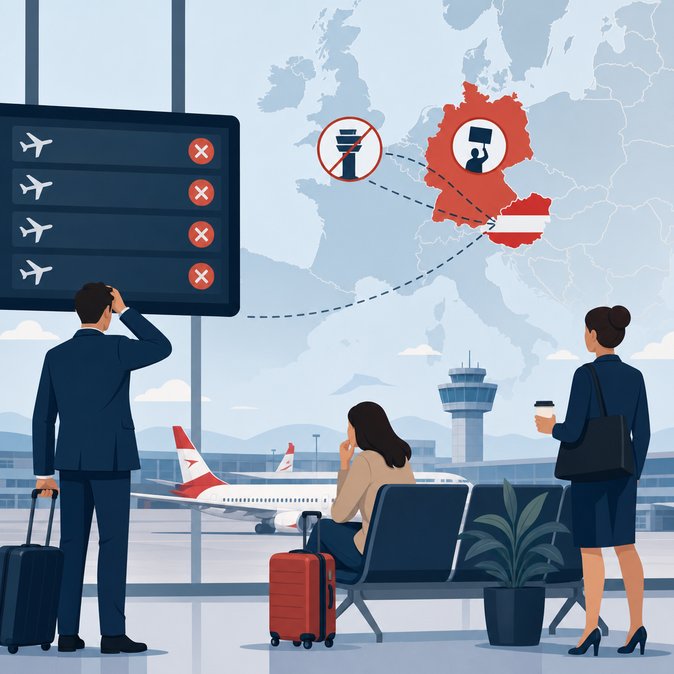
Passengers travelling through Vienna International Airport faced fresh disruption on Tuesday, 26 May, after Austrian Airlines (OS) cancelled several mid-day services in the wake of rolling labour action elsewhere in Europe. According to real-time disruption tracker AirHelp, flight OS 295 (Vienna–Brussels) and flight OS 213 (Vienna–Frankfurt) were both pulled just hours before departure. Additional cancellations affected OS 618 (Zadar–Vienna), suggesting aircraft and crew rotations were knocked out of sequence. Although the stoppage originated outside Austria – ground-handling unions in Belgium and air-traffic-control staff in Germany staged coordinated walk-outs – the impact underlines how tightly integrated European aviation has become. Brussels and Frankfurt are two of Austrian Airlines’ key feeder hubs, carrying a high share of corporate and connecting traffic for Central and Eastern Europe. With the summer conference season looming, mobility managers are being urged to build more resilience into travel itineraries and to brief travellers on their EU261 compensation rights.
![Strike ripple hits Austrian Airlines: Vienna–Brussels and Vienna–Frankfurt flights cancelled on 26 May]()
For travellers who might suddenly need alternative routings or last-minute entry clearances, VisaHQ’s Austria portal (https://www.visahq.com/austria/) can take the headache out of visa and travel-document requirements. The platform offers quick eligibility checks, digital application assistance, and real-time status tracking—services that prove invaluable when strikes force unexpected detours through countries with differing entry rules.
Under EU passenger-rights rules, travellers whose flights are cancelled with less than 14 days’ notice are entitled to re-routing or reimbursement and, in many cases, cash compensation of up to €400. AirHelp’s database lists the 26 May cancellations as strike-related, meaning Austrian Airlines must still provide care (meals, hotel if necessary) even if it can invoke ‘extraordinary circumstances’ to avoid compensation. Companies that purchase bundled mobility insurance should verify that industrial-action clauses have not been tightened since last year’s wave of strikes. Vienna Airport says its overall operations remain stable: only five departures – all operated by Lufthansa Group carriers – were cancelled on Tuesday morning. However, unions in Italy and Portugal have announced fresh 24-hour stoppages for 3 June, and Germany’s train-drivers’ union GDL has hinted at another national rail strike in early June. Austrian firms that rely on rail-air connections via Munich or rail-fly tickets from Linz and Salzburg may therefore face knock-on effects. Practical tips for mobility teams: (1) register travellers on airline apps for immediate push alerts; (2) keep alternative rail inventory open on ÖBB Railjet services to Munich and Frankfurt; (3) remind employees that same-day digital re-booking via the Lufthansa Group hub often works faster than telephone hotlines during mass disruptions. Given the current wage-bargaining climate across Europe, experts expect sporadic strike waves to continue through the summer peak.

For travellers who might suddenly need alternative routings or last-minute entry clearances, VisaHQ’s Austria portal (https://www.visahq.com/austria/) can take the headache out of visa and travel-document requirements. The platform offers quick eligibility checks, digital application assistance, and real-time status tracking—services that prove invaluable when strikes force unexpected detours through countries with differing entry rules.
Under EU passenger-rights rules, travellers whose flights are cancelled with less than 14 days’ notice are entitled to re-routing or reimbursement and, in many cases, cash compensation of up to €400. AirHelp’s database lists the 26 May cancellations as strike-related, meaning Austrian Airlines must still provide care (meals, hotel if necessary) even if it can invoke ‘extraordinary circumstances’ to avoid compensation. Companies that purchase bundled mobility insurance should verify that industrial-action clauses have not been tightened since last year’s wave of strikes. Vienna Airport says its overall operations remain stable: only five departures – all operated by Lufthansa Group carriers – were cancelled on Tuesday morning. However, unions in Italy and Portugal have announced fresh 24-hour stoppages for 3 June, and Germany’s train-drivers’ union GDL has hinted at another national rail strike in early June. Austrian firms that rely on rail-air connections via Munich or rail-fly tickets from Linz and Salzburg may therefore face knock-on effects. Practical tips for mobility teams: (1) register travellers on airline apps for immediate push alerts; (2) keep alternative rail inventory open on ÖBB Railjet services to Munich and Frankfurt; (3) remind employees that same-day digital re-booking via the Lufthansa Group hub often works faster than telephone hotlines during mass disruptions. Given the current wage-bargaining climate across Europe, experts expect sporadic strike waves to continue through the summer peak.