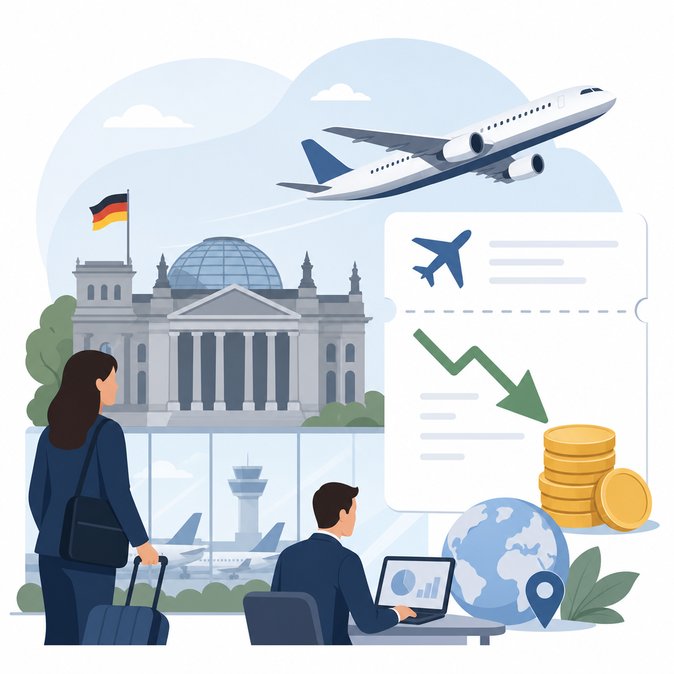
Late on 21 May 2026 the German Bundestag adopted the Second Act Amending the Air Traffic Tax Act, reversing a 2024 surcharge that had raised levy rates on every ticket issued in Germany. The cross-party measure lowers the levy by €2.50 on short-haul, €6.33 on medium-haul and €11.40 on long-haul itineraries, bringing the rates back to roughly the 2023 levels (€13.03, €33.01 and €59.43 respectively). Background. Germany introduced the Luftverkehrsteuer in 2011 as an environmental-budget instrument; rates were hiked in May 2024 to plug a fiscal gap and nudge travellers toward rail. Carriers – led by Lufthansa Group, Condor and the Board of Airline Representatives in Germany – argued that the surcharge merely diverted traffic to Amsterdam, Vienna and Zurich without cutting emissions. With the aviation lobby warning of capacity pull-outs (Ryanair already removed two Berlin aircraft in April), MPs from all governing parties agreed to restore competitiveness before the 2026 summer peak. What changes for business mobility? • TMCs can expect GDS displays for ex-Germany fares to drop by roughly 3–4 % once airlines file new ATPCO tax codes. Savings are greatest on premium long-haul classes, where the absolute tax cut exceeds €45 on a typical J-class return. • German subsidiaries that reimburse staff under “total trip cost” policies should revise travel budgets for the second half of the year. • Foreign assignment managers should note that the tax is collected on the first coupon ex-Germany only; tickets issued outside Germany but originating here will also fall in price. • Airlines have not guaranteed to pass on the full reduction, citing Kerosene prices that remain 18 % above pre-crisis levels.
![Bundestag votes to cut Germany’s air-travel tax from 1 July 2026]()
If the new levy encourages you or your team to schedule more Germany-origin trips, remember that visa and entry requirements can still be a stumbling block. VisaHQ’s digital portal (https://www.visahq.com/germany/) streamlines the process of checking requirements, preparing documentation and submitting visa applications for Germany or onward destinations, letting travel planners lock in the lower airfares without compliance headaches.
Policy implications. The Finance Ministry projects a revenue shortfall of €185 million in 2026, rising to €355 million a year by 2030. Opposition MPs criticised the move as a “give-away to weekend flyers”, while green NGOs said the cut undermines the EU’s ‘Fit-for-55’ trajectory. Yet the government insists that Germany still levies one of the highest aviation taxes in Europe and that modal-shift goals will be pursued through rail-infrastructure spending and the coming kerosene-blend mandate rather than ticket taxes alone. Practical tips. Travel buyers should: 1) refresh contract worksheets with updated tax tables; 2) rerun ‘cheapest logical fare’ benchmarks from 1 July; 3) communicate new per-diem thresholds to travelling staff; and 4) review mobility budgets for trainee and short-term assignee rotations commencing after the rate cut. Airlines must update fare-quote systems by the industry-standard D-15 timetable (mid-June) to avoid ADM disputes. In sum, the tax rollback removes a price irritant that had made Germany the costliest European market for long-haul departures. Whether the saving reaches passengers depends on competitive pressure, but global-mobility managers should plan for lower invoice totals on tickets issued from July onward.

If the new levy encourages you or your team to schedule more Germany-origin trips, remember that visa and entry requirements can still be a stumbling block. VisaHQ’s digital portal (https://www.visahq.com/germany/) streamlines the process of checking requirements, preparing documentation and submitting visa applications for Germany or onward destinations, letting travel planners lock in the lower airfares without compliance headaches.
Policy implications. The Finance Ministry projects a revenue shortfall of €185 million in 2026, rising to €355 million a year by 2030. Opposition MPs criticised the move as a “give-away to weekend flyers”, while green NGOs said the cut undermines the EU’s ‘Fit-for-55’ trajectory. Yet the government insists that Germany still levies one of the highest aviation taxes in Europe and that modal-shift goals will be pursued through rail-infrastructure spending and the coming kerosene-blend mandate rather than ticket taxes alone. Practical tips. Travel buyers should: 1) refresh contract worksheets with updated tax tables; 2) rerun ‘cheapest logical fare’ benchmarks from 1 July; 3) communicate new per-diem thresholds to travelling staff; and 4) review mobility budgets for trainee and short-term assignee rotations commencing after the rate cut. Airlines must update fare-quote systems by the industry-standard D-15 timetable (mid-June) to avoid ADM disputes. In sum, the tax rollback removes a price irritant that had made Germany the costliest European market for long-haul departures. Whether the saving reaches passengers depends on competitive pressure, but global-mobility managers should plan for lower invoice totals on tickets issued from July onward.
More From Germany
View all
Berlin Brandenburg Airport drops “BER Runway” time-slot service as CT scanners reshape security flow

Two-day ÜSTRA and Regiobus strike paralyses Hannover public transport