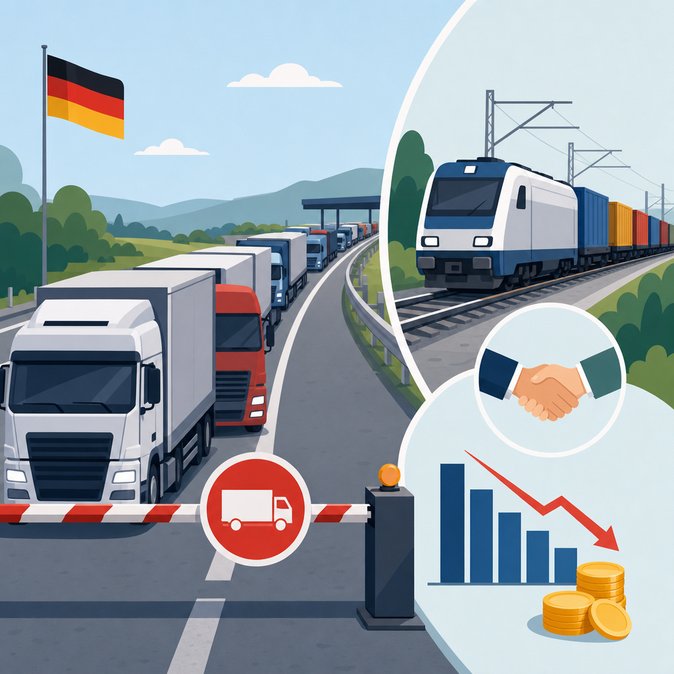
Cross-border supply chains faced a predictable but still painful bottleneck on Sunday, 17 May 2026, as Germany enforced its public-holiday truck driving ban from 00:00 to 22:00 for heavy goods vehicles over 7.5 tonnes. The restriction, catalogued in week-20 notices compiled by logistics portal Nakordoni.eu, coincided with Ascension Day weekend closures in Switzerland and Austria, creating a domino effect of parked lorries stretching 15 kilometres along the A3 near the Austrian border. Germany is one of nine EU member states that still impose blanket Sunday or holiday bans on large freight, aimed at reducing congestion and pollution during peak leisure travel. Critics argue that the rule merely shifts traffic to the hours immediately before and after the ban, leading to dangerous ‘freight tsunamis’. The Federal Transport Ministry counters that predictable windows allow police to plan enforcement and give drivers compulsory rest time mandated by EU Regulation 561/2006.
![Ascension-Day truck bans create one-day blockade on German roads]()
International logistics planners who routinely shuffle drivers across European borders also need to keep an eye on crew travel documents. VisaHQ’s Germany portal (https://www.visahq.com/germany/) streamlines visa and passport services for multi-national driver pools, ensuring that paperwork doesn’t become an additional bottleneck on top of holiday road bans. The platform offers real-time guidance and courier handling, freeing fleet managers to focus on load optimisation rather than consulate queues.
This year, the overlap with Ascension Day—still a nationwide public holiday—meant that drivers entering from France and the Netherlands had to scramble for scarce parking well before midnight on 16 May. Trade body DSLV estimates that forced idling cost German carriers €4.3 million in lost utilisation and driver overtime. Companies with time-critical cargo such as fresh produce paid premiums of up to 20 percent for train and intermodal slots to circumvent the road ban. Looking ahead, mobility managers should build the holiday calendar into routing algorithms and secure warehouse capacity near borders. Digital platforms that match short-term trailer storage saw a 35 percent spike in listings, signalling a market opportunity for yard operators. Some Länder (states) grant exemptions for combined transport and perishables; however, permits must be requested several weeks in advance and are rarely issued for generic consumer goods. EU transport ministers are expected to revisit harmonisation of holiday bans at their June council meeting, but for now, Germany’s 17 May standstill serves as another reminder: in continental Europe, public holidays remain a hard stop for wheels on asphalt.

International logistics planners who routinely shuffle drivers across European borders also need to keep an eye on crew travel documents. VisaHQ’s Germany portal (https://www.visahq.com/germany/) streamlines visa and passport services for multi-national driver pools, ensuring that paperwork doesn’t become an additional bottleneck on top of holiday road bans. The platform offers real-time guidance and courier handling, freeing fleet managers to focus on load optimisation rather than consulate queues.
This year, the overlap with Ascension Day—still a nationwide public holiday—meant that drivers entering from France and the Netherlands had to scramble for scarce parking well before midnight on 16 May. Trade body DSLV estimates that forced idling cost German carriers €4.3 million in lost utilisation and driver overtime. Companies with time-critical cargo such as fresh produce paid premiums of up to 20 percent for train and intermodal slots to circumvent the road ban. Looking ahead, mobility managers should build the holiday calendar into routing algorithms and secure warehouse capacity near borders. Digital platforms that match short-term trailer storage saw a 35 percent spike in listings, signalling a market opportunity for yard operators. Some Länder (states) grant exemptions for combined transport and perishables; however, permits must be requested several weeks in advance and are rarely issued for generic consumer goods. EU transport ministers are expected to revisit harmonisation of holiday bans at their June council meeting, but for now, Germany’s 17 May standstill serves as another reminder: in continental Europe, public holidays remain a hard stop for wheels on asphalt.