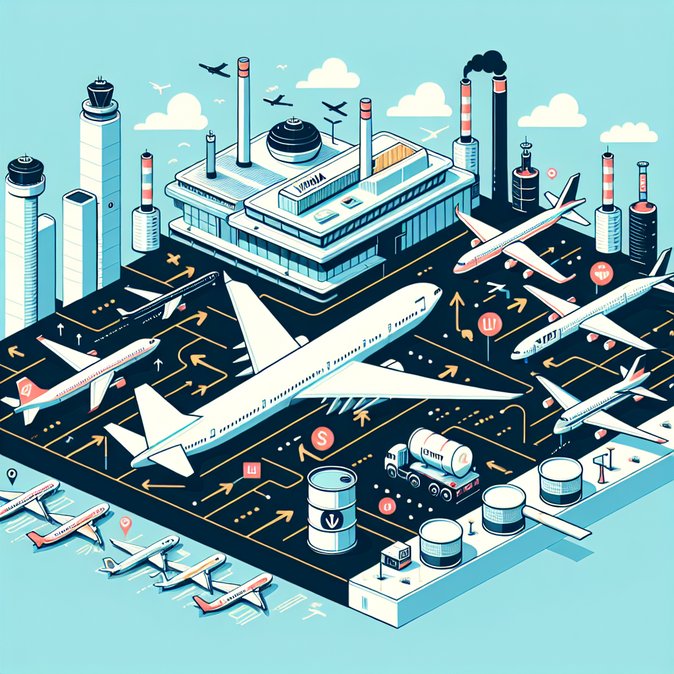
Austrian Airlines (AUA) moved swiftly on 6 May to calm fears that the global jet-fuel crunch could ground flights from its Vienna hub over the busy summer season. In a morning statement the Lufthansa-Group carrier said it expected “no restrictions on fuel availability at Vienna International Airport,” adding that corporate travel managers could plan with confidence for the June-to-September high season. Behind the upbeat message lies a delicate balancing act. The brutal spike in kerosene prices triggered by renewed conflict in the Gulf has already pushed AUA to post a €112 million loss in the first quarter.
To conserve cash and insulate its network from further shocks, the airline has frozen services to Tel Aviv, Amman, Erbil, Teheran, Dubai and three other Middle-East destinations until at least 24 October. The freed-up aircraft will be redeployed on short-haul routes such as Palma de Mallorca, Nizza and Barcelona, where demand from Austrian holiday-makers and business travellers alike is surging. For global-mobility teams the announcement is a double-edged sword. On the plus side, Vienna retains its reputation for schedule reliability at a time when carriers elsewhere in Europe are trimming frequencies because fuel cannot be trucked in fast enough.
![Austrian Airlines Assures Adequate Jet-Fuel Supplies for Summer Peak, Keeps Middle-East Routes Suspended]()
At the planning stage, VisaHQ can lighten the administrative load for travel managers and assignees alike. The platform’s Austria portal (https://www.visahq.com/austria/) lets users check visa rules instantly, assemble the right documents and submit applications online, helping travellers avoid unpleasant surprises when itineraries are suddenly rerouted through hubs like Frankfurt, Istanbul or Doha.
Long-haul assignees, however, will face extended journey times to important project sites in the Gulf, with many forced to route via Frankfurt, Istanbul or Doha. Employers may need to revise per-diem budgets upward to account for extra lay-overs and higher ticket prices caused by tight capacity. From a policy perspective, the episode underscores the vulnerability of Austria’s export-driven economy to geopolitical energy shocks. Industry groups are calling on the government to accelerate diversification of fuel-supply contracts and to examine strategic stock-piling at Vienna and secondary airports such as Graz and Linz. In the meantime, AUA says it is monitoring local fuel pipelines at out-stations so that contingency tankering can be arranged if shortages emerge. For travellers the practical advice is straightforward: check itineraries daily, allow buffers for connecting flights and ensure travel-insurance policies cover missed onward sectors. Despite the near-term turbulence, AUA CEO Annette Mann voiced optimism: “We are well prepared for the summer surge and expect robust traffic across Europe.”
To conserve cash and insulate its network from further shocks, the airline has frozen services to Tel Aviv, Amman, Erbil, Teheran, Dubai and three other Middle-East destinations until at least 24 October. The freed-up aircraft will be redeployed on short-haul routes such as Palma de Mallorca, Nizza and Barcelona, where demand from Austrian holiday-makers and business travellers alike is surging. For global-mobility teams the announcement is a double-edged sword. On the plus side, Vienna retains its reputation for schedule reliability at a time when carriers elsewhere in Europe are trimming frequencies because fuel cannot be trucked in fast enough.

At the planning stage, VisaHQ can lighten the administrative load for travel managers and assignees alike. The platform’s Austria portal (https://www.visahq.com/austria/) lets users check visa rules instantly, assemble the right documents and submit applications online, helping travellers avoid unpleasant surprises when itineraries are suddenly rerouted through hubs like Frankfurt, Istanbul or Doha.
Long-haul assignees, however, will face extended journey times to important project sites in the Gulf, with many forced to route via Frankfurt, Istanbul or Doha. Employers may need to revise per-diem budgets upward to account for extra lay-overs and higher ticket prices caused by tight capacity. From a policy perspective, the episode underscores the vulnerability of Austria’s export-driven economy to geopolitical energy shocks. Industry groups are calling on the government to accelerate diversification of fuel-supply contracts and to examine strategic stock-piling at Vienna and secondary airports such as Graz and Linz. In the meantime, AUA says it is monitoring local fuel pipelines at out-stations so that contingency tankering can be arranged if shortages emerge. For travellers the practical advice is straightforward: check itineraries daily, allow buffers for connecting flights and ensure travel-insurance policies cover missed onward sectors. Despite the near-term turbulence, AUA CEO Annette Mann voiced optimism: “We are well prepared for the summer surge and expect robust traffic across Europe.”