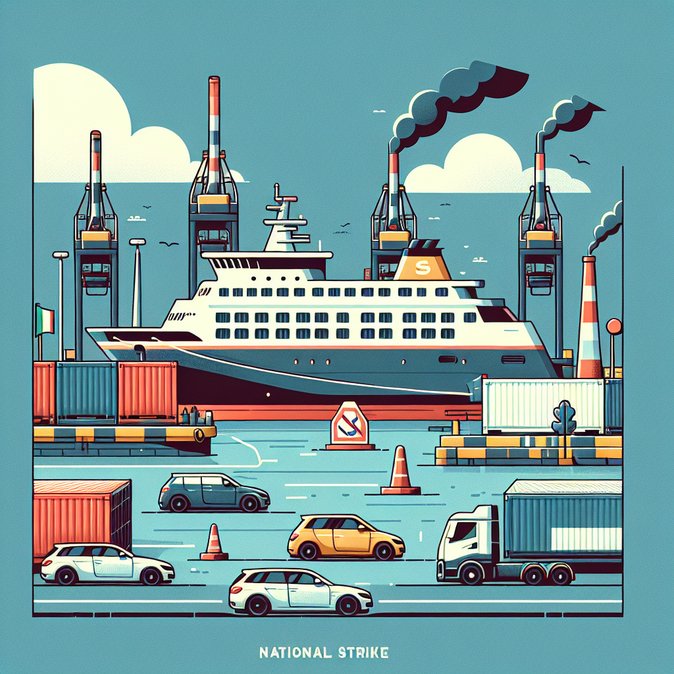
Italy’s maritime sector faces a full-day shutdown on Tuesday 7 May after USB Lavoro Privato and UGL Mare e Porti confirmed a 24-hour national strike across cargo-handling companies and port authorities. The action, listed in the MIT strike bulletin on 5 May, affects firms operating under articles 16-18 of Law 84/94 and those applying the national ports contract (CCNL Porti). All Italian container, cruise and ferry terminals fall within scope, including Genoa, Trieste, Livorno and terminals on Sardinia and Sicily.
Travel planners caught up in the disruption should also double-check that passports, visas and seafarer documents are current: VisaHQ’s Italy page (https://www.visahq.com/italy/) streamlines e-visa eligibility checks, supplies up-to-date requirements and offers courier submission services—useful when last-minute schedule changes leave crews and executives scrambling for compliant paperwork.
![24-Hour National Port Strike Set for 7 May Threatens Ferry and Ro-Ro Schedules]()
Port authorities must still guarantee minimum services—for example emergency pilotage—but ferry departures and roll-on/roll-off freight schedules are expected to suffer delays. The unions are protesting what they call “chronic understaffing” and the slow renewal of the collective agreement, which expired in December 2024. Employers counter that automation and green-port investments have changed skill requirements and that wage negotiations should be linked to productivity gains.
For corporate relocation programmes the timing is awkward: summer household-goods shipments for expatriates traditionally spike in mid-May. Mobility suppliers should check warehouse capacity, advance-book road haulage as a back-up, and alert assignees to possible late-arrival of personal effects. Companies relying on passenger ferries to connect mainland offices with Sardinian and Sicilian plants should consider charter flights or remote-work contingencies for 7 May. Industry observers note that if talks fail, the maritime stoppage could dovetail with aviation strikes on 11 May, compounding Italy’s multi-modal disruption and challenging the resilience of business-travel itineraries.
Travel planners caught up in the disruption should also double-check that passports, visas and seafarer documents are current: VisaHQ’s Italy page (https://www.visahq.com/italy/) streamlines e-visa eligibility checks, supplies up-to-date requirements and offers courier submission services—useful when last-minute schedule changes leave crews and executives scrambling for compliant paperwork.

Port authorities must still guarantee minimum services—for example emergency pilotage—but ferry departures and roll-on/roll-off freight schedules are expected to suffer delays. The unions are protesting what they call “chronic understaffing” and the slow renewal of the collective agreement, which expired in December 2024. Employers counter that automation and green-port investments have changed skill requirements and that wage negotiations should be linked to productivity gains.
For corporate relocation programmes the timing is awkward: summer household-goods shipments for expatriates traditionally spike in mid-May. Mobility suppliers should check warehouse capacity, advance-book road haulage as a back-up, and alert assignees to possible late-arrival of personal effects. Companies relying on passenger ferries to connect mainland offices with Sardinian and Sicilian plants should consider charter flights or remote-work contingencies for 7 May. Industry observers note that if talks fail, the maritime stoppage could dovetail with aviation strikes on 11 May, compounding Italy’s multi-modal disruption and challenging the resilience of business-travel itineraries.