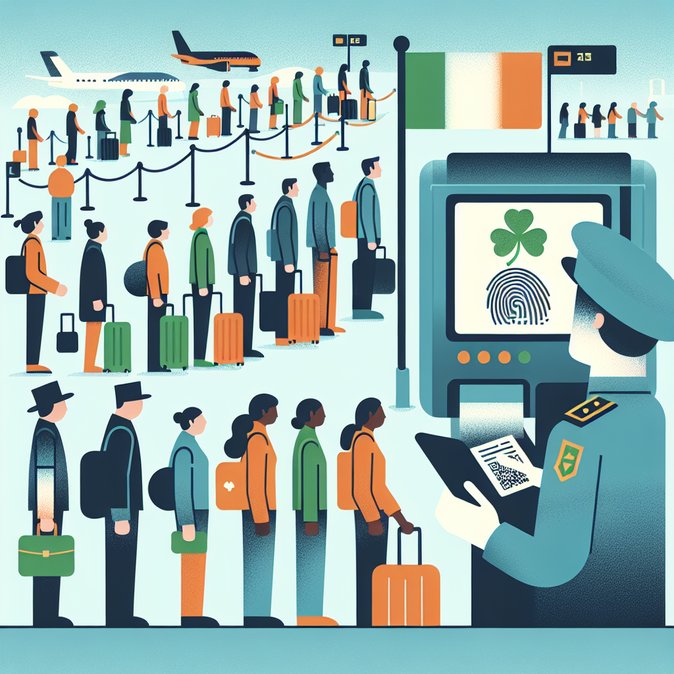
Irish business travellers heading to the Continent this week could encounter a welcome change at many of Europe’s busiest airports. In a decision released in Brussels on the morning of 4 May 2026, the European Commission authorised Schengen member states to waive the mandatory capture of fingerprints and facial images at external borders when passenger flows exceed processing capacity. The move is designed to “prevent unacceptable queues and missed onward connections” that have plagued the new Entry/Exit System (EES) since it became fully operational on 10 April. Although Ireland is outside Schengen, the ruling matters for Irish corporates whose staff connect through hubs such as Paris-CDG, Amsterdam-Schiphol and Frankfurt. Under the temporary measure, border officers can revert to manual passport-stamping during surge periods, provided biometric data are collected once traffic stabilises. Airlines must still transmit Advance Passenger Information and Passenger Name Records. The Commission stressed that the database itself—already logging more than 61 million crossings—remains live. National authorities are expected to publish local operating guidelines within days. Travel-management companies in Dublin say they will monitor each airport’s implementation closely; some intend to pre-advise clients to allow an extra 30-45 minutes for connections until new flow-management rules bed in.
![EU Allows Temporary Suspension of Biometric Border Checks to Ease Schengen Entry/Exit Queues]()
Whether travellers need guidance on these updated Schengen formalities or entirely different destinations, VisaHQ can streamline the process. The service’s Ireland portal (https://www.visahq.com/ireland/) offers rapid passport-validity checks, visa requirement intelligence and document couriering—valuable back-office support for mobility teams adapting to shifting border rules.
Legal experts note that the decision relies on a safeguard clause in the 2017 EES Regulation permitting derogations “in exceptional circumstances.” While the clause was envisaged for technical outages, Brussels concluded that sustained overcrowding posed an equivalent risk to the system’s integrity. The step is expected to be reviewed after the Pentecost travel peak in late May. In practical terms, Irish passengers should see a mixed model at Schengen airports: eGates and kiosks will remain the default, but manual booths will re-open whenever real-time queue data breach thresholds that each country sets. Mobility managers are advising travellers to keep boarding passes handy—even in transit—because some airports plan to triage passengers with tight onward connections. For global mobility teams, the development underscores the need to refresh traveller briefings: staff who were trained to expect compulsory biometrics must be told that procedures may now vary by terminal and time of day. Employers with frequent travellers are also reminded to verify passport validity; lost EES records caused by manual stamping must be re-captured at the next automated crossing, and passports with less than two blank pages can still trigger secondary inspection. Ultimately, the Commission hopes the flexibility will restore passenger confidence in the €1.3 billion border-modernisation project before the summer rush. If successful, Irish businesses could benefit from smoother multi-leg itineraries and fewer duty-of-care incidents linked to missed flights.
Whether travellers need guidance on these updated Schengen formalities or entirely different destinations, VisaHQ can streamline the process. The service’s Ireland portal (https://www.visahq.com/ireland/) offers rapid passport-validity checks, visa requirement intelligence and document couriering—valuable back-office support for mobility teams adapting to shifting border rules.
Legal experts note that the decision relies on a safeguard clause in the 2017 EES Regulation permitting derogations “in exceptional circumstances.” While the clause was envisaged for technical outages, Brussels concluded that sustained overcrowding posed an equivalent risk to the system’s integrity. The step is expected to be reviewed after the Pentecost travel peak in late May. In practical terms, Irish passengers should see a mixed model at Schengen airports: eGates and kiosks will remain the default, but manual booths will re-open whenever real-time queue data breach thresholds that each country sets. Mobility managers are advising travellers to keep boarding passes handy—even in transit—because some airports plan to triage passengers with tight onward connections. For global mobility teams, the development underscores the need to refresh traveller briefings: staff who were trained to expect compulsory biometrics must be told that procedures may now vary by terminal and time of day. Employers with frequent travellers are also reminded to verify passport validity; lost EES records caused by manual stamping must be re-captured at the next automated crossing, and passports with less than two blank pages can still trigger secondary inspection. Ultimately, the Commission hopes the flexibility will restore passenger confidence in the €1.3 billion border-modernisation project before the summer rush. If successful, Irish businesses could benefit from smoother multi-leg itineraries and fewer duty-of-care incidents linked to missed flights.